
Understanding Print and Sentences
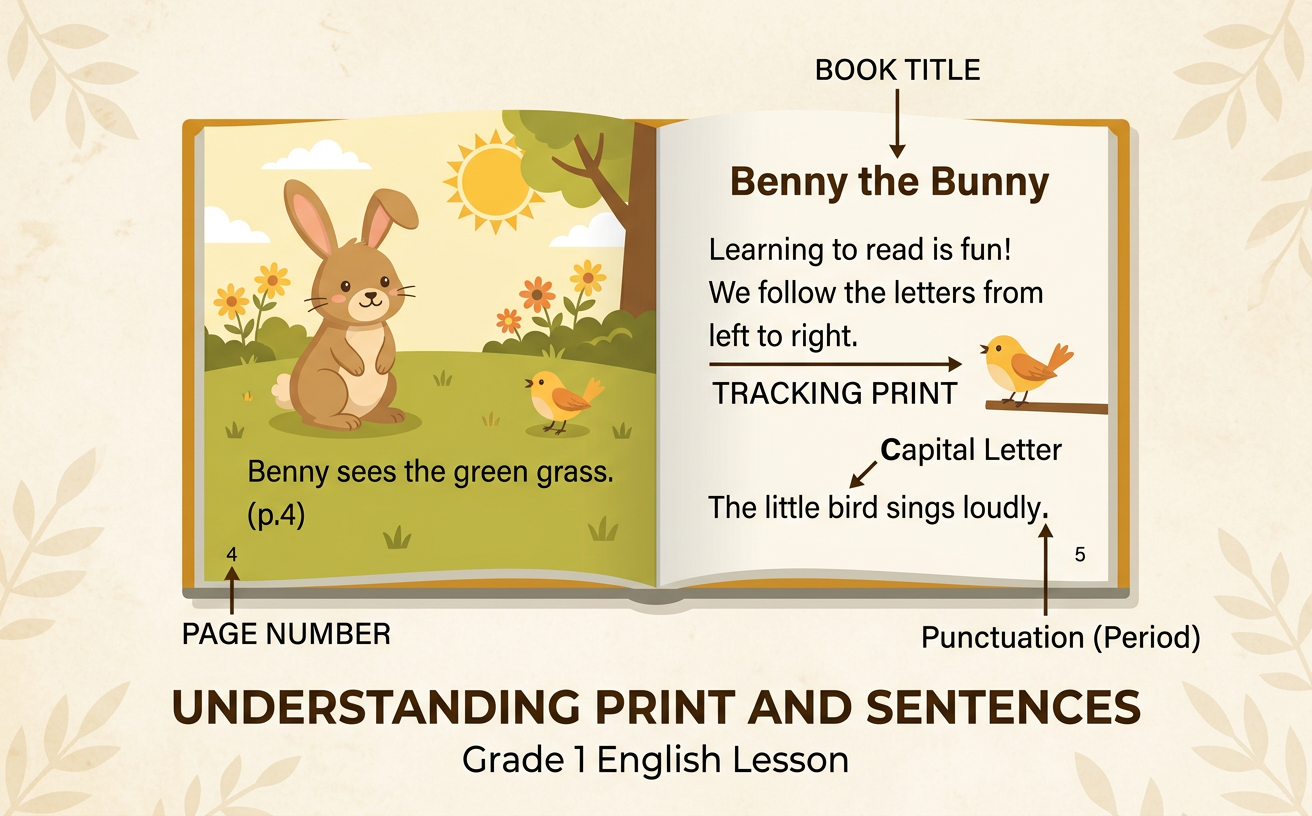
Students identify the parts of a book, track print from left to right, and recognize that sentences begin with capital letters and end with punctuation.
Illustrations are auto-generated and may be placeholders. They can be refreshed to match the narration.
Explore a Book
A book has parts that help us use it. The front cover is the first outside part. It usually shows the title, which is the name of the book. It may also name the author, who wrote the words, and the illustrator, who made the pictures. The back cover is the last outside part. The spine connects the front and back covers and helps hold the pages together. Inside, the title page shows the title again. To hold a book correctly, keep it right side up and turn one page at a time. For example, before reading a book called Little Red Kite, look at the front cover, read the title, and find the names of the author and illustrator.
Track Print
English print is read from left to right. Start at the first word on the left side of a line. Move your eyes or finger across the line toward the right. When you reach the end, move down to the beginning of the next line. This movement is called a return sweep. Read the top line before the lines below it. For example, look at these two lines: “A frog can hop. It lands on a log.” Begin with A, move right to hop, and then move down and left to It. Point under each word as you read, but do not skip words or move backward. Tracking print helps you read the words in the correct order.
Find Words and Sentences
Letters join together to make words. A space separates one word from the next word. For example, “The cat naps.” has three words: The, cat, and naps. You can point to each word and count one, two, three. A sentence is a group of words that tells a complete idea. It begins with a capital letter and ends with punctuation. On a page, a sentence may fit on one line, or it may continue onto the next line. Do not mistake the end of a line for the end of a sentence. Look for ending punctuation instead. In “The cat naps. The dog runs.” there are six words and two sentences. The periods show where each sentence ends.
Notice Capitals and Punctuation
Every sentence begins with a capital letter. A capital letter is the large form of a letter, such as T instead of t. Every sentence also ends with a punctuation mark. A period ends a telling sentence: “The sun is hot.” A question mark ends an asking sentence: “Is the sun hot?” An exclamation point ends a sentence that shows excitement or strong feeling: “What a bright sun!” Look at the first and last marks when you read. In “Birds can fly.” the capital B tells you where the sentence begins, and the period tells you where it ends. Capitals and punctuation help readers understand the meaning of print and know how a sentence should sound.
Print Concepts Check
Use what you know to check a book page. First, point to the front cover, title, and spine. Open the book and find where reading begins. Point to the first word on the left and slide your finger to the right. At the end of the line, move down and back to the left. Next, look at the sentence “My fish can swim.” Count four words by using the spaces. Circle the capital M at the beginning and the period at the end. Then explain that the sentence starts with a capital letter and ends with punctuation. Try another example: “Can fish jump?” Point to each word, count three words, name the capital C, and identify the question mark.