
Understanding Ratios and Ratio Language
Students use diagrams and real-world comparisons to understand ratios and describe relationships between two quantities using accurate ratio language.
Illustrations are auto-generated and may be placeholders. They can be refreshed to match the narration.
Identify Two Related Quantities
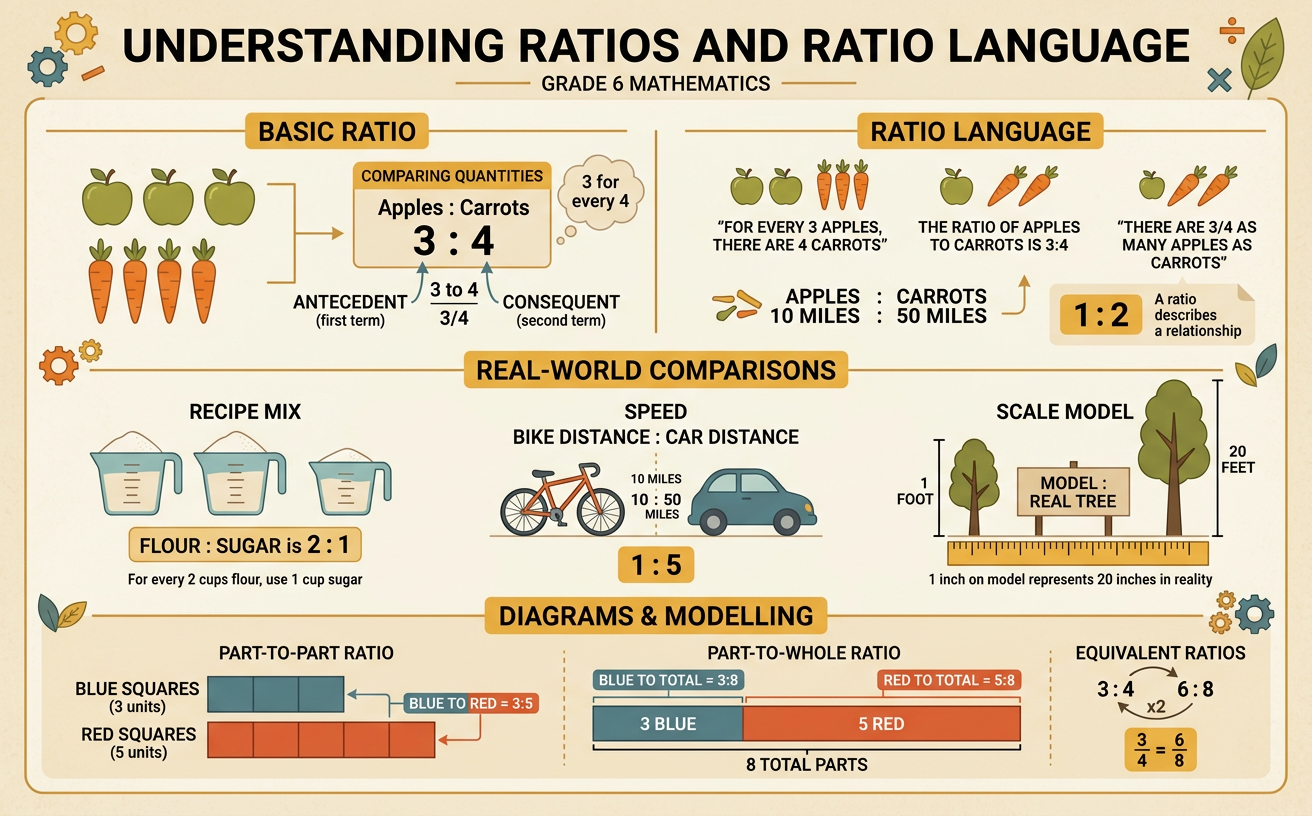
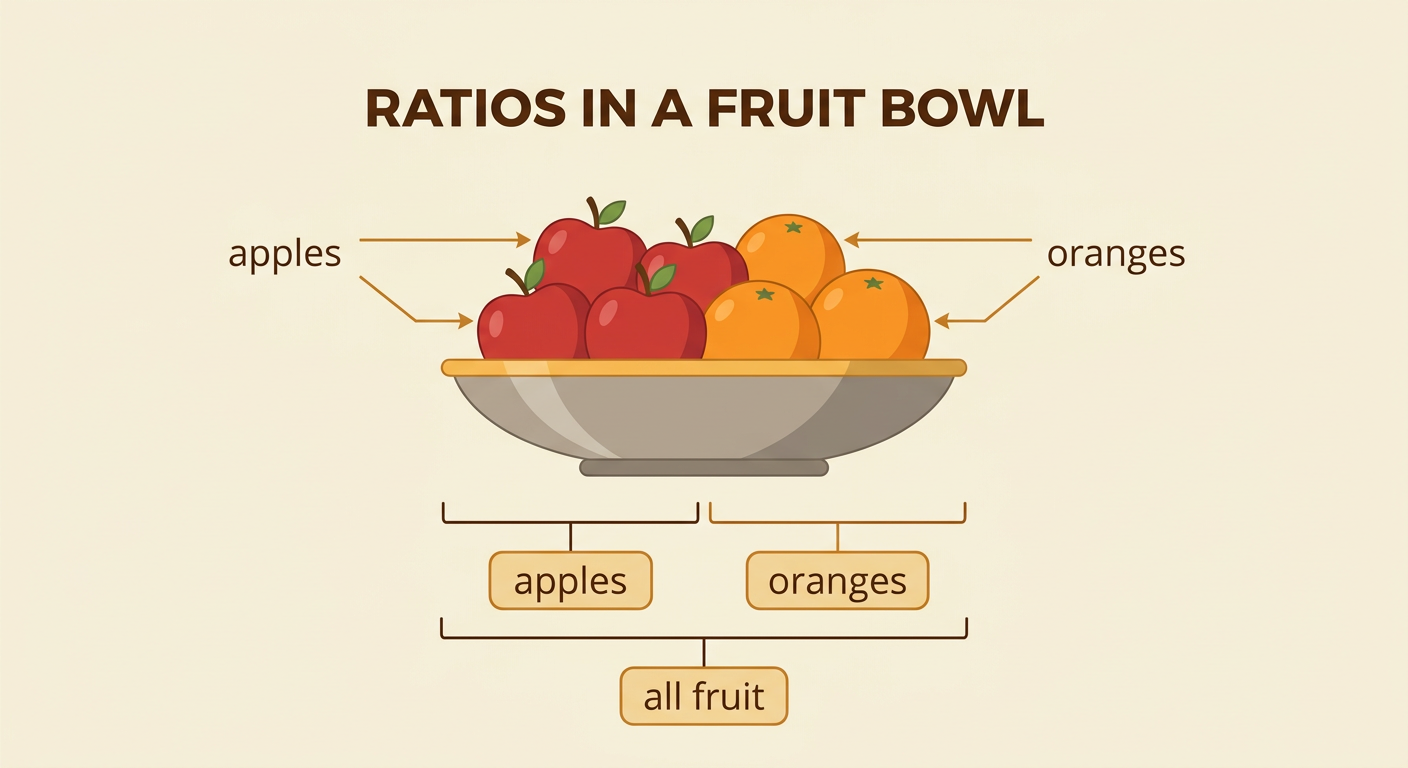
A ratio compares two quantities that are related in the same situation. Begin by naming what is being counted or measured. Suppose a fruit bowl contains 4 apples and 3 oranges. The two related quantities are the number of apples and the number of oranges. You can compare apples with oranges, apples with all the fruit, or oranges with all the fruit. Each comparison answers a different question. There are 4 apples compared with 3 oranges, while there are 4 apples compared with 7 total pieces of fruit. Always check that the quantities belong to the same situation and that you know exactly which two quantities are being compared.
Write Ratios in Three Forms
A ratio can be written in three common forms: with words, with a colon, or as a fraction. Imagine a box holding 3 red markers and 5 blue markers. The ratio of red markers to blue markers can be written as 3 to 5, 3:5, or 3/5. All three forms describe the same comparison and keep the quantities in the same order. The first number represents the red markers, and the second number represents the blue markers. When writing a fraction form, place the first quantity in the numerator and the second quantity in the denominator. Include words or labels when needed so readers know what the numbers represent.

Interpret the Order of a Ratio
The order of a ratio tells which quantity is named first and which is named second. Changing the order changes the comparison. Suppose an animal shelter room has 2 cats and 6 dogs. The ratio of cats to dogs is 2:6 because cats are named first. The ratio of dogs to cats is 6:2 because dogs are named first. These ratios describe opposite comparisons, so they should not be used interchangeably. You can also compare one group with the total. Because there are 8 animals altogether, the ratio of cats to all animals is 2:8. Before writing a ratio, read the comparison carefully and match each number to the order of the words.

Use Ratio Language
Ratio language explains the relationship between quantities, not just the numbers. Suppose a supply table has 4 notebooks for every 3 folders. You can say, “The ratio of notebooks to folders is 4 to 3.” You can also say, “For every 4 notebooks, there are 3 folders.” Both statements describe the same relationship. If the pattern is repeated, 8 notebooks would be paired with 6 folders because both quantities were multiplied by 2. The phrase “for every” helps show how the quantities go together in equal groups. Name the objects when speaking or writing so the meaning is clear. Saying only “4 to 3” does not identify what is being compared.

Practice with Real-World Comparisons
Ratios appear in recipes, sports, classrooms, maps, and many other situations. Consider a drink recipe made with 2 cups of juice and 3 cups of sparkling water. First identify the quantities: cups of juice and cups of water. Next follow the stated order. The ratio of juice to water is 2:3, while the ratio of water to juice is 3:2. In ratio language, the recipe uses 2 cups of juice for every 3 cups of sparkling water. If the recipe is doubled, it uses 4 cups of juice and 6 cups of water, and the relationship stays the same. When solving a real-world ratio problem, identify the quantities, note their order, write the ratio, and explain it with words.