
Understanding Square Roots and Solving Squared Equations
Students interpret square roots as inverse operations of squaring, evaluate roots of small perfect squares, and use square root notation to solve equations of the form x² = p.
Illustrations are auto-generated and may be placeholders. They can be refreshed to match the narration.
Connecting Squares and Square Roots
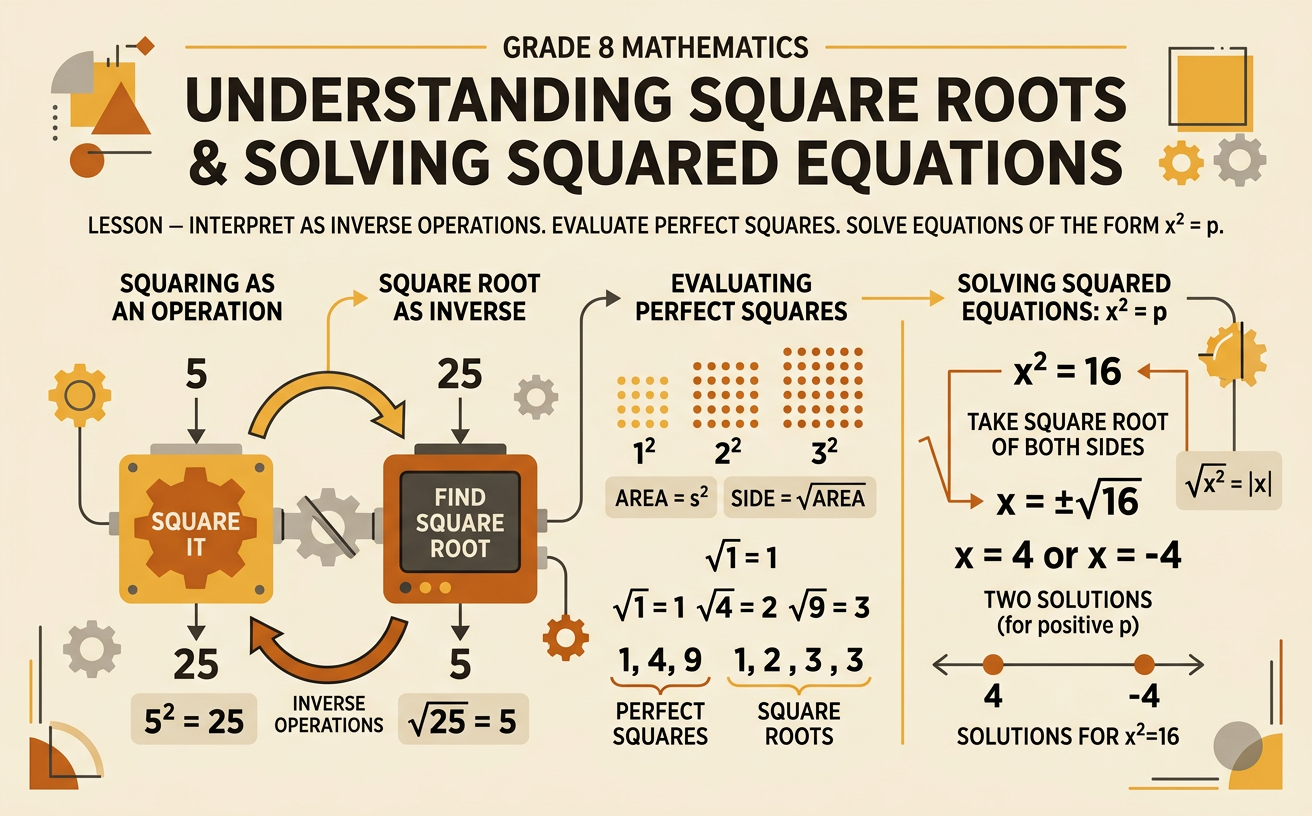
Squaring a number means multiplying the number by itself. For example, 5² = 5 × 5 = 25. A square root reverses this operation. Because 5² = 25, √25 = 5. You can picture this relationship with a square whose side length is 5 units. Its area is 25 square units. If you know the area but not the side length, taking the square root finds the positive side length. Thus, the side length is √25 = 5 units. Squaring and taking a square root are inverse operations when working with nonnegative numbers. In general, if a is nonnegative, then √(a²) = a. The radical symbol √ indicates a square root, and the number written under it is called the radicand.

Recognizing Small Perfect Squares
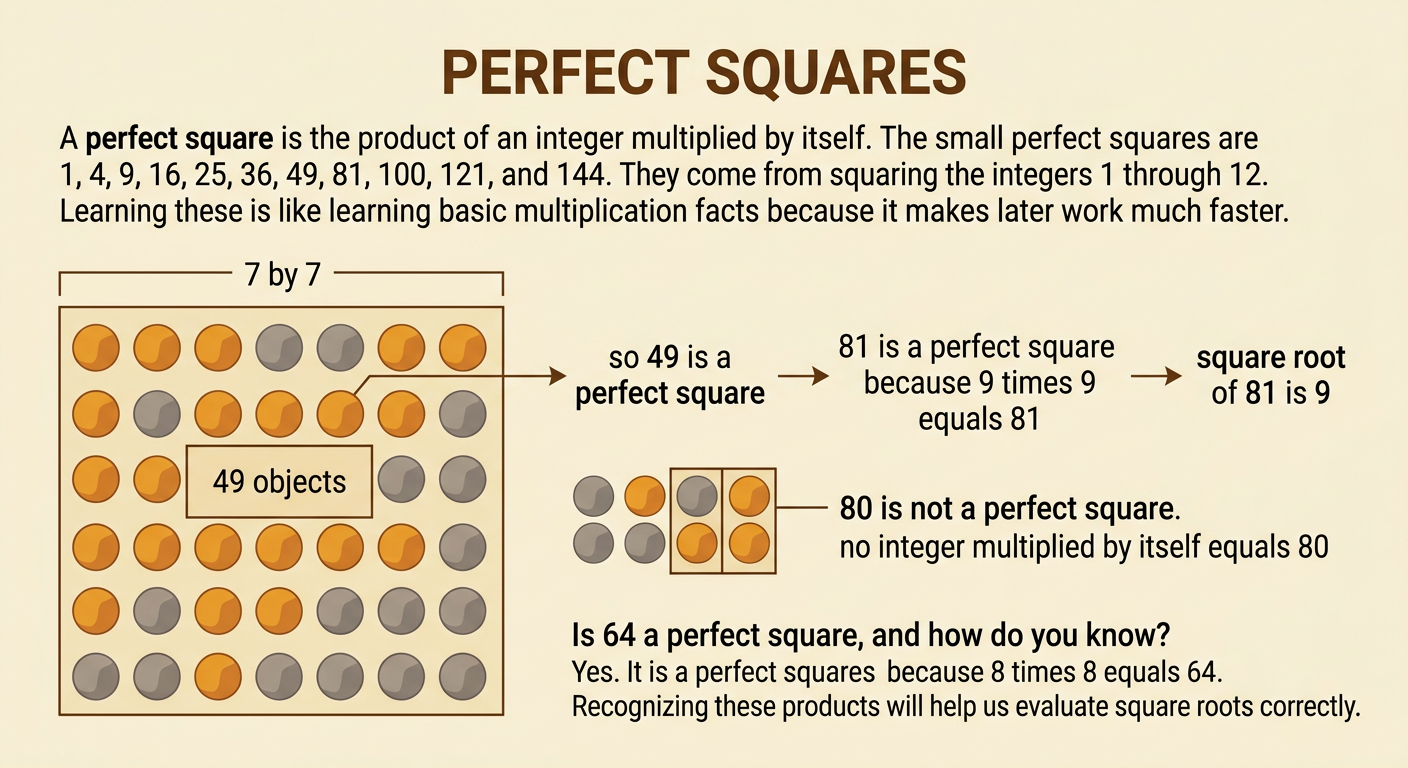
A perfect square is the product of an integer multiplied by itself. Learning small perfect squares helps you evaluate roots quickly. The first several are 1² = 1, 2² = 4, 3² = 9, 4² = 16, 5² = 25, 6² = 36, 7² = 49, 8² = 64, 9² = 81, 10² = 100, 11² = 121, and 12² = 144. For example, 81 is a perfect square because 9 × 9 = 81. Therefore, √81 = 9. In contrast, 80 is not a perfect square because no integer multiplied by itself equals 80. One way to recognize perfect squares is to connect each number to a square array. A 7-by-7 array contains 49 objects, so 49 is a perfect square.
Evaluating Principal Square Roots
The symbol √ refers to the principal square root, which is the nonnegative square root of a number. To evaluate √64, ask, “What nonnegative number squared equals 64?” Since 8² = 64, √64 = 8. The answer is not −8 because the radical symbol by itself represents only the principal, or nonnegative, root. You can verify the value by squaring it: 8 × 8 = 64. Use known perfect squares to evaluate expressions such as √1 = 1, √16 = 4, and √121 = 11. Be careful not to divide the radicand by 2. Taking a square root is not the same as halving. For example, √36 = 6 because 6² = 36, not because 36 ÷ 2 equals 18.
Solving Equations of the Form x² = p
To solve an equation such as x² = 49, find every number whose square is 49. Both 7² = 49 and (−7)² = 49, so the solutions are x = 7 and x = −7. This is often written x = ±√49, which simplifies to x = ±7. The symbol ± means “positive or negative.” Check both solutions by substitution: 7² = 49 and (−7)² = 49. In general, when p is positive, the equation x² = p has two real solutions, x = √p and x = −√p. Keep the negative solution even though the principal square root √p is positive. For example, x² = 100 gives x = ±√100 = ±10, so the solution set is {−10, 10}.
Distinguishing One Principal Root from Two Solutions
A square root expression and a squared equation ask different questions. The expression √25 asks for the principal square root of 25, so its value is 5. It does not equal ±5. The equation x² = 25 asks for all values of x that make the statement true, so it has two solutions: x = 5 and x = −5. Both values work because 5² = 25 and (−5)² = 25. The negative sign in −√25 is outside the radical, so −√25 = −5. Remember the distinction: √p represents one nonnegative number, while x² = p has two real solutions when p is positive. For example, √9 = 3, but if y² = 9, then y = ±3.
Independent Practice and Exit Check
Use perfect squares and the difference between principal roots and equation solutions. First, evaluate √36, √100, and √144. Next, solve a² = 64, b² = 121, and c² = 16. For example, √36 = 6 because 6² = 36, but a² = 64 has two solutions, a = ±8. Check each equation solution by squaring both the positive and negative values. For the exit check, answer these two questions: What is √49? What are all solutions of n² = 49? Your answers should show the key distinction: √49 = 7, while n = ±7. Before finishing, ask yourself whether the problem contains only a radical expression or an equation with a squared variable. That clue determines whether you report one principal root or two solutions.