
Unit Circle and Radian Measures
Students use the unit circle to connect radian measures with coordinates and determine sine and cosine values for key angles.

Illustrations are auto-generated and may be placeholders. They can be refreshed to match the narration.
Degrees, Radians, and Arc Length
Degrees divide one complete rotation into 360 equal parts, while radians measure an angle using arc length. One radian is the angle that intercepts an arc whose length equals the circle’s radius. For any circle, the arc-length formula is s = rθ, where θ is measured in radians. On a unit circle, r = 1, so s = θ. Therefore, an angle’s radian measure equals the length of its intercepted arc. A full circle has circumference 2π, so 360° = 2π radians. A half-turn is π radians, and a quarter-turn is π/2 radians. To convert degrees to radians, multiply by π/180. For example, 120° × π/180 = 2π/3. Thus, rotating 120° counterclockwise around the unit circle traces an arc of length 2π/3.

Constructing the Unit Circle
The unit circle is a circle with center (0, 0) and radius 1. Begin by drawing perpendicular x- and y-axes, then mark the four axis intersections: (1, 0), (0, 1), (−1, 0), and (0, −1). Measure angles counterclockwise from the positive x-axis. Label common first-quadrant angles 0, π/6, π/4, π/3, and π/2. Their degree measures are 0°, 30°, 45°, 60°, and 90°. Continue these angle patterns through the other quadrants. For example, π/3 identifies a 60° counterclockwise rotation. Its terminal side meets the unit circle in Quadrant I. A complete rotation returns to (1, 0) at 2π radians. Because rotations can continue or reverse, the same construction represents angles greater than 2π and negative angles as well.

Coordinates as Cosine and Sine
For an angle θ in standard position, its terminal side meets the unit circle at a point P. The coordinates of P are (cos θ, sin θ). This relationship follows from right-triangle ratios: cosine is the horizontal coordinate divided by the radius, and sine is the vertical coordinate divided by the radius. Because the unit-circle radius is 1, the coordinates directly equal cosine and sine. For example, at θ = π/3, the terminal point is (1/2, √3/2). Therefore, cos(π/3) = 1/2 and sin(π/3) = √3/2. The signs depend on the quadrant. Points to the left of the y-axis have negative cosine values, while points below the x-axis have negative sine values. Every unit-circle point also satisfies x² + y² = 1.

Evaluating Key Angles
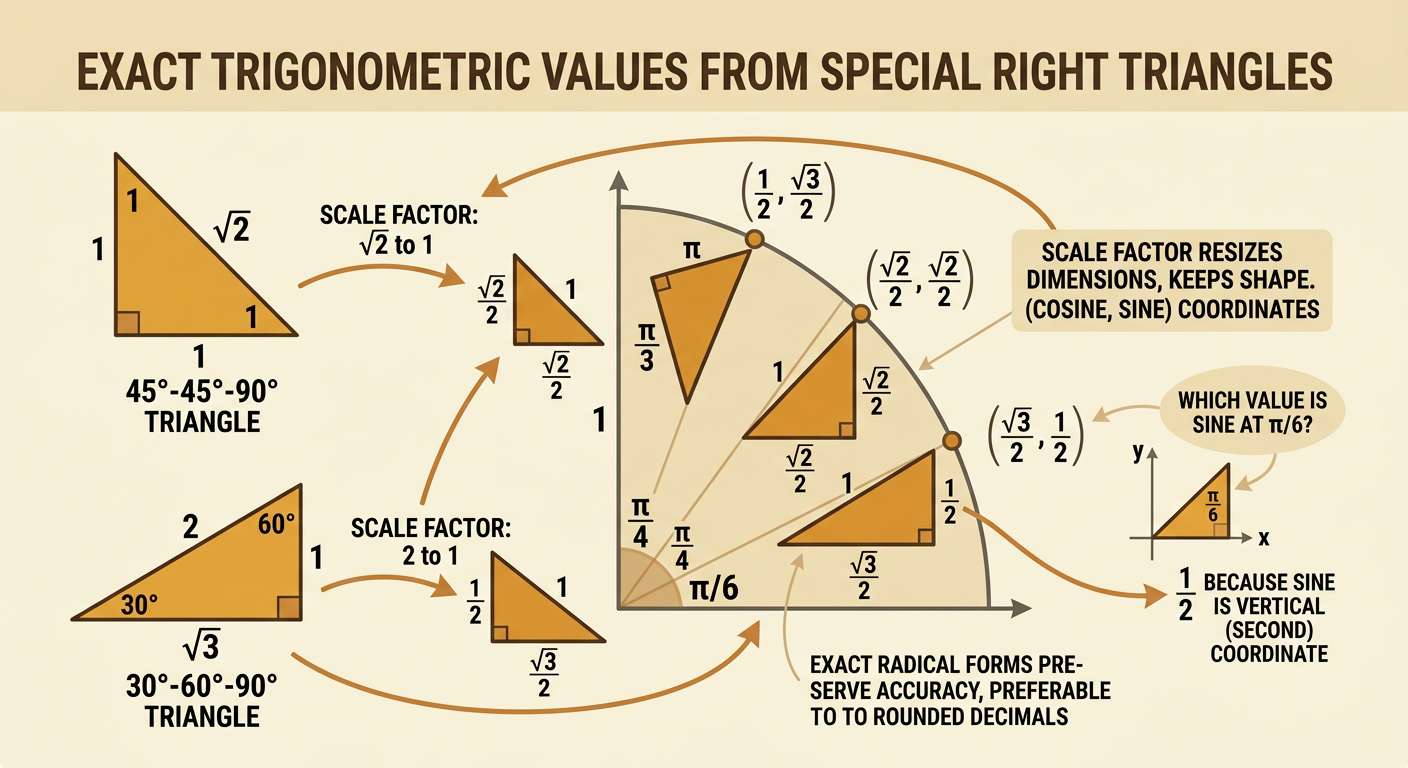
Exact sine and cosine values for key angles come from special right triangles. A 45°-45°-90° triangle has side ratios 1:1:√2. After scaling its hypotenuse to 1, both legs are √2/2, so the point at π/4 is (√2/2, √2/2). Thus, cos(π/4) = √2/2 and sin(π/4) = √2/2. A 30°-60°-90° triangle has side ratios 1:√3:2. Scaling the hypotenuse to 1 gives leg lengths 1/2 and √3/2. At π/6, the terminal point is (√3/2, 1/2), so cos(π/6) = √3/2 and sin(π/6) = 1/2. At π/3, the coordinates switch to (1/2, √3/2). These exact forms are preferable to rounded decimal approximations.
Using Symmetry and Reference Angles
A reference angle is the positive acute angle between an angle’s terminal side and the x-axis. Reference angles let you use first-quadrant coordinate magnitudes for angles in every quadrant. The quadrant determines the signs. Cosine is positive in Quadrants I and IV because x is positive there. Sine is positive in Quadrants I and II because y is positive there. For example, 5π/6 lies in Quadrant II and has reference angle π/6. The π/6 coordinate magnitudes are √3/2 and 1/2. In Quadrant II, x is negative and y is positive, so cos(5π/6) = −√3/2 and sin(5π/6) = 1/2. Coterminal angles share a terminal side. Therefore, 5π/6 + 2π has the same sine and cosine values, extending the functions to rotations represented by any real number.
