Universal Gravitation and Orbital Motion
Students use the universal gravitation equation to explain how mass and distance affect gravitational attraction, orbital motion, and satellite applications.
Illustrations are auto-generated and may be placeholders. They can be refreshed to match the narration.
Gravity as a Universal Interaction
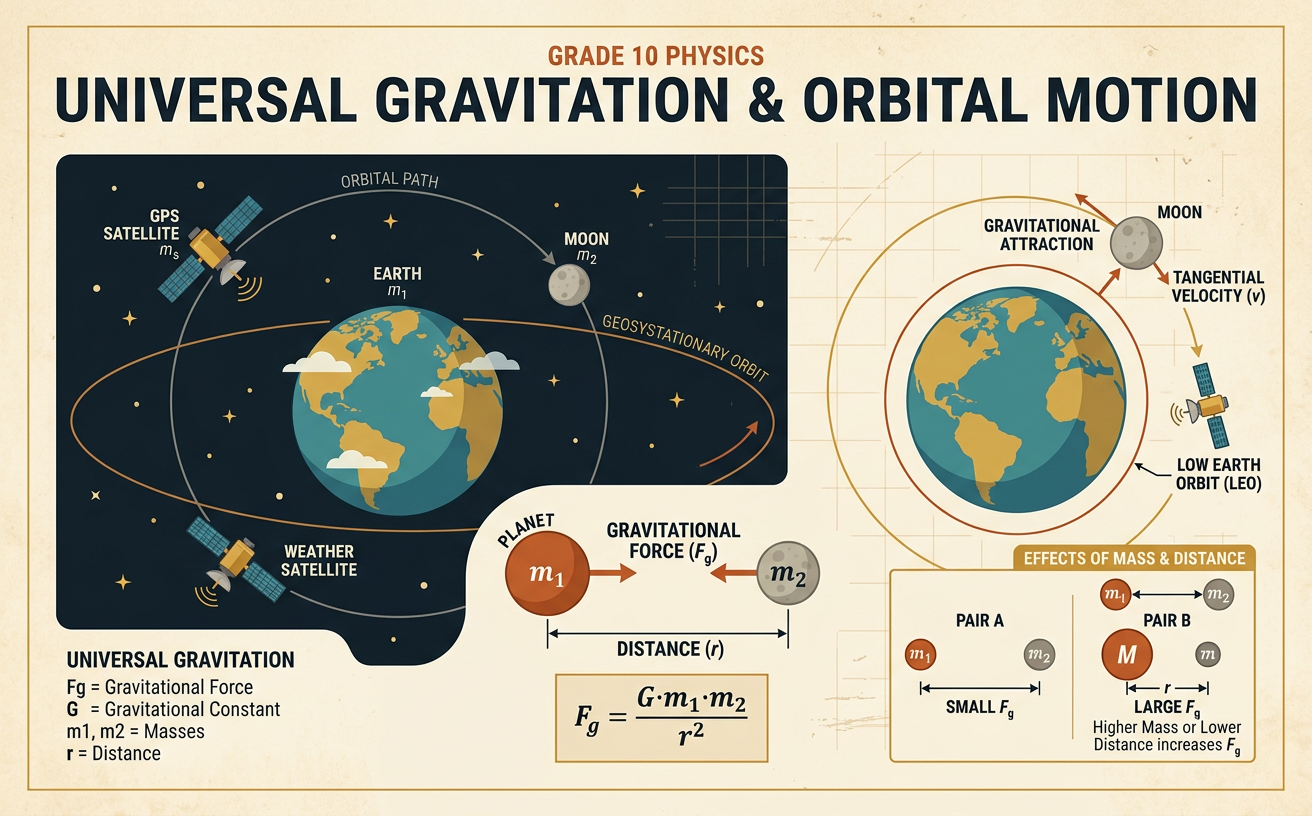
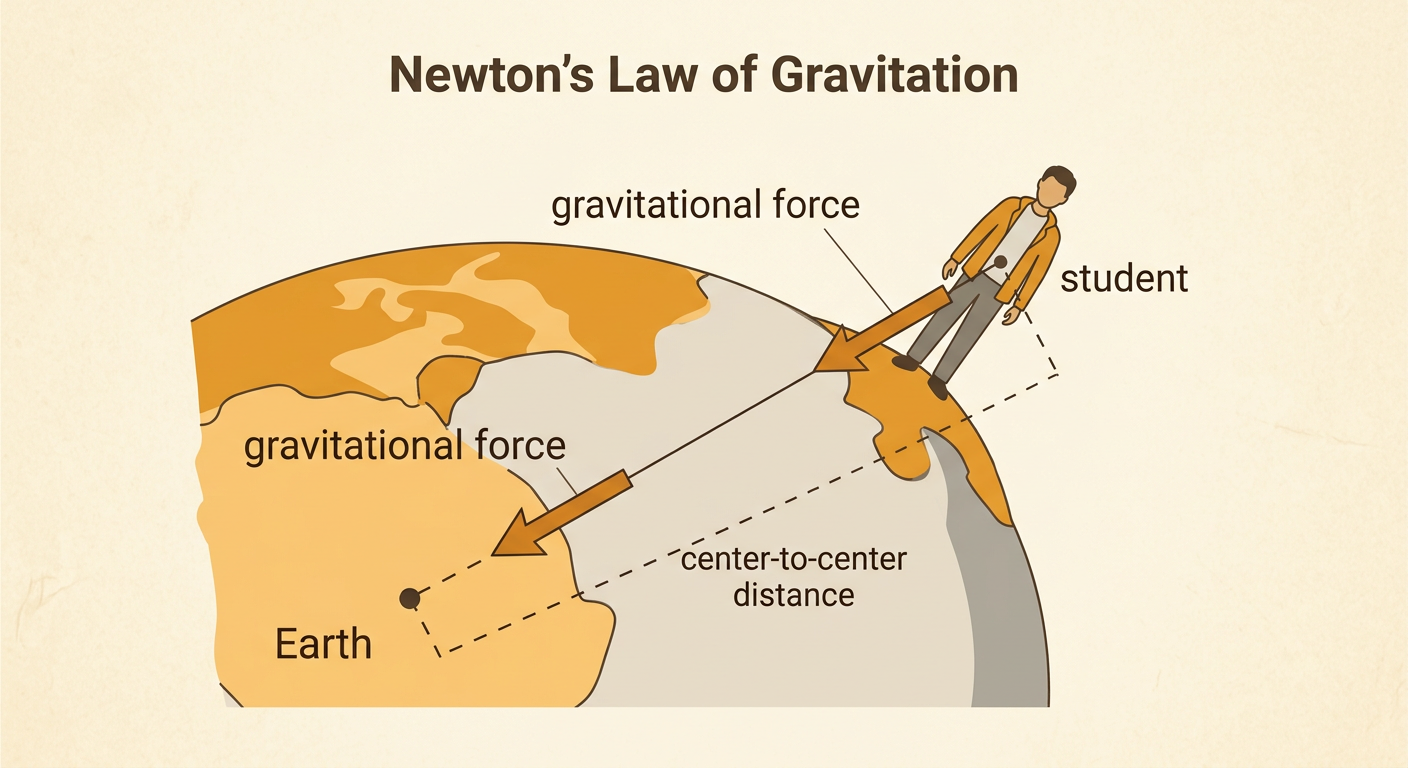
Gravity is an attractive interaction between every pair of objects with mass. Newton’s law of universal gravitation represents its strength as F = Gm₁m₂/r². In this equation, F is gravitational force, G is the universal gravitational constant, m₁ and m₂ are the objects’ masses, and r is the distance between their centers. Each object pulls on the other with an equal-magnitude force in the opposite direction. For example, Earth pulls a student downward, while the student pulls Earth upward with the same force. Earth’s motion is unnoticeable because its enormous mass gives it an extremely small acceleration. Gravity acts across space and governs falling objects, ocean tides, planetary motion, and the paths of artificial satellites.
Mass, Distance, and the Inverse-Square Relationship
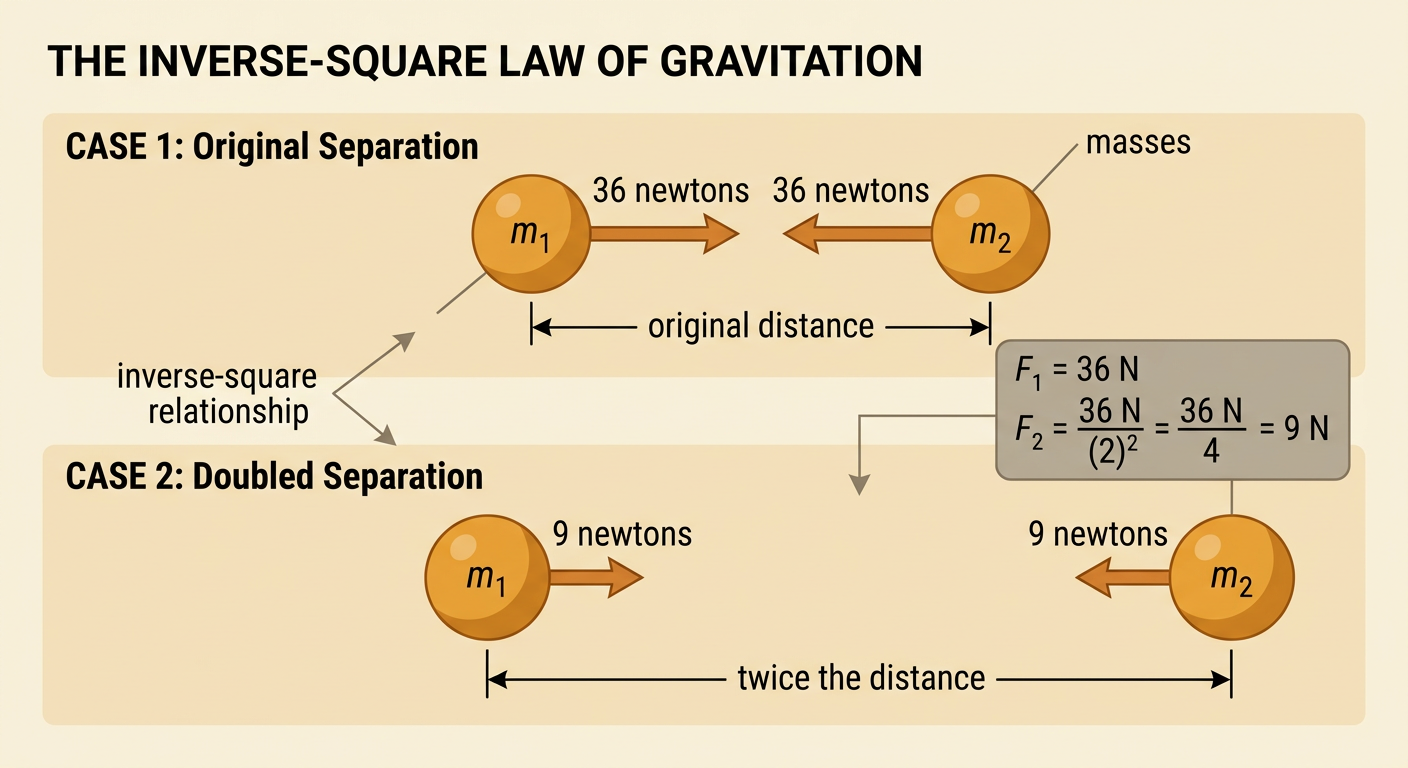
The universal gravitation equation shows that gravitational force depends directly on both masses and inversely on the square of the distance between their centers. If one mass doubles while everything else stays constant, the force doubles. If both masses double, the force becomes four times as great. Distance has a different effect because r is squared. If the center-to-center distance doubles, the force becomes one-fourth as strong; if the distance triples, it becomes one-ninth as strong. For example, suppose two objects attract each other with 36 newtons of force at a certain distance. Moving them to twice that distance reduces the force to 36/2², or 9 newtons. This inverse-square relationship explains why gravity weakens rapidly with distance but never becomes exactly zero.
Calculating Gravitational Force
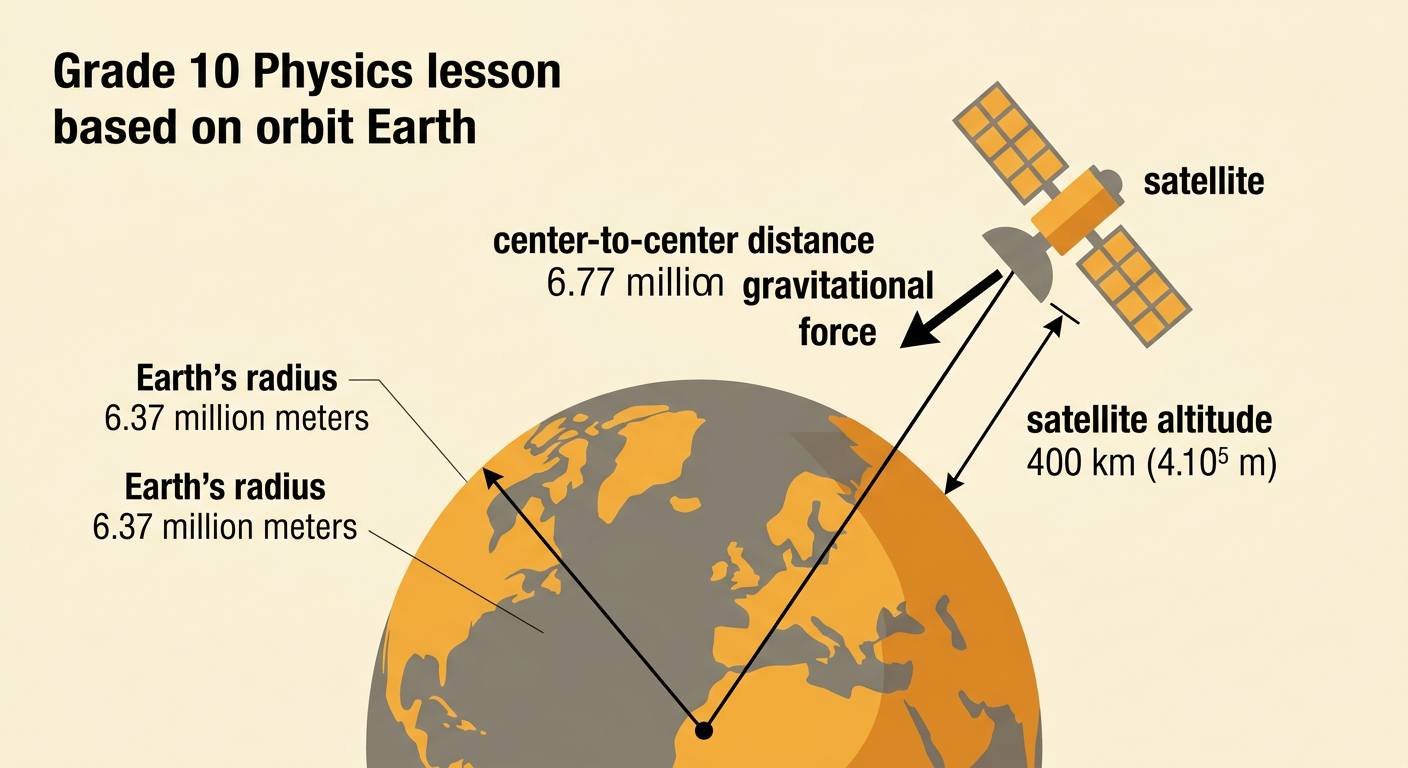
To calculate gravitational force, use consistent SI units: masses in kilograms, distance in meters, and force in newtons. The constant G is 6.674 × 10⁻¹¹ N·m²/kg². Consider a 1,000-kilogram satellite orbiting 400 kilometers above Earth. Earth’s radius is about 6.37 × 10⁶ meters, so the distance from Earth’s center is 6.77 × 10⁶ meters. Substitution gives F = (6.674 × 10⁻¹¹)(5.97 × 10²⁴)(1,000)/(6.77 × 10⁶)², or approximately 8.70 × 10³ newtons. The formula can also be rearranged to highlight an unknown. For example, solving F = GMm/r² for the satellite’s mass gives m = Fr²/(GM). This algebraic form allows mass to be determined from measured force and distance.
Why Objects Stay in Orbit
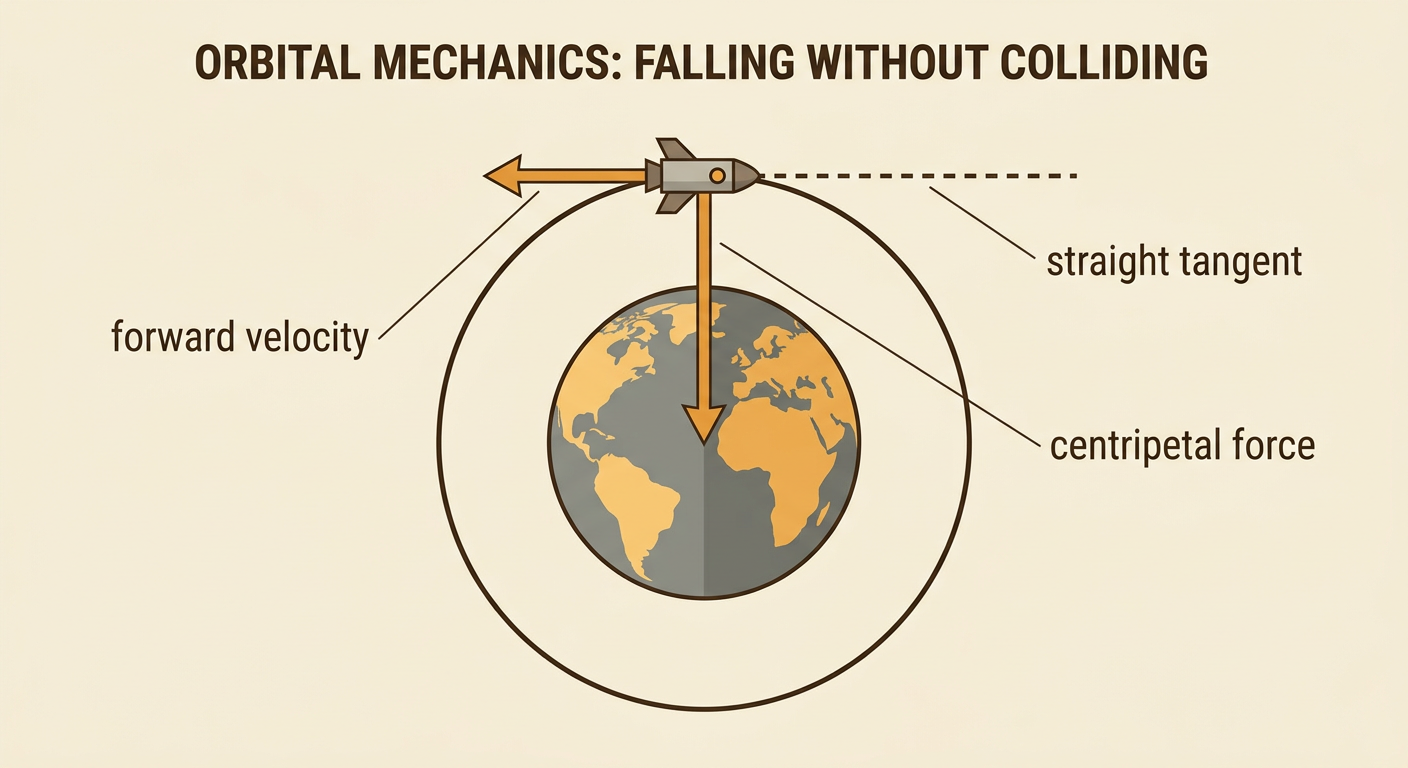
An orbiting object is continuously falling toward Earth, but its forward motion keeps it from reaching the surface. Gravity supplies the inward, or centripetal, force that continually changes the direction of the object’s velocity. Without gravity, the object would move along a straight tangent. Without enough sideways speed, it would fall into Earth; with an appropriate speed, Earth’s curved surface drops away beneath it at the same rate that it falls. For example, the International Space Station travels at about 7.7 kilometers per second in low Earth orbit. Gravity there is still strong, so astronauts are not weightless because gravity is absent. Instead, the station and everything inside it are falling together, creating apparent weightlessness. A faster or slower launch speed can produce a different orbit or a collision with Earth.
Satellite Orbits and Geospatial Applications
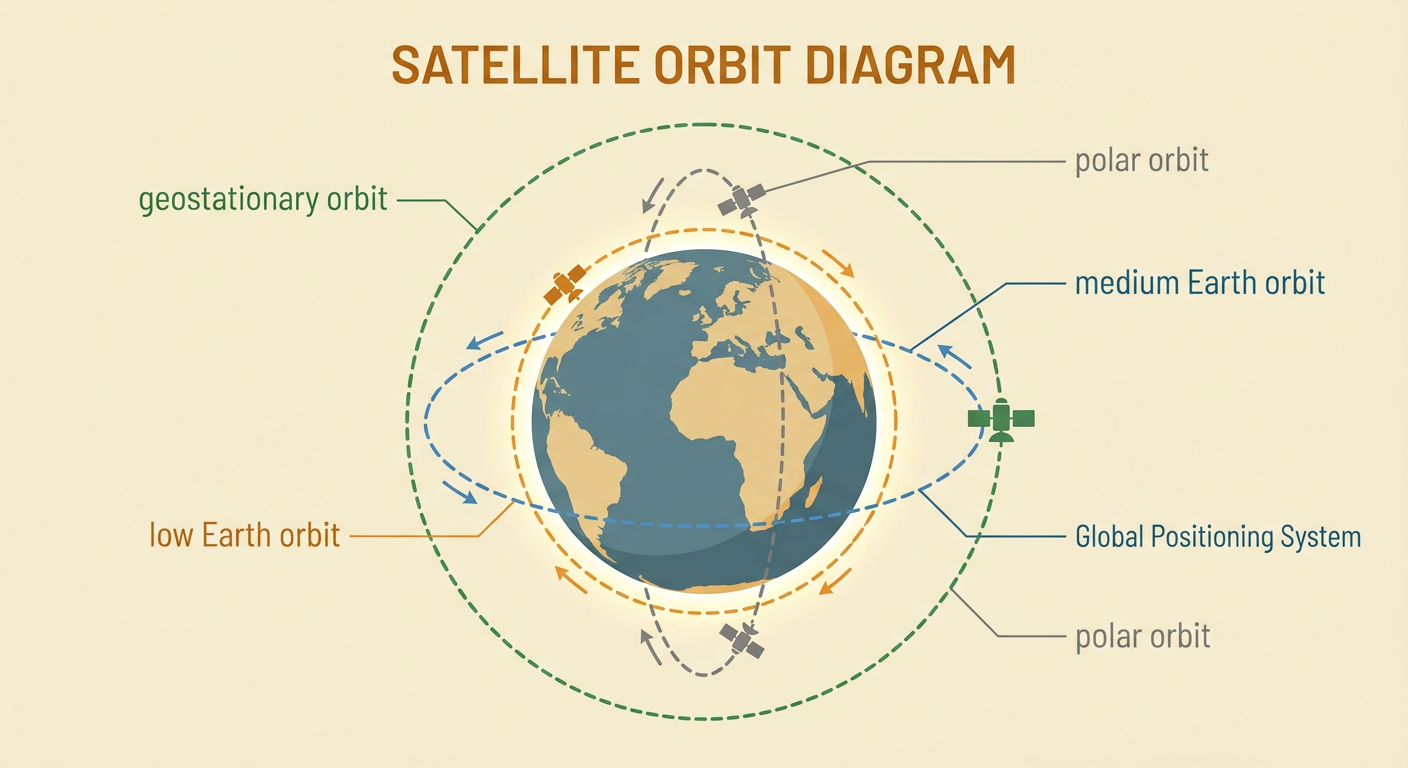
Satellites occupy different orbits depending on their purposes. Low Earth orbit supports detailed imaging because satellites pass relatively close to the surface. Polar and near-polar satellites can observe nearly the entire planet as Earth rotates beneath their paths, helping scientists map vegetation, ice, wildfires, storms, and urban growth. Global Positioning System satellites use medium Earth orbits and transmit timed signals that receivers use to determine location. A geostationary satellite orbits above the equator at an altitude of about 35,786 kilometers and completes one orbit in approximately 24 hours, so it appears fixed over one longitude. This makes it useful for continuous weather monitoring and communication. For example, comparing satellite images taken months apart can reveal a spatial pattern of shrinking lake area, allowing geographers to investigate drought, water use, and environmental change.