Universal Gravitation and Orbital Motion
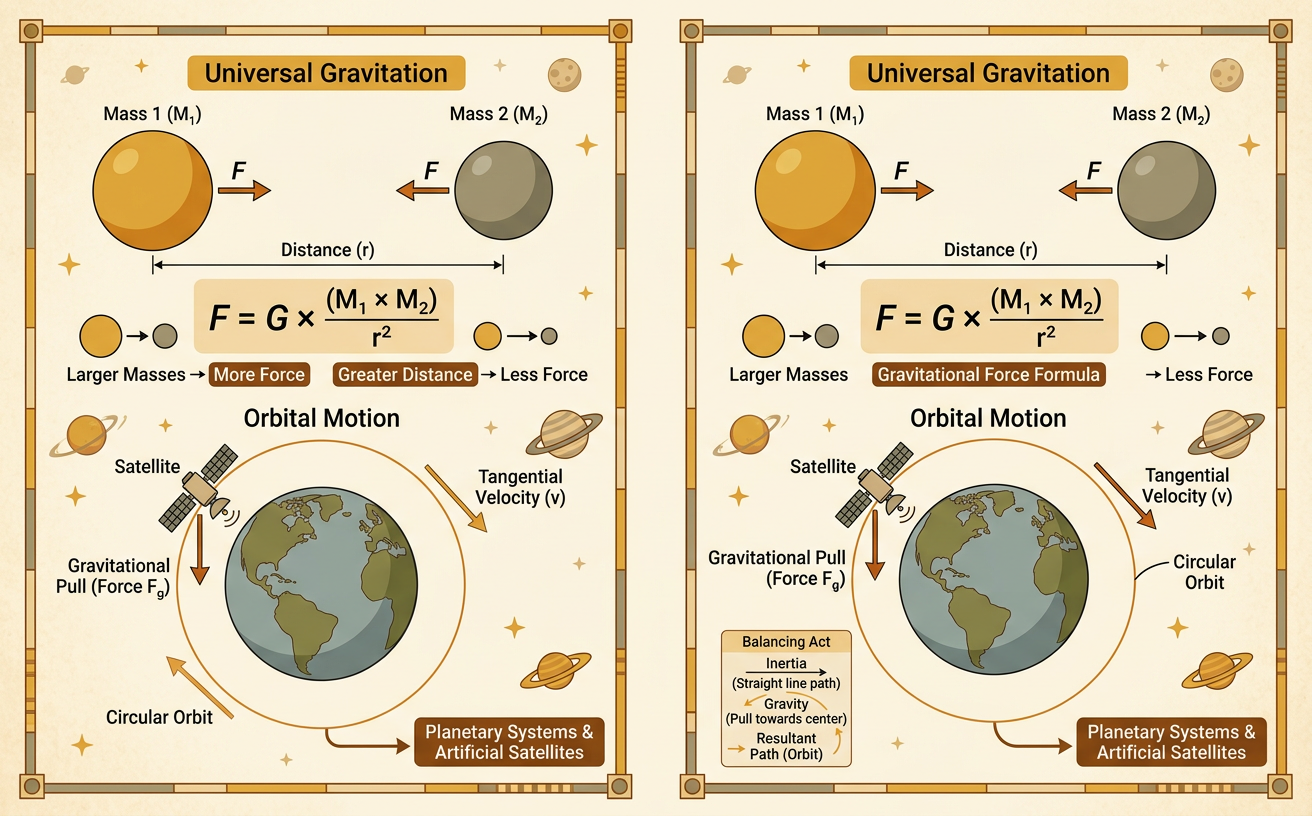
Students use Newton’s law of universal gravitation to predict how mass and distance affect gravitational force and explain why satellites remain in orbit.
Illustrations are auto-generated and may be placeholders. They can be refreshed to match the narration.
Gravity as an Attractive Force
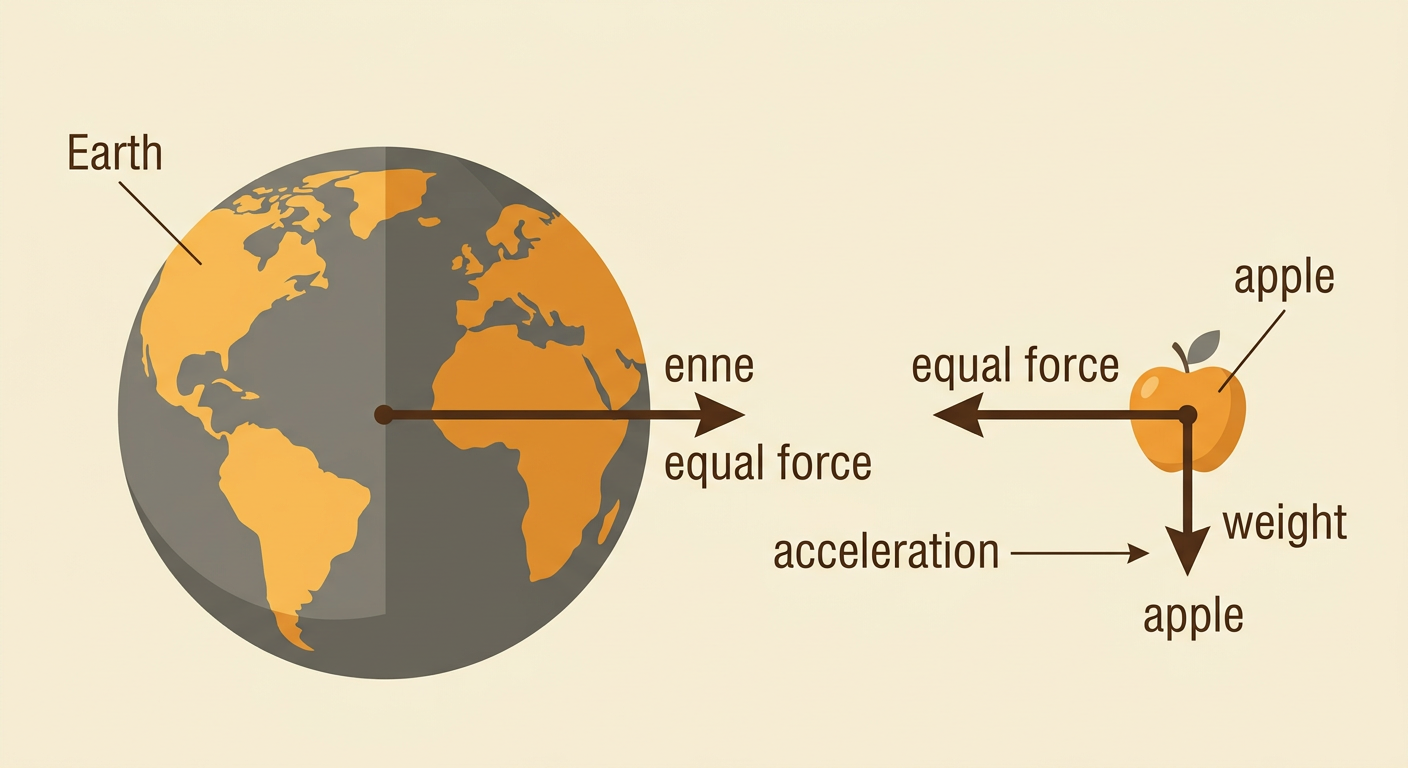
Gravity is an attractive interaction between any two objects that have mass. Each object pulls the other toward its center. The pulls are equal in strength and opposite in direction, even when the objects have very different masses. However, the same force causes a smaller acceleration in the more massive object. For example, Earth pulls a falling apple downward, while the apple pulls Earth upward with an equal gravitational force. Earth’s much greater mass makes its resulting acceleration too small to notice. Gravitational force acts without direct contact and becomes weaker as objects move farther apart. Near Earth’s surface, this attraction gives objects weight. Although Earth’s gravity is familiar, the same universal interaction operates between planets, stars, moons, satellites, and people.
Mass, Distance, and Force
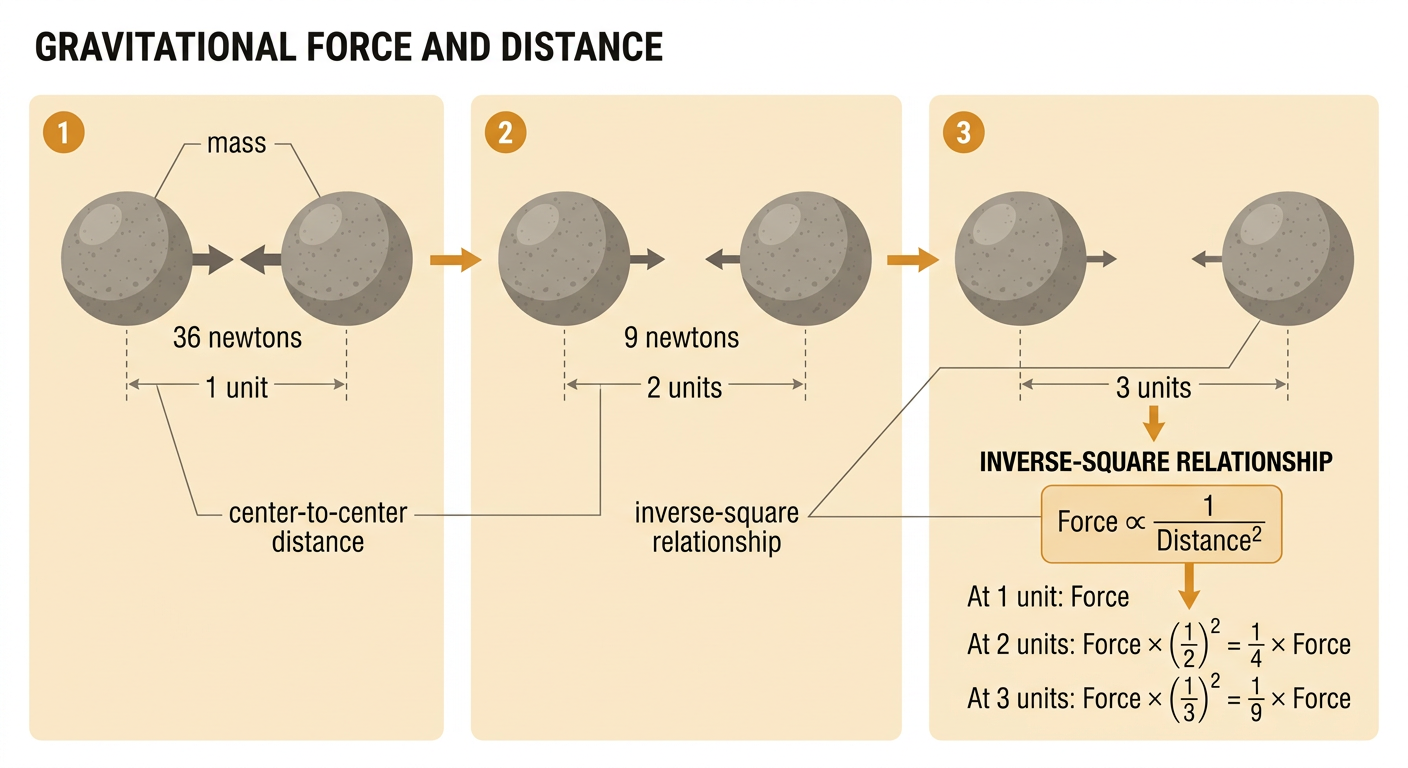
Newton’s law of universal gravitation shows that gravitational force depends on both mass and distance. Force is directly proportional to the product of the two masses. If one mass doubles while everything else stays the same, the force doubles. If both masses double, the force becomes four times as great. Distance has an inverse-square relationship with force, and distance is measured from center to center. If the distance doubles, the force becomes one-fourth as strong; if it triples, the force becomes one-ninth as strong. For example, suppose two objects attract each other with 36 newtons of force. Moving them to twice their original center-to-center distance reduces the force to 9 newtons. This rapid decrease explains why nearby objects exert stronger gravitational effects than equally massive objects much farther away.
Applying the Gravitation Equation
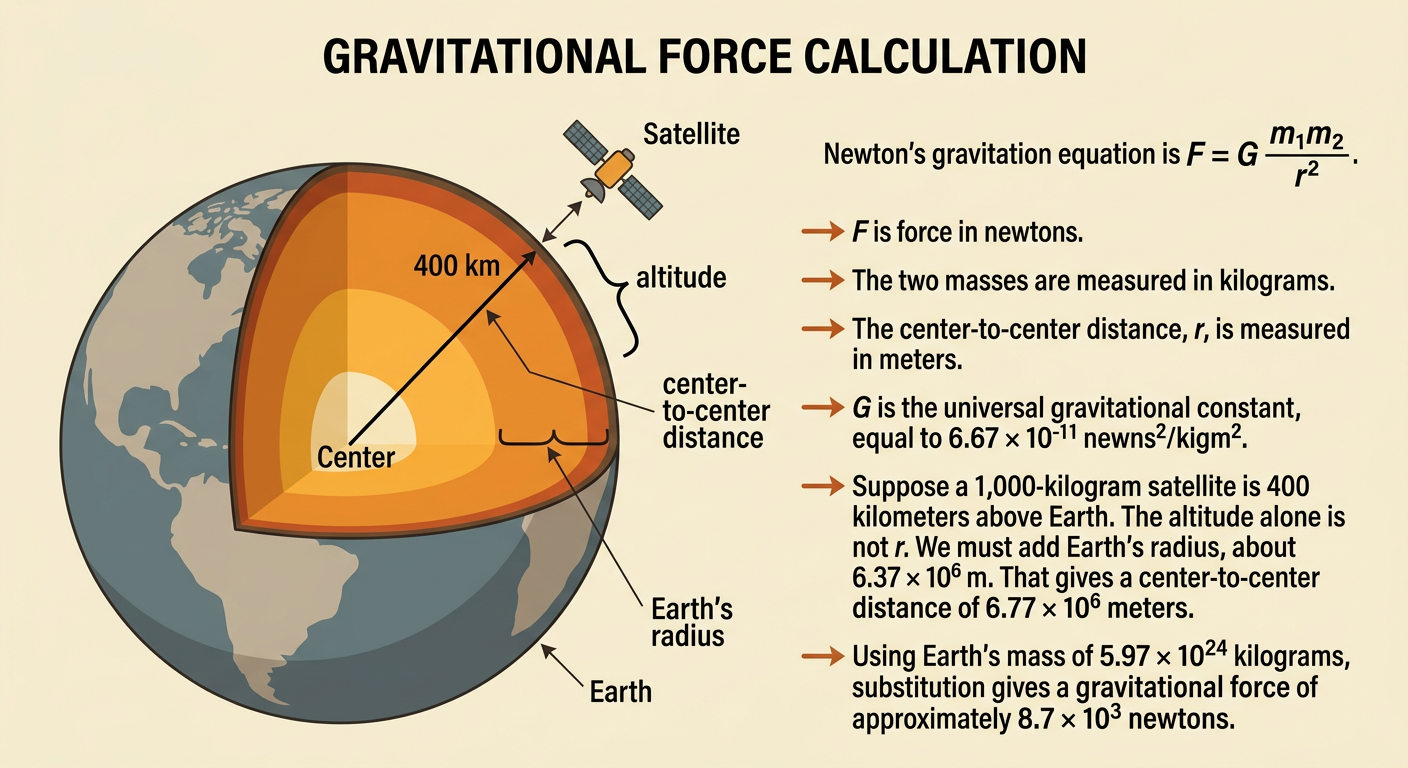
Newton’s gravitation equation is F = Gm1m2 divided by r squared. In this equation, F is force in newtons, m1 and m2 are masses in kilograms, r is center-to-center distance in meters, and G is 6.67 × 10^-11 newton-meters squared per kilogram squared. Consider a 1,000-kilogram satellite 400 kilometers above Earth. Earth’s radius is about 6.37 × 10^6 meters, so r is 6.77 × 10^6 meters, not merely the satellite’s altitude. Substituting Earth’s mass, 5.97 × 10^24 kilograms, gives F = (6.67 × 10^-11)(5.97 × 10^24)(1,000) divided by (6.77 × 10^6) squared. The result is approximately 8.7 × 10^3 newtons. Checking units and using center-to-center distance prevent common calculation errors.
Reading Force-versus-Distance Graphs
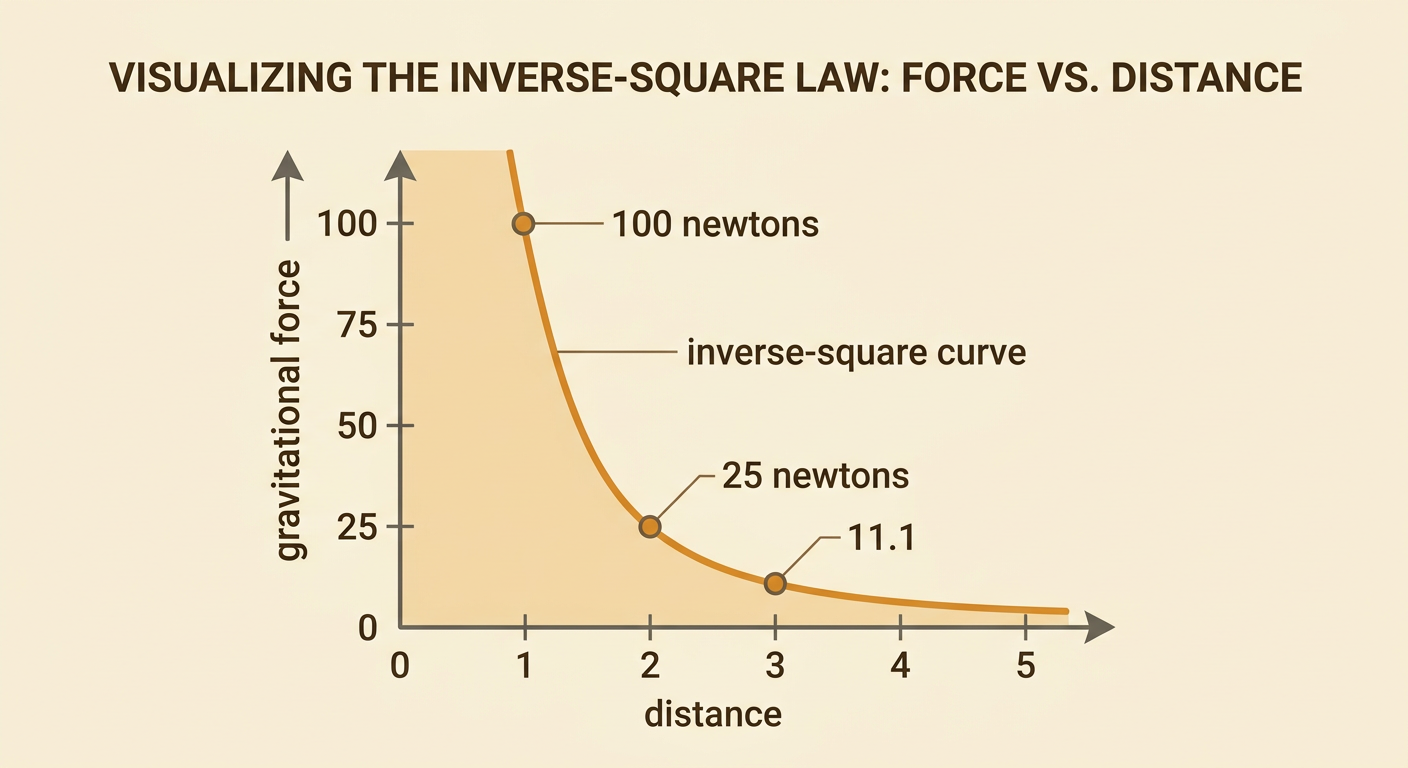
A force-versus-distance graph makes the inverse-square pattern visible. Distance appears on the horizontal axis, and gravitational force appears on the vertical axis. The curve begins high and falls steeply before gradually approaching zero. It is not a straight line because equal increases in distance do not produce equal decreases in force. If the force is 100 newtons at one distance unit, it is 25 newtons at two units and about 11.1 newtons at three units. The graph never reaches zero at any finite distance, although the force can become extremely small. The equation is not defined at zero distance because it would require division by zero, and real objects cannot have overlapping centers in this simplified model. When interpreting the graph, compare ratios of distances and forces rather than only their numerical differences.
Explaining Satellite Orbits
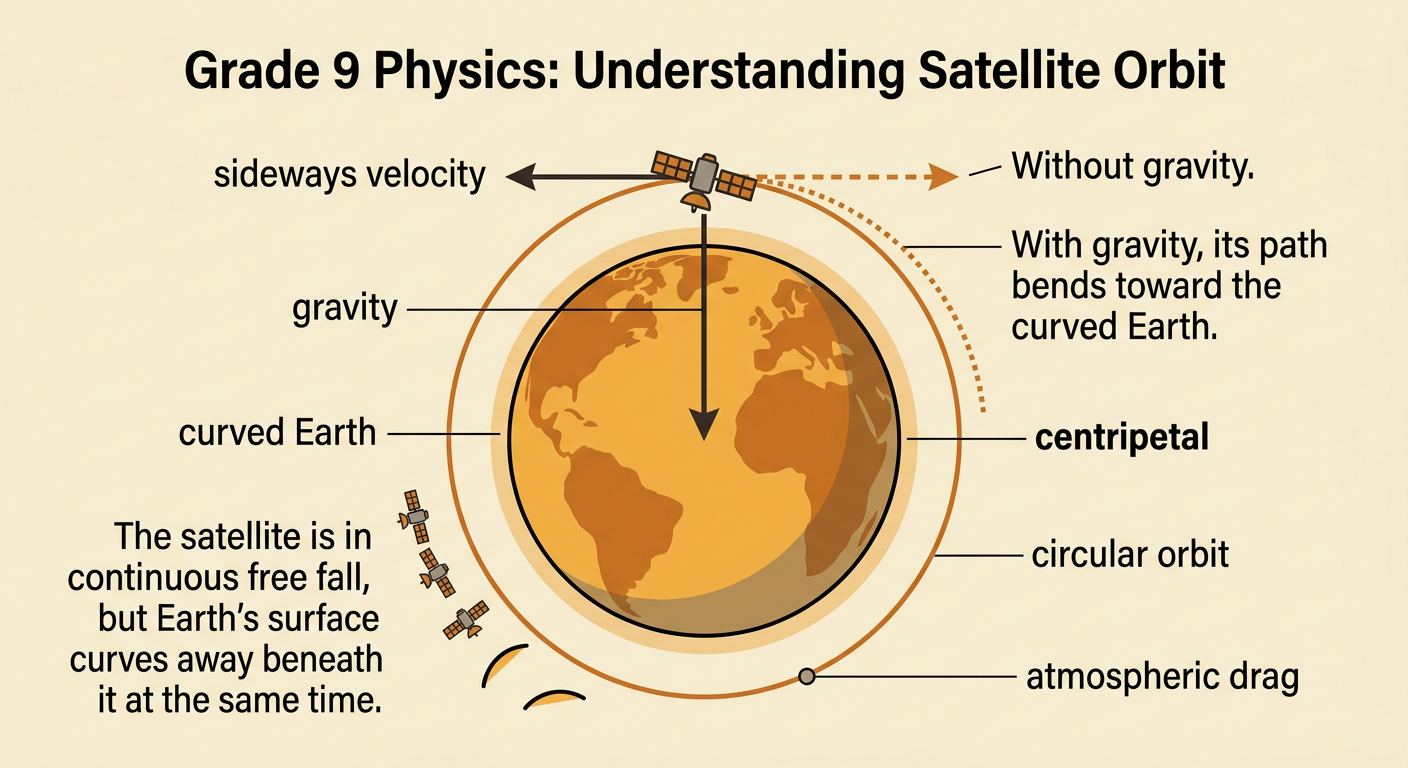
A satellite remains in orbit because gravity continuously accelerates it toward Earth while its sideways velocity carries it forward. The satellite is in continuous free fall, but Earth’s curved surface falls away beneath its path. In a nearly circular low Earth orbit, gravity supplies the inward, or centripetal, net force needed to bend the satellite’s motion into a circle. For example, the International Space Station travels at about 7.7 kilometers per second roughly 400 kilometers above Earth. Gravity there is still about 8.7 newtons per kilogram, so the claim that satellites orbit because gravity disappears is not supported by evidence. If a satellite moves too slowly, its orbit drops; if it moves fast enough, it can enter a larger orbit or escape. Real low-orbit satellites also experience slight atmospheric drag, so engines occasionally raise their orbits.