
Universal Gravitation: Predicting Forces and Orbits
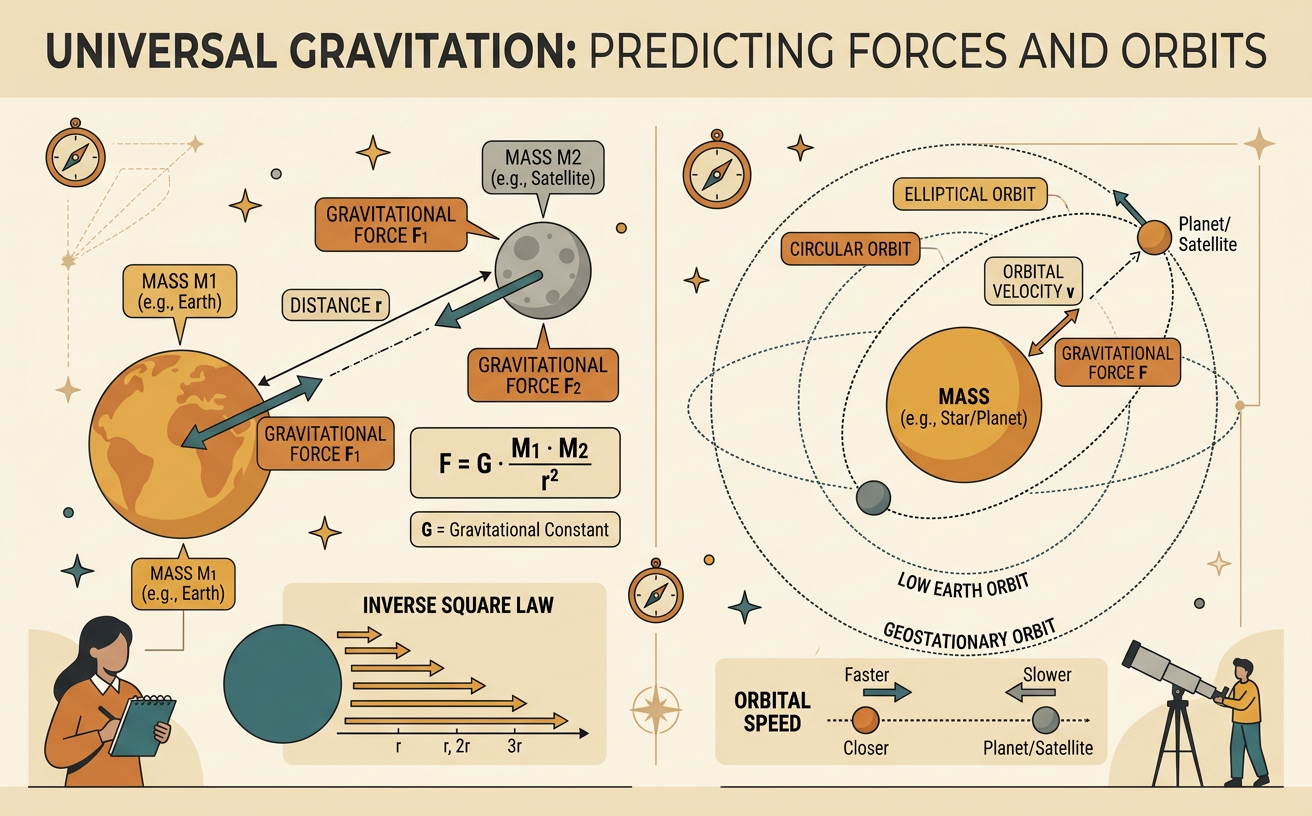
Students use Newton’s law of universal gravitation to calculate gravitational forces and explain how gravity produces satellite and planetary orbits.
Illustrations are auto-generated and may be placeholders. They can be refreshed to match the narration.
Gravity as a Universal Interaction
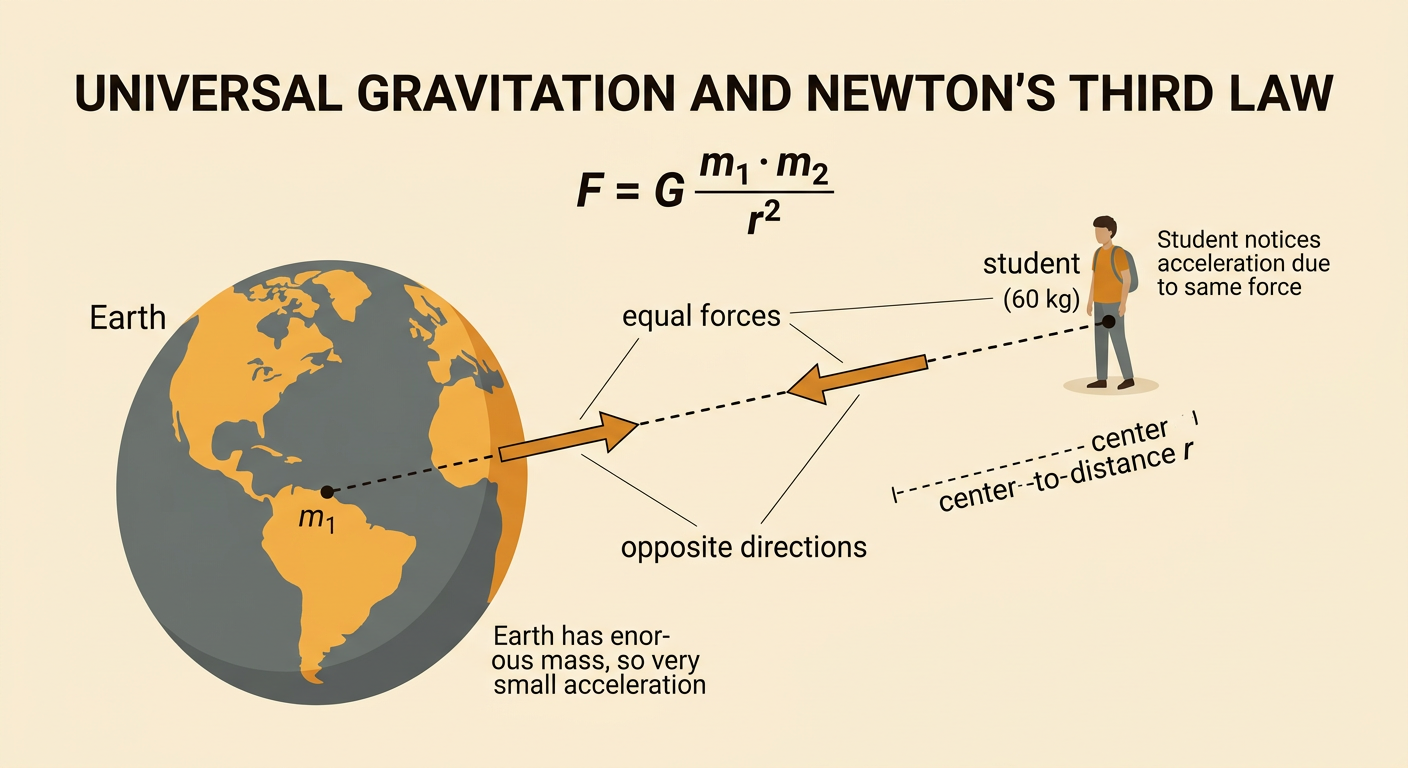
Gravity is a universal interaction between every pair of objects that has mass. Newton’s law of universal gravitation states that the force magnitude is F = Gm₁m₂/r², where m₁ and m₂ are the masses, r is the distance between their centers, and G is the universal gravitational constant. Each object pulls on the other with an equal-magnitude force in the opposite direction. For example, Earth pulls a 60-kilogram student downward, while the student pulls Earth upward with the same force. Earth’s acceleration is unnoticeably small because its mass is enormous. Gravity does not require physical contact, and it acts across space. Although gravity between ordinary classroom objects is extremely weak, it becomes important when one or both interacting objects have very large masses, such as planets, stars, and moons.
Mass, Distance, and the Inverse-Square Relationship
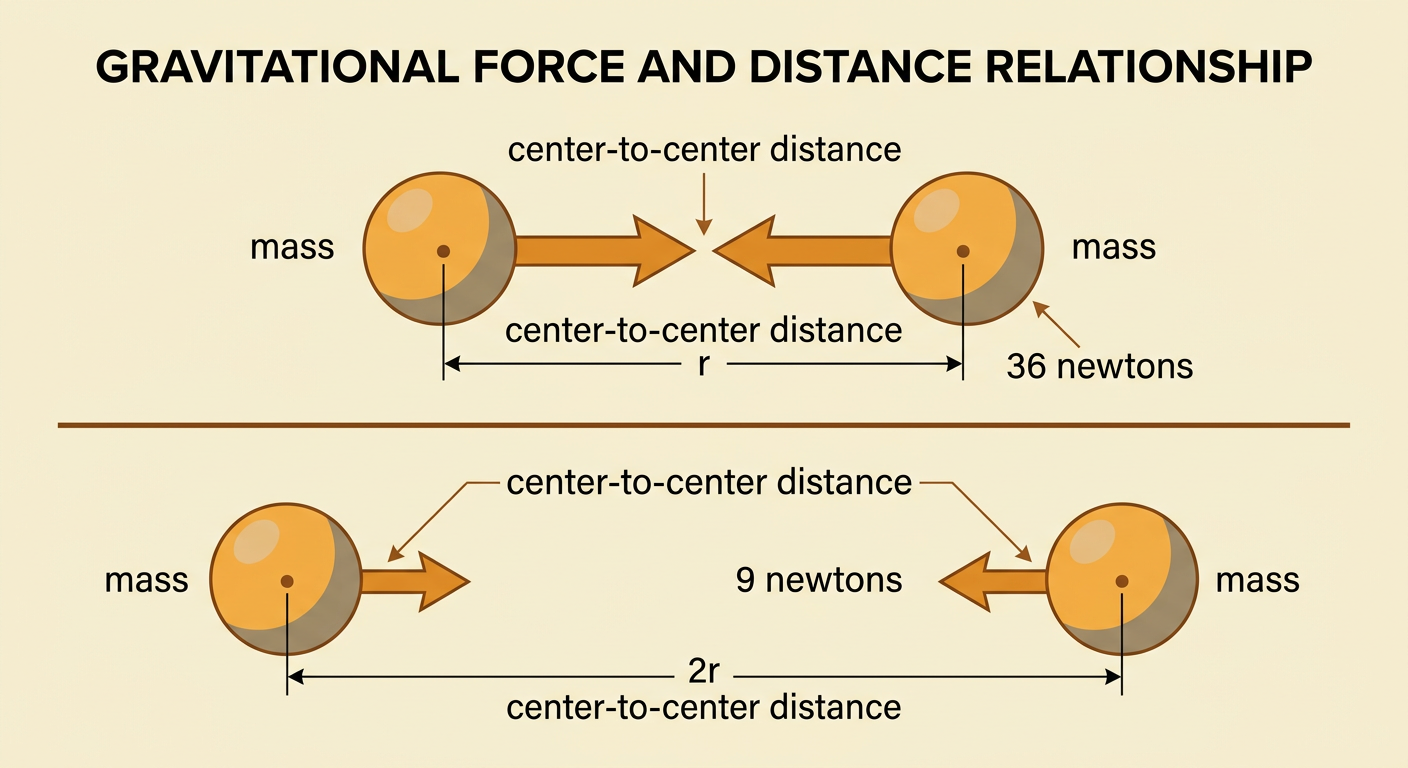
Newton’s equation shows that gravitational force depends directly on both masses and inversely on the square of the center-to-center distance. If one mass doubles while everything else stays constant, the force doubles. If both masses double, the force becomes four times as great. Distance has a different effect: doubling the separation makes the force one-fourth as large because 1/(2r)² = 1/(4r²). Tripling the distance reduces the force to one-ninth. For example, if two objects attract with 36 newtons of force at distance r, they attract with only 9 newtons at distance 2r. Always measure r from the center of one object to the center of the other, not from their surfaces. This inverse-square pattern explains why gravitational influence weakens rapidly with distance but never becomes exactly zero.
Calculating Gravitational Force
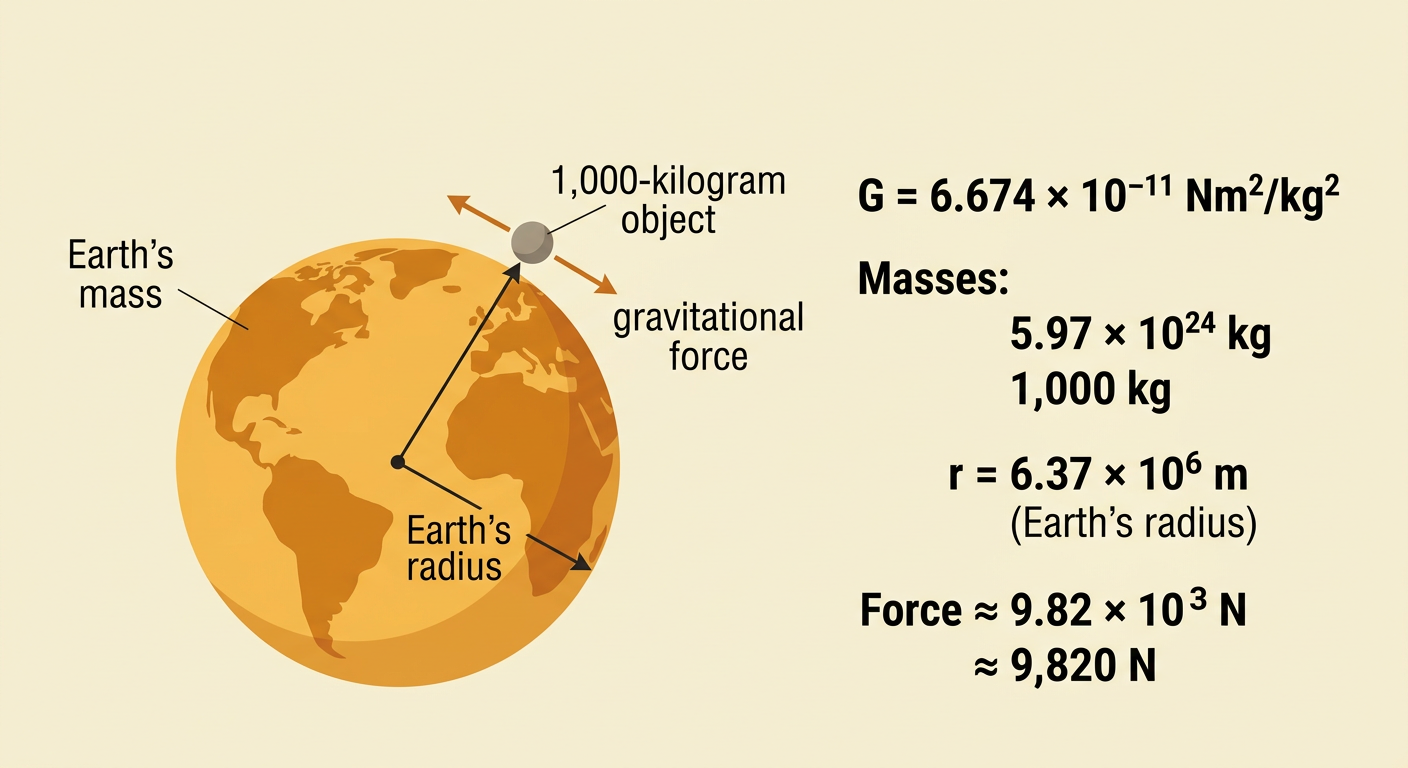
To calculate gravitational force, use F = Gm₁m₂/r² with G = 6.674 × 10⁻¹¹ N·m²/kg². Keep masses in kilograms and distance in meters. Consider a 1,000-kilogram object just above Earth’s surface. Use Earth’s mass, 5.97 × 10²⁴ kilograms, and Earth’s radius, 6.37 × 10⁶ meters. Substitution gives F = (6.674 × 10⁻¹¹)(5.97 × 10²⁴)(1,000)/(6.37 × 10⁶)², or approximately 9.82 × 10³ newtons. The formula can also be rearranged to highlight another unknown. For example, solving for distance gives r = √(Gm₁m₂/F). After calculating, check whether the units and size of the answer are reasonable. A larger mass should increase force, while a larger distance should decrease it.
Gravity as the Source of Centripetal Force
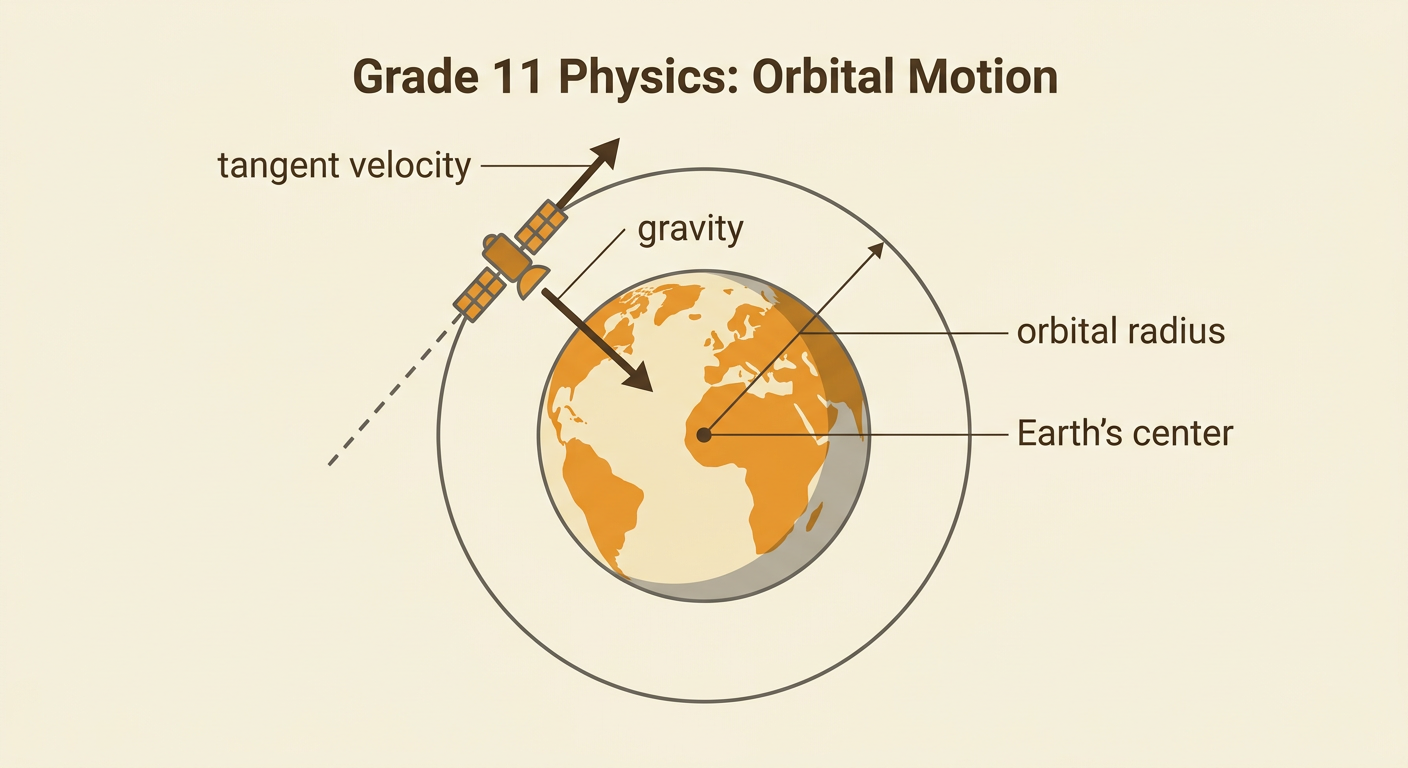
An orbiting object continually changes direction, so it has an inward acceleration even when its speed is constant. For a circular orbit, gravity supplies the required centripetal force. Setting gravitational force equal to centripetal force gives GMm/r² = mv²/r. The orbiting object’s mass m cancels, producing v = √(GM/r). This result predicts the speed needed for a circular orbit of radius r around a central mass M. For example, a satellite 400 kilometers above Earth has an orbital radius of about 6.77 × 10⁶ meters, measured from Earth’s center. Its predicted circular speed is approximately 7.67 kilometers per second. The satellite’s velocity points tangent to the orbit, while gravitational force and centripetal acceleration point inward toward Earth’s center. Without gravity, the satellite would move along a straight-line path tangent to the orbit.
Predicting and Explaining Orbital Motion
An orbit occurs when an object’s forward motion combines with continuous gravitational acceleration toward a larger body. In a circular orbit, speed and radius remain constant; in an elliptical orbit, both distance and speed change. A planet or satellite moves faster when it is closer to the central body because gravity is stronger there. Orbital models can predict period as well as speed. For a circular orbit, T = 2π√(r³/GM). A geostationary satellite orbits about 42,164 kilometers from Earth’s center and has a period of approximately 24 hours, matching Earth’s rotation. A precise evidence-based claim is that gravity persists in orbit because measured orbital speeds and periods agree with gravitational predictions. A counterclaim says astronauts float because there is no gravity. However, this claim fails to explain orbital acceleration; astronauts float because they and their spacecraft are falling together around Earth.
