
How the U.S. Government Works
The three branches, checks and balances, and how a bill becomes a law.
Illustrations are auto-generated and may be placeholders. They can be refreshed to match the narration.
Three branches
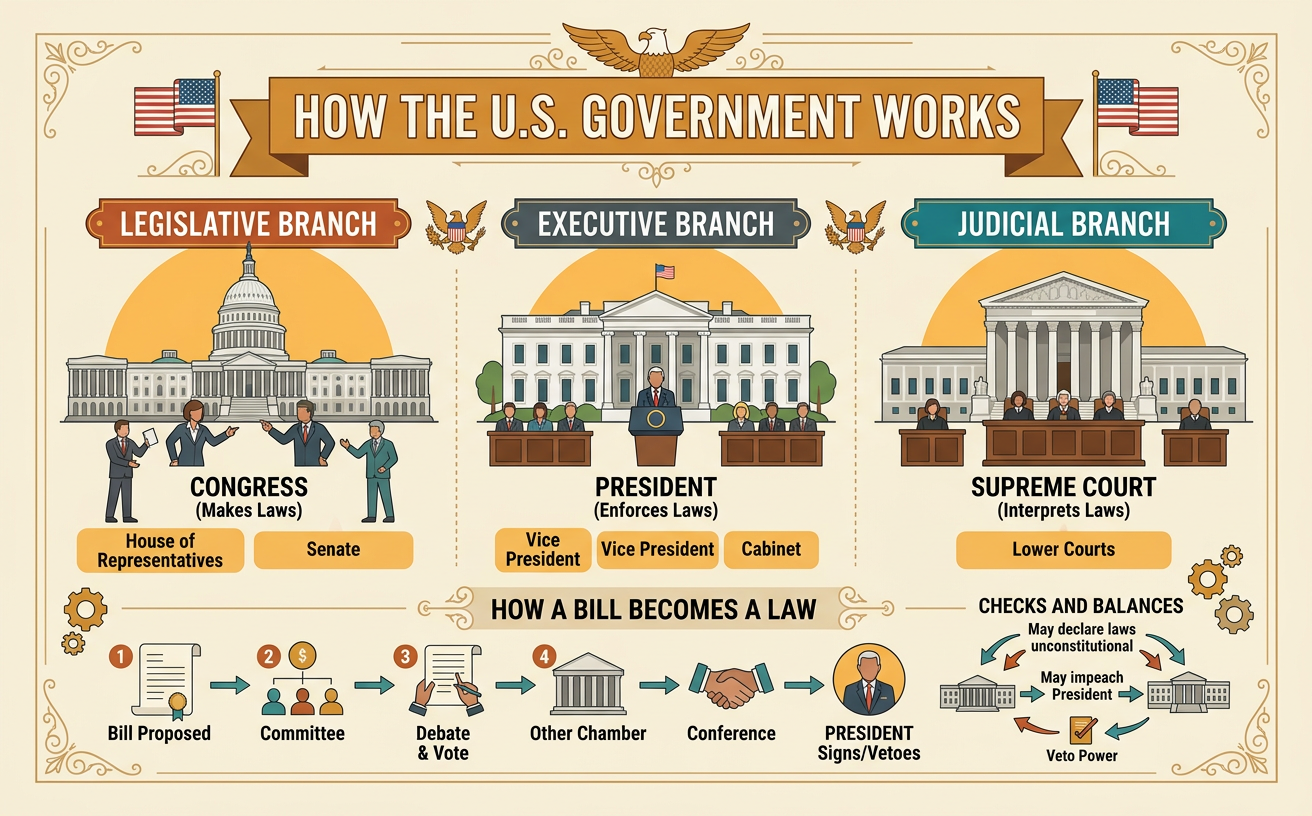
The Constitution divides federal power into three branches. Congress (legislative) writes laws, the President and executive agencies carry them out, and the federal courts (judicial) interpret them and judge whether laws follow the Constitution.
Checks and balances
No branch acts alone. Congress passes a bill, but the President can veto it; Congress can override a veto with a two-thirds vote. The President nominates judges, but the Senate must confirm them. The Supreme Court can strike down laws it finds unconstitutional.
How a bill becomes a law
A bill is introduced in the House or Senate, studied in committee, debated and voted on, then sent to the other chamber. Once both chambers pass identical text, it goes to the President to sign into law or veto.