Using Context and Word Parts to Determine Meaning
Students determine the meanings of unfamiliar words by applying context clues, Greek and Latin affixes and roots, and reference tools.

Illustrations are auto-generated and may be placeholders. They can be refreshed to match the narration.
Identify the Unfamiliar Word
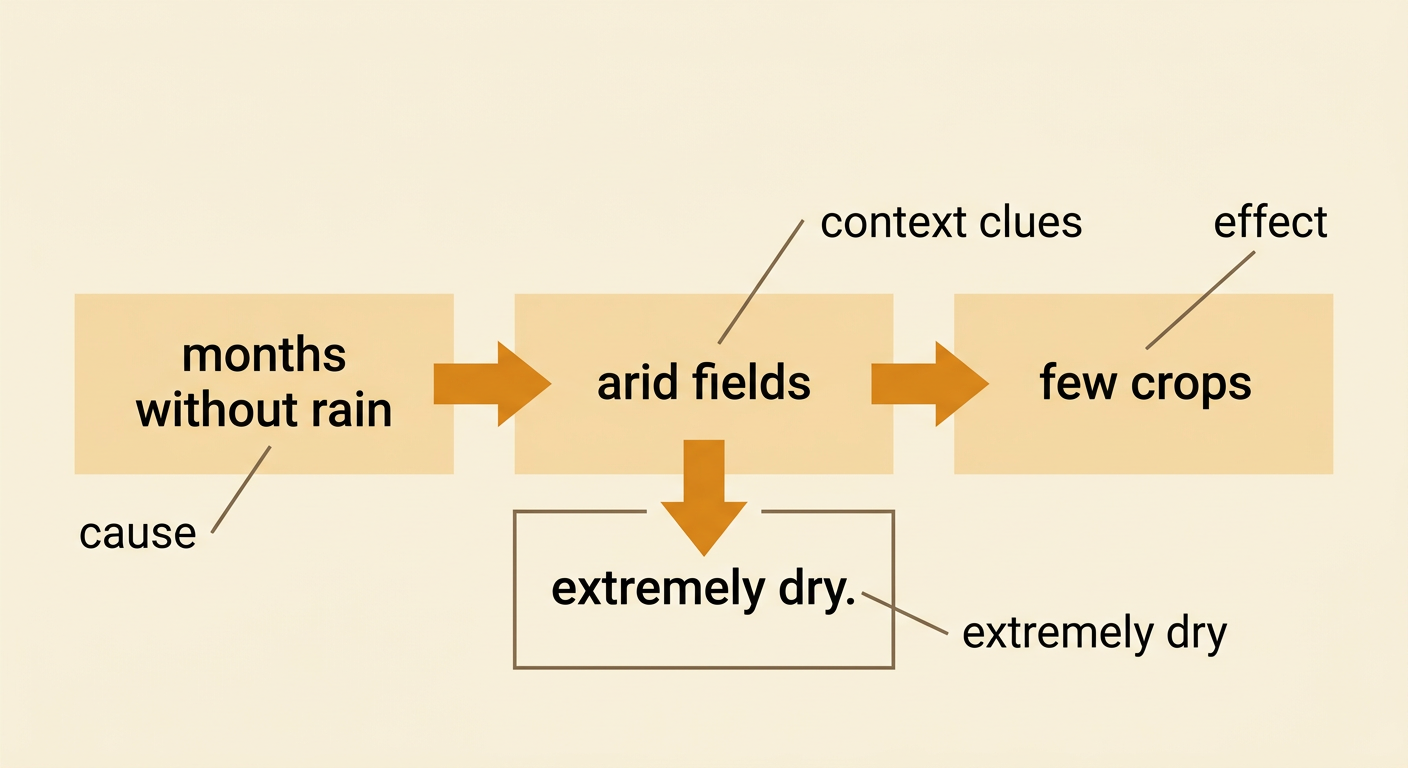
When you meet an unfamiliar word, first identify exactly which word is causing confusion. Read the entire sentence without stopping, and mark the unknown word. Then notice its job in the sentence. Is it naming a person, place, thing, or idea? Is it showing an action, describing something, or modifying an action? This grammatical role can narrow the possible meanings. For example, consider, “After months without rain, the arid fields produced few crops.” The word arid may be unfamiliar, but its position before fields shows that it is an adjective describing the fields. Also ask whether the word might have more than one meaning. Identifying the word, its sentence position, and its part of speech prepares you to examine other clues without making a random guess.

Examine Context Clues
Context clues are words, phrases, and ideas near an unfamiliar word that suggest its meaning. Look in the same sentence and in the sentences before and after it. Common clues include definitions, examples, synonyms, antonyms, contrasts, and causes or effects. In “After months without rain, the arid fields produced few crops,” the phrase “months without rain” describes a cause, while “produced few crops” describes an effect. Together, these clues suggest that arid means extremely dry. Test that meaning by replacing the unfamiliar word: “The extremely dry fields produced few crops.” The sentence still makes sense. Remember that a context clue may suggest only part of a word’s meaning. Gather more than one clue when possible, and avoid selecting a meaning simply because it sounds familiar.
Break Down Roots and Affixes
Word parts can reveal meaning when context alone is not enough. A prefix appears at the beginning of a word, a root carries the central meaning, and a suffix appears at the end and may change the word’s meaning or grammatical role. Consider predictable in the sentence, “Because the bus arrived at the same time every day, its schedule was predictable.” The prefix pre- means “before,” the Latin root dict means “say,” and the suffix -able means “capable of.” Combined, predictable literally suggests “capable of being said beforehand,” or able to be expected. The repeated schedule supports that meaning. Word parts are clues, not automatic answers, because some words have changed meaning over time. Always combine your knowledge of roots and affixes with the surrounding context.

Confirm Meaning with Reference Tools
After forming a likely meaning, confirm it with an appropriate reference tool. A dictionary provides definitions, pronunciations, parts of speech, word origins, and sample sentences. A glossary explains specialized terms used in a particular text or subject. A thesaurus lists related words, but its synonyms may have different shades of meaning, so it should not replace a dictionary. Suppose a science text says, “Electrons carry a negative charge.” A dictionary lists several meanings for charge, including a price, an accusation, a sudden movement, and an electrical property. The science context shows that the electrical definition is correct. Check that the definition matches both the topic and the word’s grammatical role. Digital tools can be useful, but choose reliable dictionaries or academic glossaries rather than accepting the first search result.

Apply the Meaning in Context
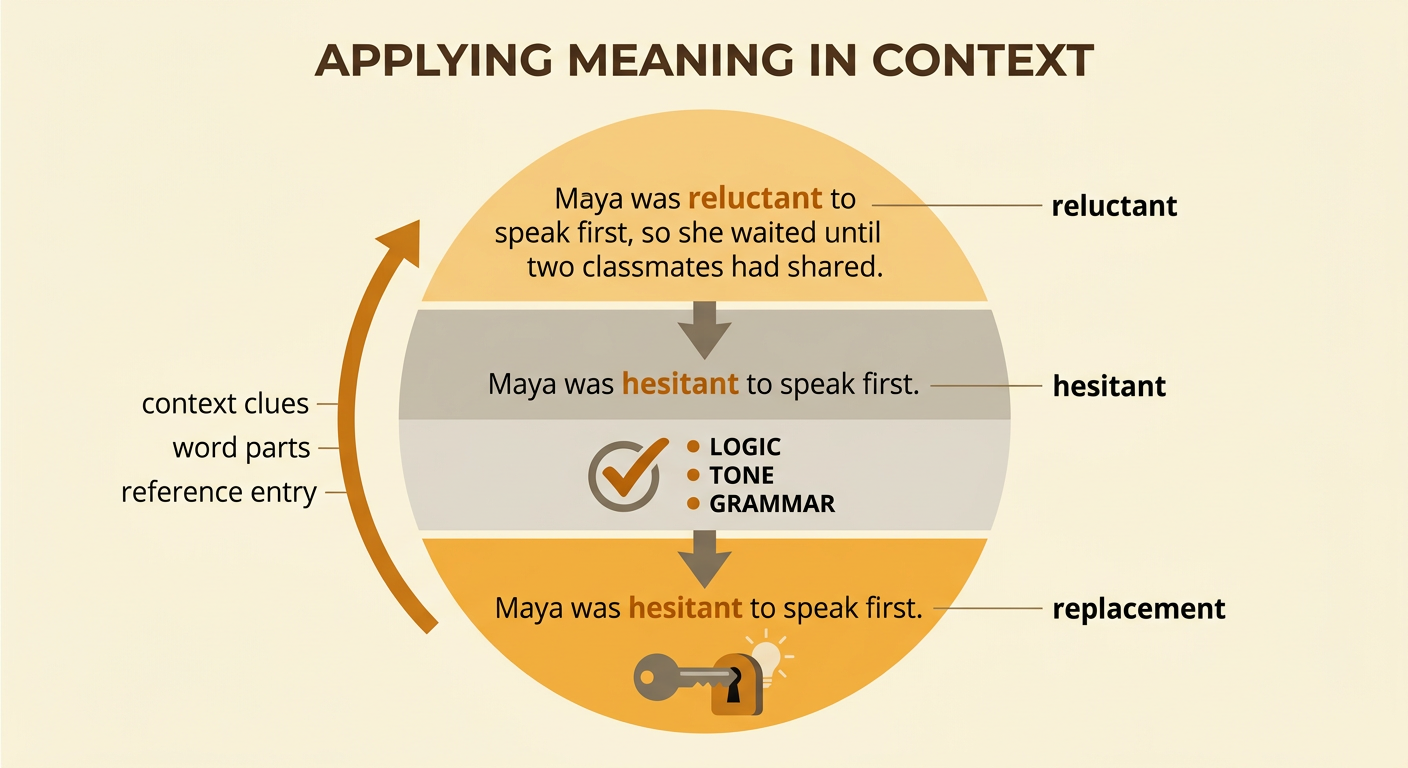
The final step is to apply the confirmed meaning to the original passage. Replace the unfamiliar word with a short definition and reread the sentence. Check whether the replacement preserves the sentence’s logic, tone, and grammar. For example, consider, “Maya was reluctant to speak first, so she waited until two classmates had shared.” Context suggests that reluctant means unwilling or hesitant. Substituting the definition gives, “Maya was hesitant to speak first,” which matches her decision to wait. Next, explain the meaning in your own words or use the word in a new sentence: “I was reluctant to enter the contest because I had never performed in public.” Correct application shows more understanding than simply copying a definition. If the replacement creates confusion, return to the context, word parts, or reference entry and reconsider your choice.