Using Context Clues to Determine Word Meaning
Students use clues in nearby words and sentences to determine the meaning of unfamiliar words in a grade-level text.

Illustrations are auto-generated and may be placeholders. They can be refreshed to match the narration.
Meet an Unfamiliar Word
An unfamiliar word is a word you do not know or cannot explain yet. When you meet one, do not stop reading right away. Read the whole sentence and notice what is happening. For example, read: “Maya was famished after soccer practice, so she quickly ate two sandwiches and an apple.” You may not know the word “famished,” but you can mark it as the word to investigate. Ask yourself, “What is Maya doing, and why?” She eats a large amount of food quickly after exercising. Those details can help you understand the unfamiliar word. Remember that readers do not need to know every word at first. Strong readers pause, stay curious, and gather information from the words and sentences around the unfamiliar word.

Look for Nearby Clues
Context clues are helpful words and details near an unfamiliar word. They may tell what happened, describe an action, give an example, or show an opposite idea. Read: “The tiny kitten was timid. It hid behind the chair when visitors entered and would not come out.” The actions “hid behind the chair” and “would not come out” are clues about “timid.” They show that the kitten does not feel bold or comfortable around visitors. Sometimes the best clue is in the same sentence. Other times it appears in the sentence before or after the word. Reread nearby sentences and look for details that connect to the unfamiliar word. Ignore details that do not help explain it. Useful clues should make the sentence’s events and ideas fit together.

Infer the Word’s Meaning
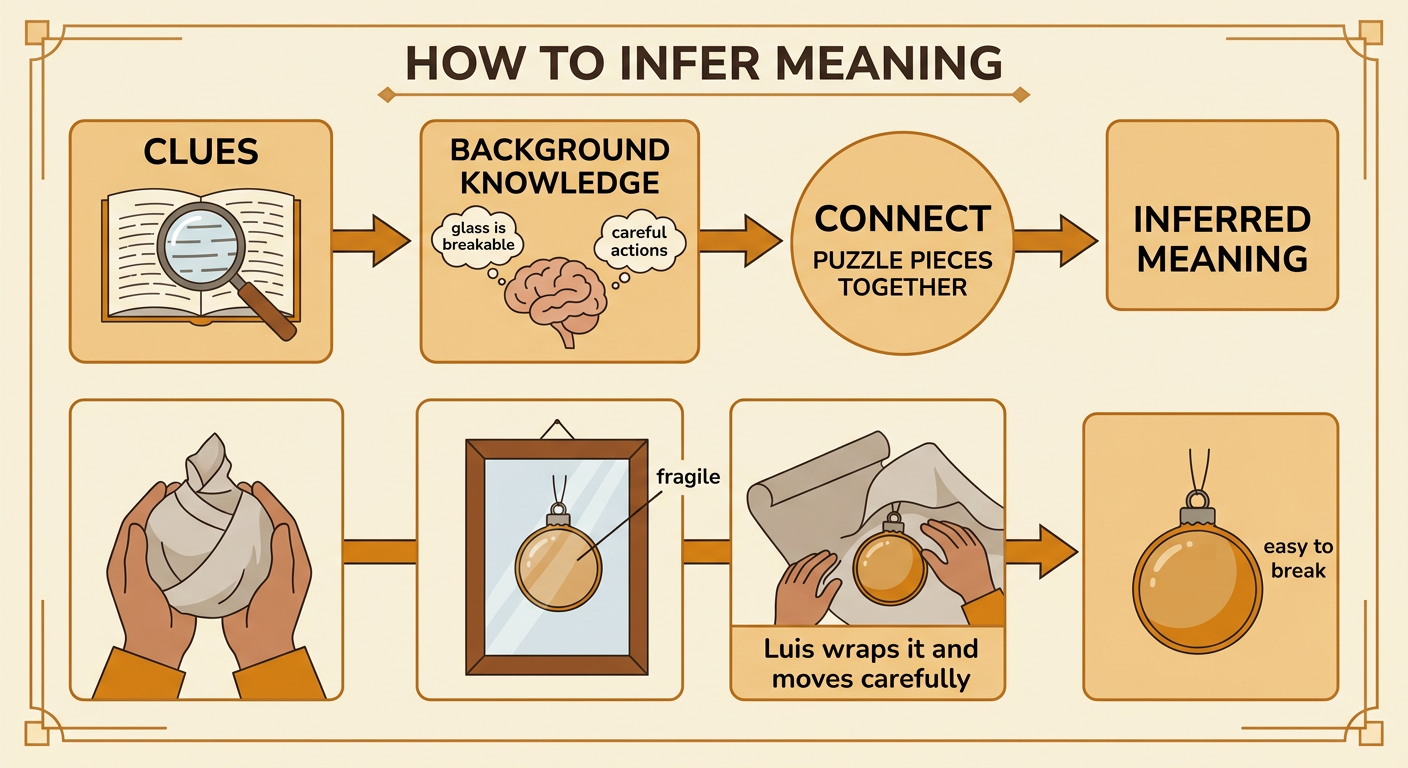
To infer means to make a smart guess using clues and what you already know. First, collect the useful context clues. Next, think about how they connect. Then state a possible meaning in your own words. Consider this sentence: “The glass ornament was fragile, so Luis wrapped it in soft paper and carried it carefully.” The words “glass,” “wrapped it,” and “carefully” suggest that the ornament could be damaged easily. You can infer that “fragile” means easy to break. Your inferred meaning does not need to sound like a dictionary definition. It only needs to express the correct idea clearly. Do not make a random guess based only on the word’s sound. A strong inference is supported by specific details from the text.
Check the Meaning in Context
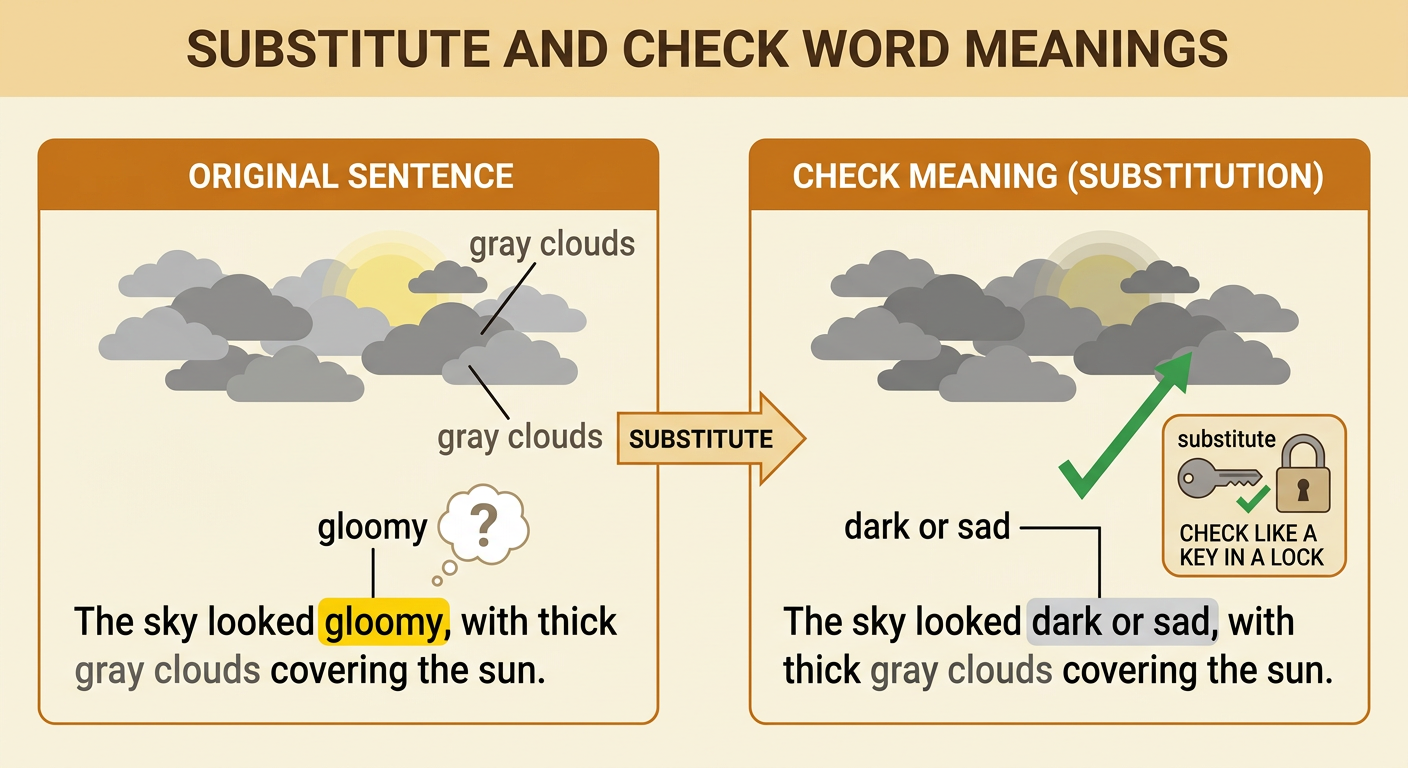
After you infer a meaning, check whether it makes sense in the original sentence. Replace the unfamiliar word with your meaning and reread. For example, suppose you infer that “gloomy” means dark or sad in this sentence: “The sky looked gloomy, with thick gray clouds covering the sun.” Substitute your meaning: “The sky looked dark or sad, with thick gray clouds covering the sun.” The idea fits the clues, especially “gray clouds” and “covering the sun.” If your replacement makes the sentence confusing or changes its main idea, look for more clues and revise your meaning. You can also check a glossary or dictionary after using context. The definition should match the way the word is used in that particular sentence because some words have more than one meaning.
Practice with a Short Passage
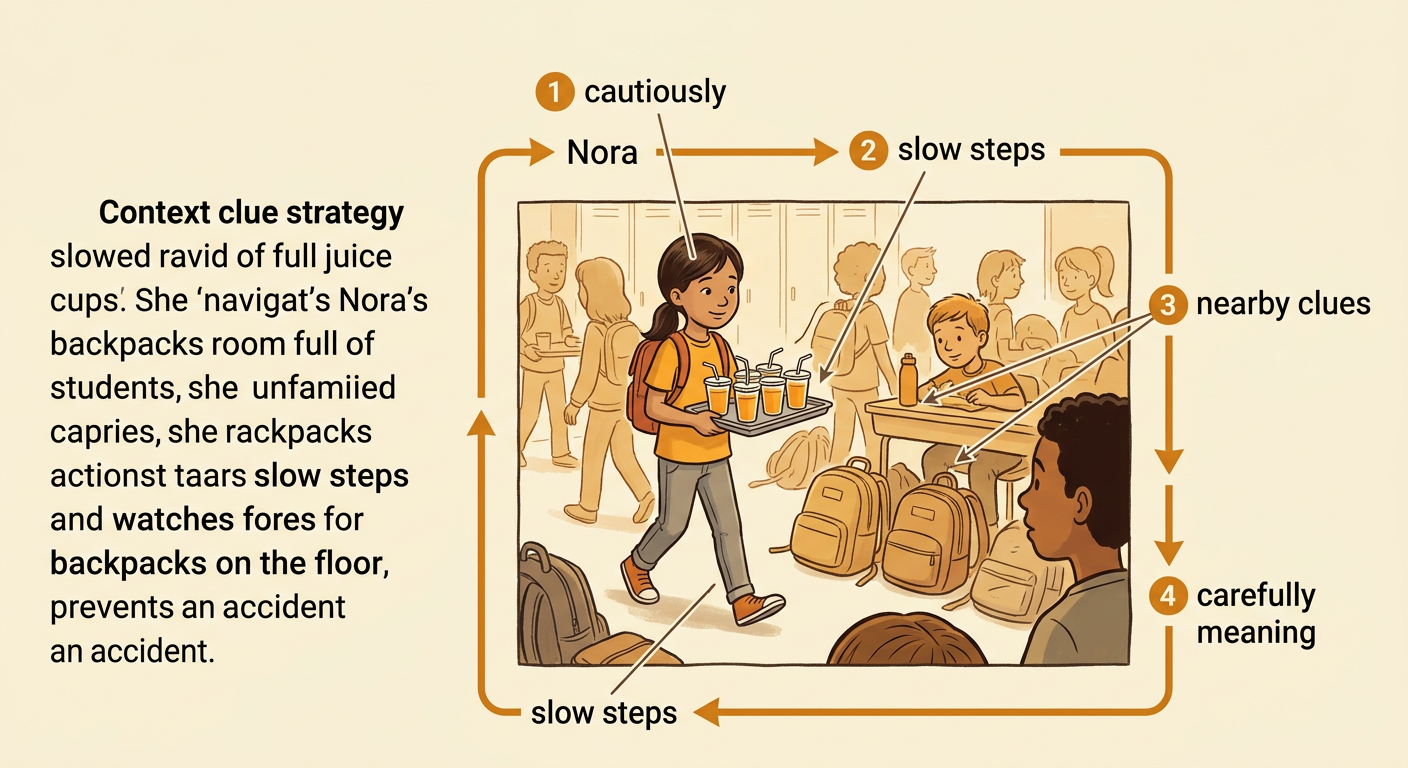
Read this passage: “Nora carried a tray of juice across the crowded room. She moved cautiously, taking slow steps and watching for backpacks on the floor. At last, she set the tray safely on the table.” What does “cautiously” mean? First, identify the unfamiliar word. Then find nearby clues. Nora takes “slow steps,” watches for obstacles, and gets the tray to the table safely. These actions show that she is trying to prevent an accident. You can infer that “cautiously” means carefully or in a way that avoids danger. Check the meaning by substituting “carefully”: “She moved carefully, taking slow steps.” The sentence still makes sense. Use the same steps whenever you meet a new word: notice the word, gather nearby clues, infer a meaning, and check that meaning in context.