Using Pronouns in the Correct Case
Students distinguish subjective, objective, and possessive pronouns and select the correct pronoun case in sentences.

Illustrations are auto-generated and may be placeholders. They can be refreshed to match the narration.
Reviewing Pronouns and Antecedents
A pronoun is a word that takes the place of a noun. The noun or noun phrase to which a pronoun refers is called its antecedent. In the sentence “Maya finished her project,” Maya is the antecedent of her. A pronoun should clearly match its antecedent in number. A singular antecedent usually takes a singular pronoun, while a plural antecedent takes a plural pronoun. For example, “The players packed their uniforms” correctly connects the plural antecedent players with the plural pronoun their. Pronouns help writers avoid unnecessary repetition, but unclear pronouns can confuse readers. In “When Ava spoke to Lena, she smiled,” the reader may not know who she refers to. Replacing she with Ava or Lena makes the meaning clear. Identifying the antecedent helps you decide which pronoun form belongs in a sentence.

Identifying the Three Pronoun Cases
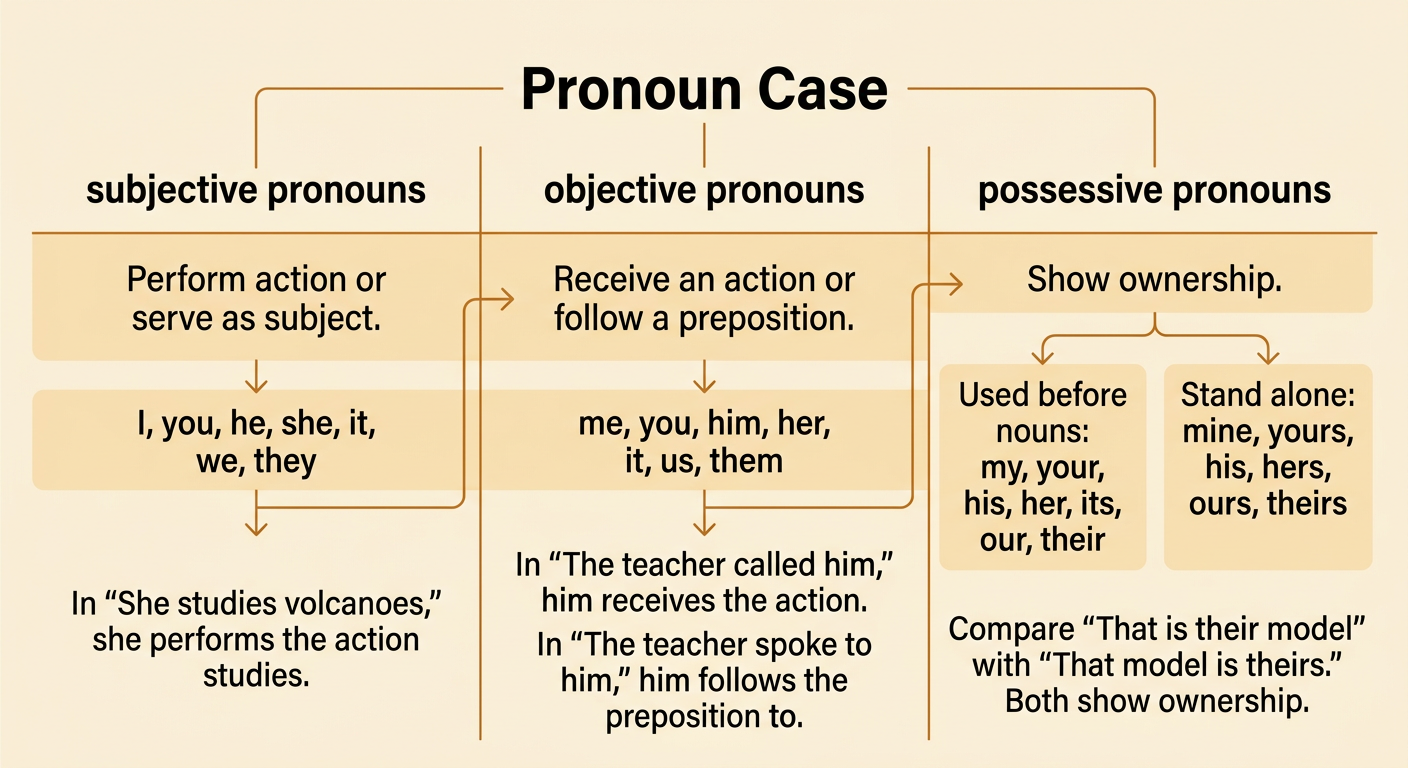
Pronoun case is the form a pronoun takes based on its job in a sentence. Subjective pronouns act as subjects: I, you, he, she, it, we, and they. In “She studies volcanoes,” she performs the action. Objective pronouns receive an action or follow a preposition: me, you, him, her, it, us, and them. In “The teacher called him,” him receives the action. In “The teacher spoke to him,” him follows the preposition to. Possessive pronouns show ownership. Forms used before nouns include my, your, his, her, its, our, and their. Forms that can stand alone include mine, yours, his, hers, ours, and theirs. For example, “That is their model” and “That model is theirs” both show ownership. Possessive pronouns do not use apostrophes.
Choosing Pronouns by Sentence Function
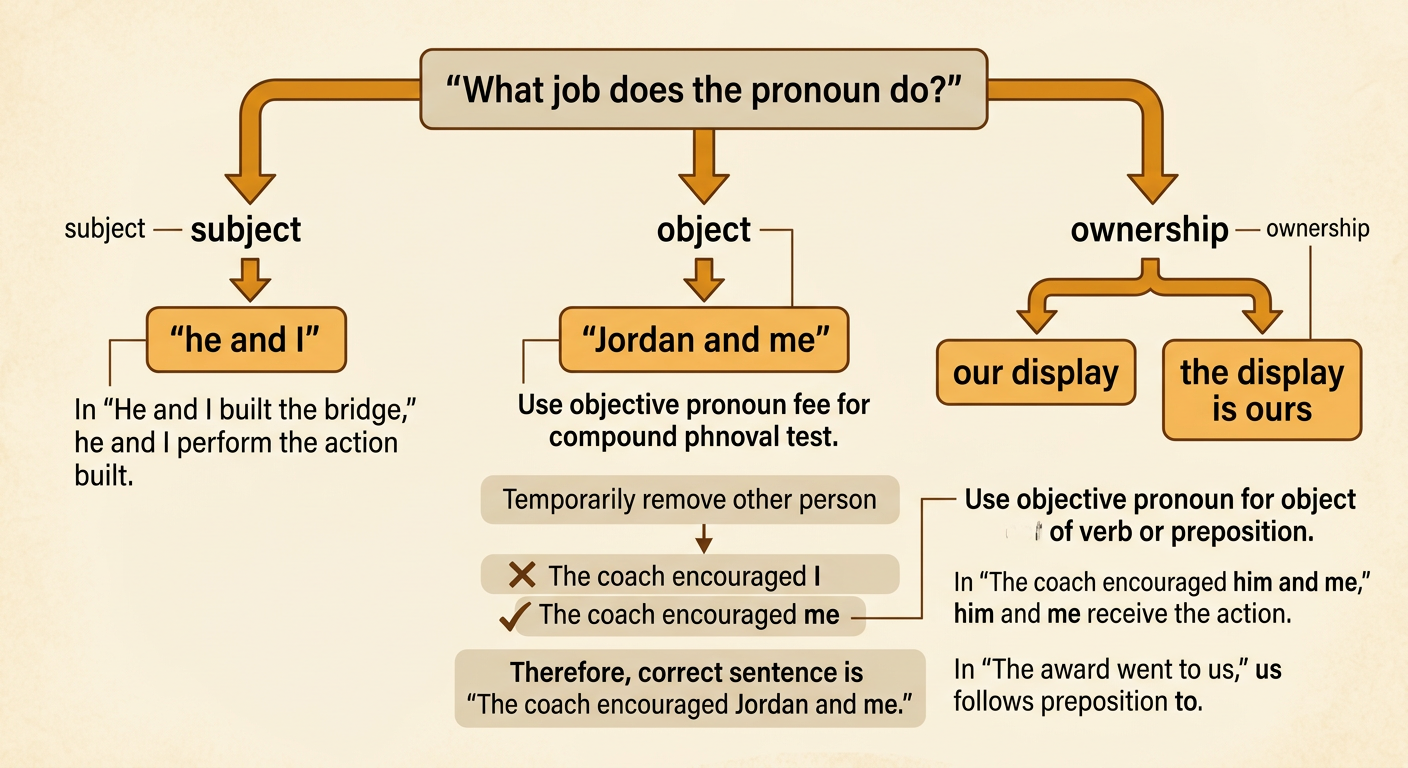
To choose the correct case, first identify the pronoun’s function. Use a subjective pronoun when it is the subject of a verb: “He and I built the bridge.” Use an objective pronoun when it is the object of a verb or preposition: “The coach encouraged him and me” and “The award went to us.” Compound phrases can make the choice seem difficult. Test a compound by temporarily removing the other person. “The coach encouraged I” sounds incorrect, but “The coach encouraged me” is correct, so write “The coach encouraged Jordan and me.” Do not choose a pronoun simply because it sounds more formal. For possession, decide whether a noun follows. Write “This is our display” before a noun, but write “This display is ours” when the possessive pronoun stands alone.
Correcting Pronoun Case Errors
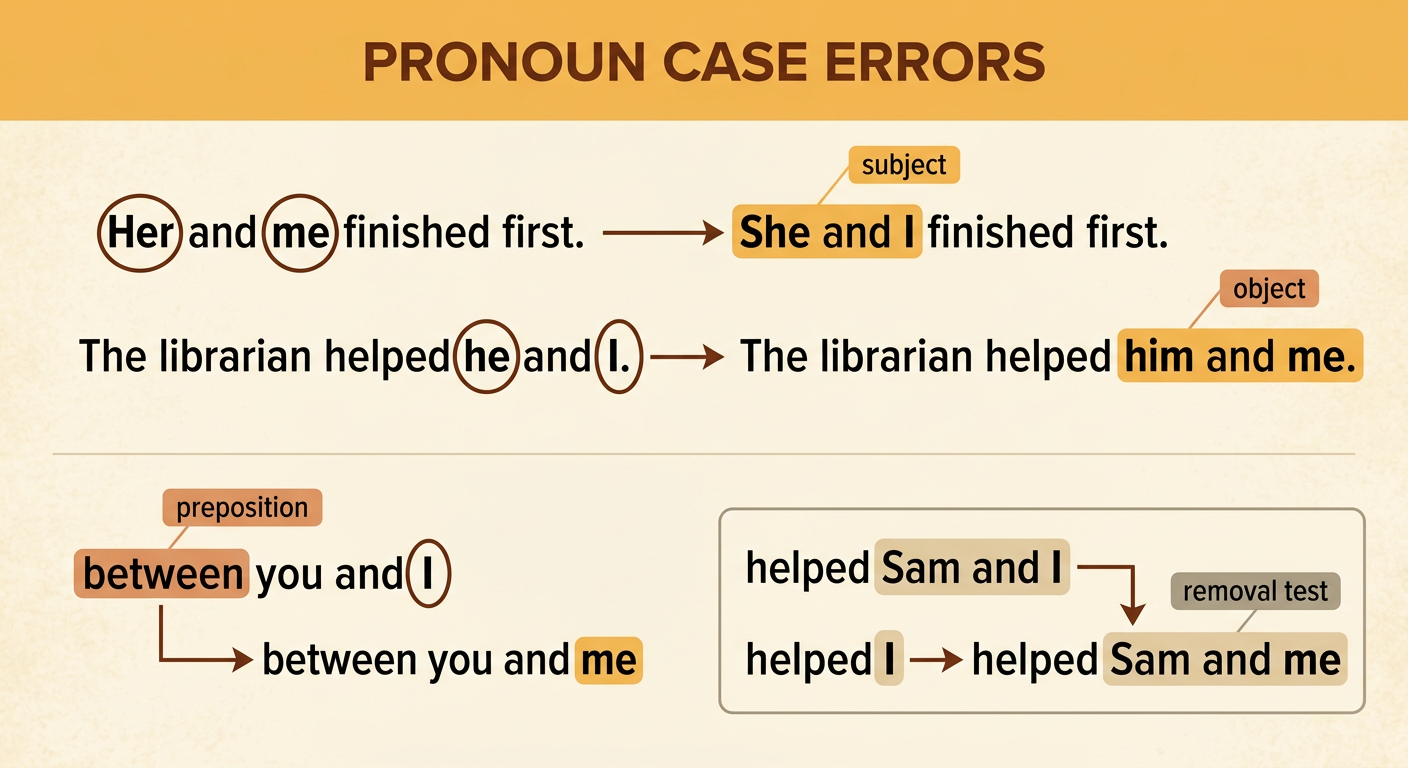
Pronoun case errors occur when a pronoun’s form does not match its function. In “Her and me finished first,” both pronouns are subjects, so the correction is “She and I finished first.” In “The librarian helped he and I,” the pronouns receive the action helped. The correct sentence is “The librarian helped him and me.” Pronouns that follow prepositions must also use the objective case. Change “between you and I” to “between you and me” because between is a preposition. To correct an error, find the verb, locate its subject, and identify any objects. Then check for pronouns following prepositions such as to, for, with, from, or between. Finally, read the revised sentence without any extra name or noun in a compound phrase. This removal test often makes the correct case easy to hear.
Applying Pronoun Case in Writing
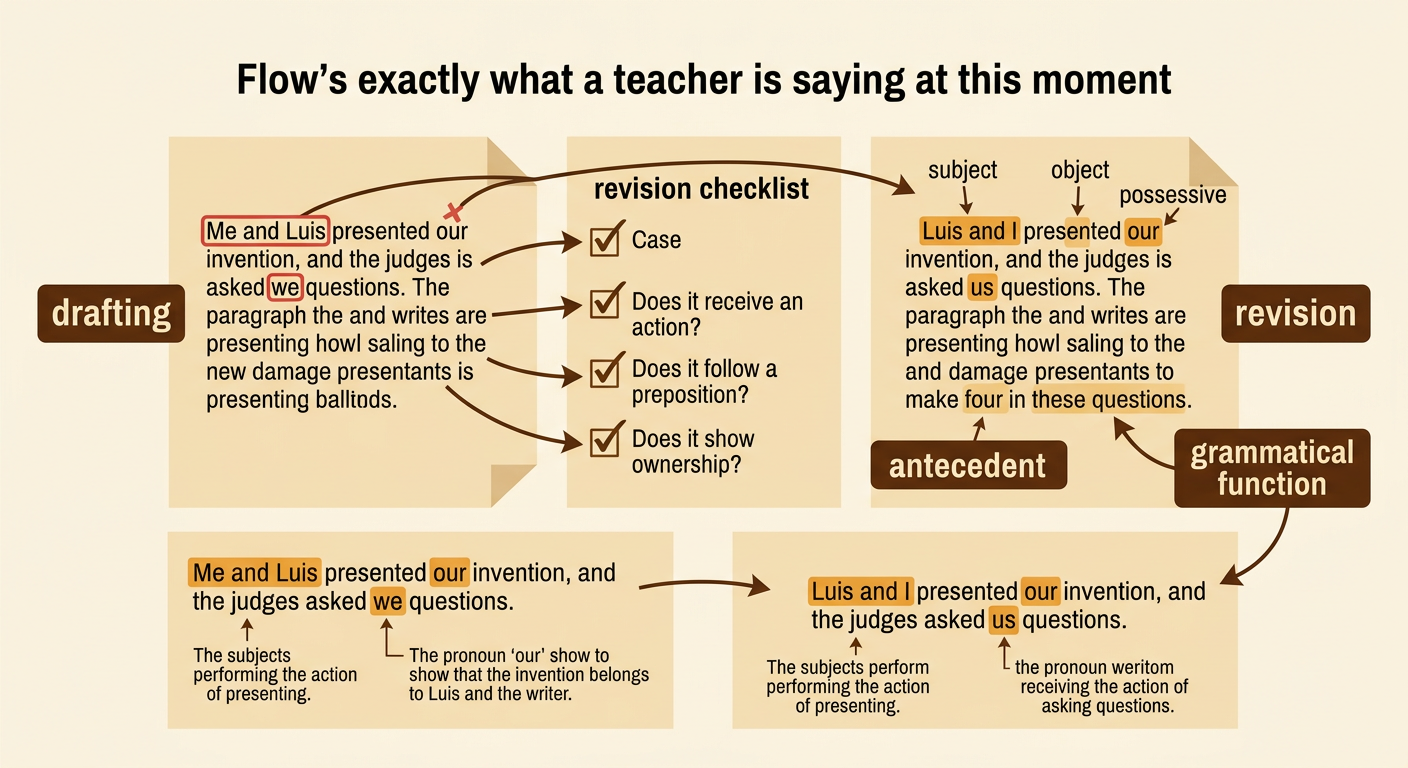
Use correct pronoun case when drafting and revising stories, explanations, and arguments. During drafting, focus on expressing your ideas. During revision, circle each pronoun and determine its job. Ask whether it performs an action, receives an action, follows a preposition, or shows ownership. For example, a student might draft, “Me and Luis presented our invention, and the judges asked we questions.” Revision changes the subjects to “Luis and I” and the object to “us”: “Luis and I presented our invention, and the judges asked us questions.” The possessive pronoun our is already correct because it shows that the invention belongs to Luis and the writer. Also check that every pronoun has a clear antecedent. Reading your work aloud and using the removal test can reveal errors, but always confirm the choice by identifying the pronoun’s grammatical function.