Using the Associative Property of Multiplication
Students regroup three factors to make multiplication problems easier without changing the product.
Illustrations are auto-generated and may be placeholders. They can be refreshed to match the narration.
Review Factors and Products
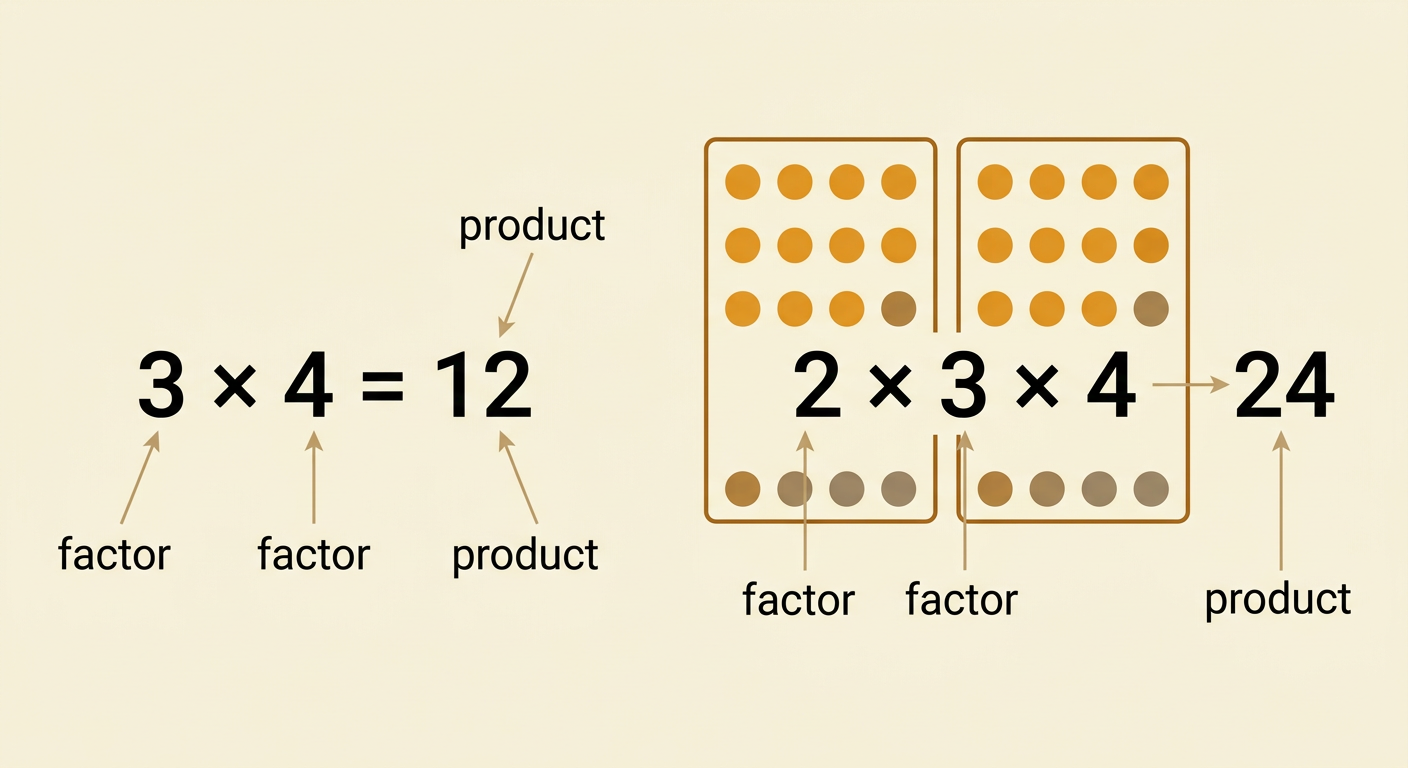
In a multiplication equation, the numbers being multiplied are called factors. The answer is called the product. In 3 × 4 = 12, the factors are 3 and 4, and the product is 12. Sometimes an equation has three factors, such as 2 × 3 × 4. This expression means that 2, 3, and 4 are all multiplied. You can think of it as 2 groups, with 3 smaller groups of 4 in each group. Altogether, there are 24 objects. Before regrouping factors, identify each factor and predict the product. Remember that regrouping changes which factors you multiply first, but it does not change the factors themselves.
Explore Different Groupings
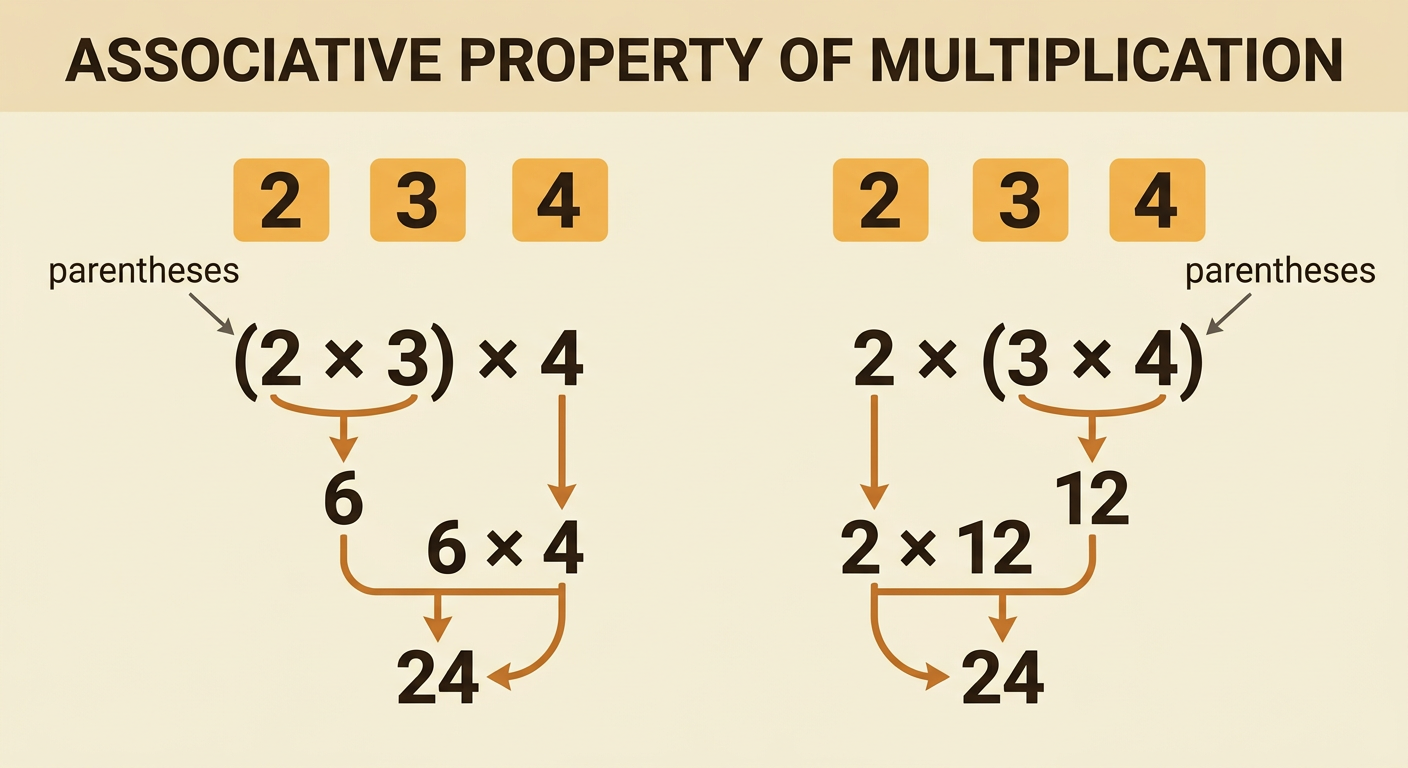
The associative property of multiplication says that three or more factors can be grouped in different ways without changing the product. Parentheses show which factors to multiply first. Compare (2 × 3) × 4 and 2 × (3 × 4). In the first expression, multiply 2 × 3 to get 6, and then multiply 6 × 4 to get 24. In the second expression, multiply 3 × 4 to get 12, and then multiply 2 × 12 to get 24. Both groupings have the same factors in the same order. Only the grouping changes. Since both products equal 24, the equations can be written as (2 × 3) × 4 = 2 × (3 × 4).
Model with Arrays and Equations
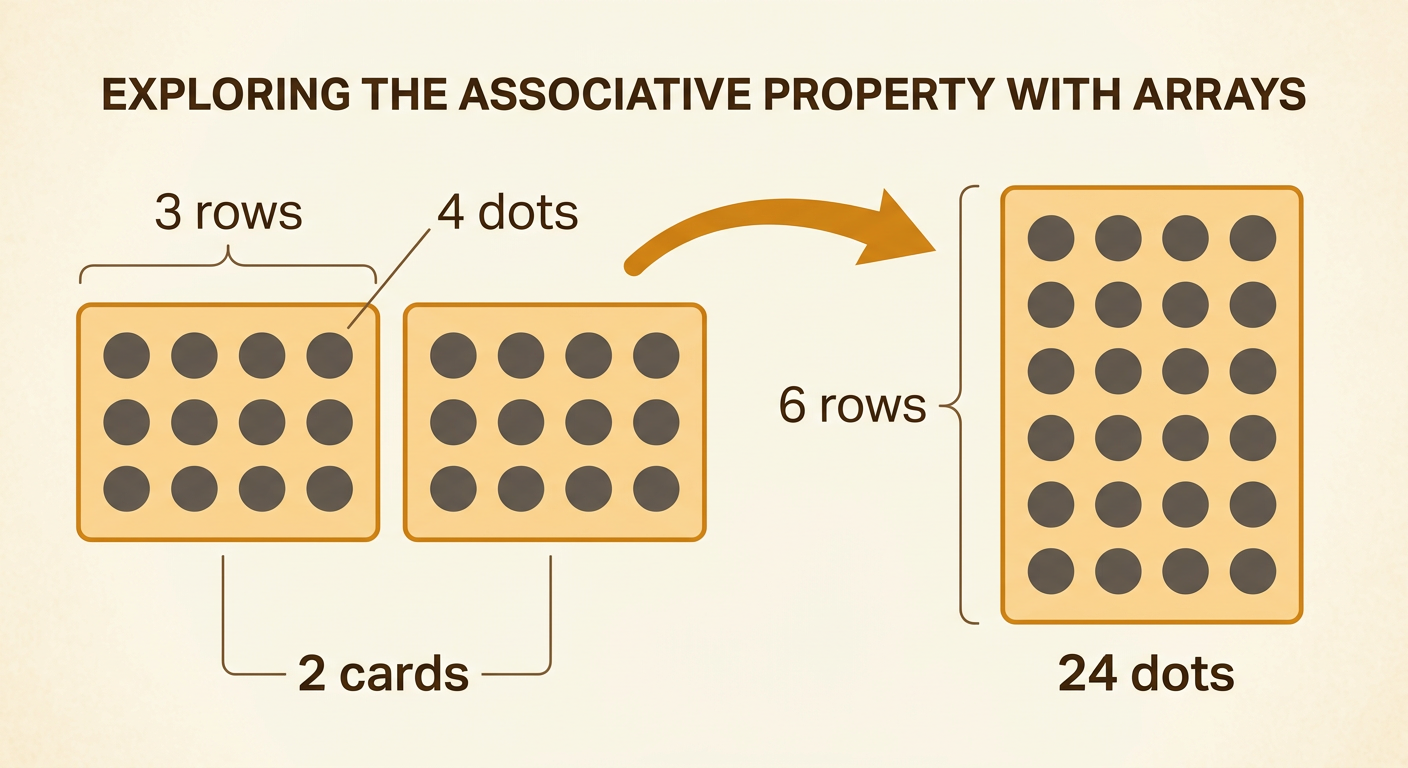
Arrays can show why regrouping works. Imagine two cards. Each card has an array with 3 rows of 4 dots. One card contains 3 × 4, or 12, dots. With two cards, there are 2 × (3 × 4) = 2 × 12 = 24 dots. Now place the two cards so their rows form one larger array. The new array has 6 rows of 4 dots because 2 × 3 = 6. This shows (2 × 3) × 4 = 6 × 4 = 24. No dots were added or removed. The same 24 dots were simply viewed in two ways: as two 3-by-4 arrays or as one 6-by-4 array.
Practice Regrouping Factors
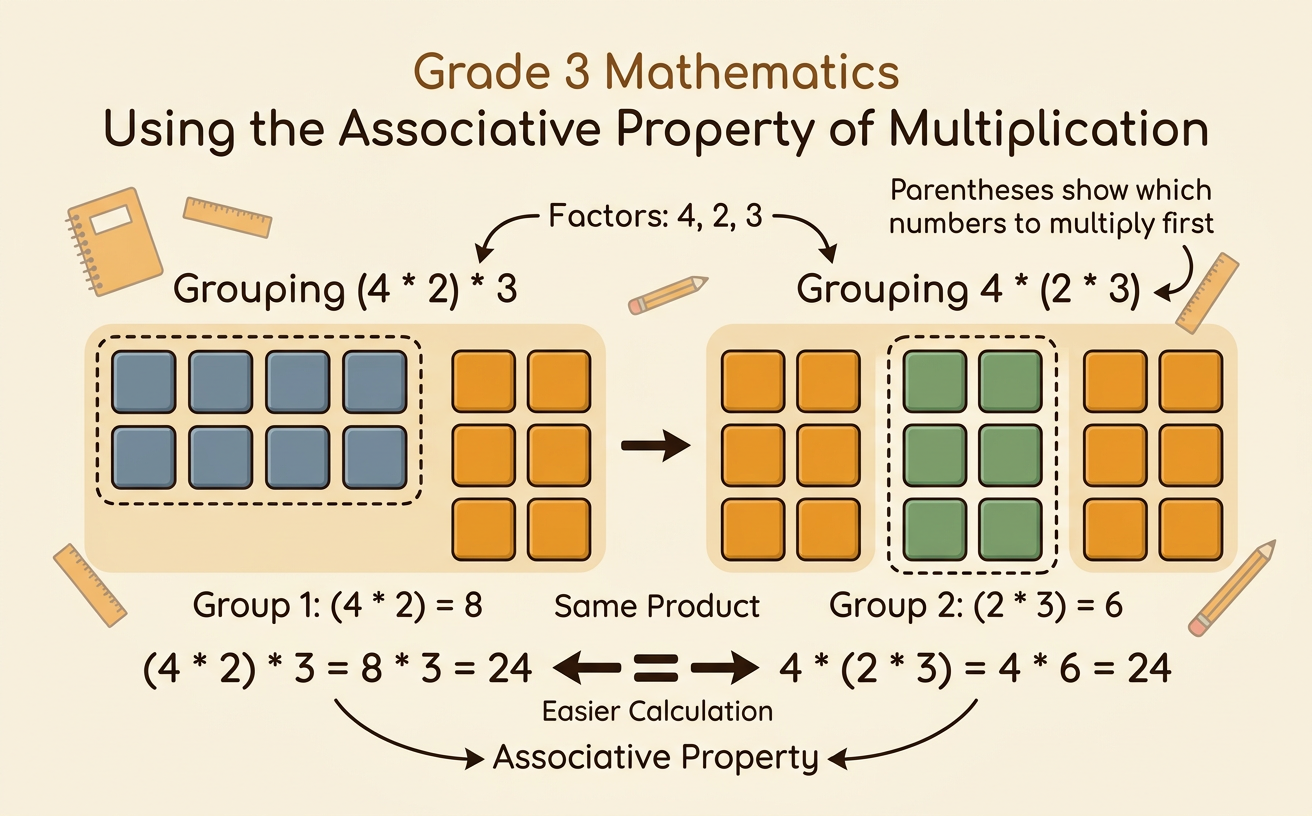
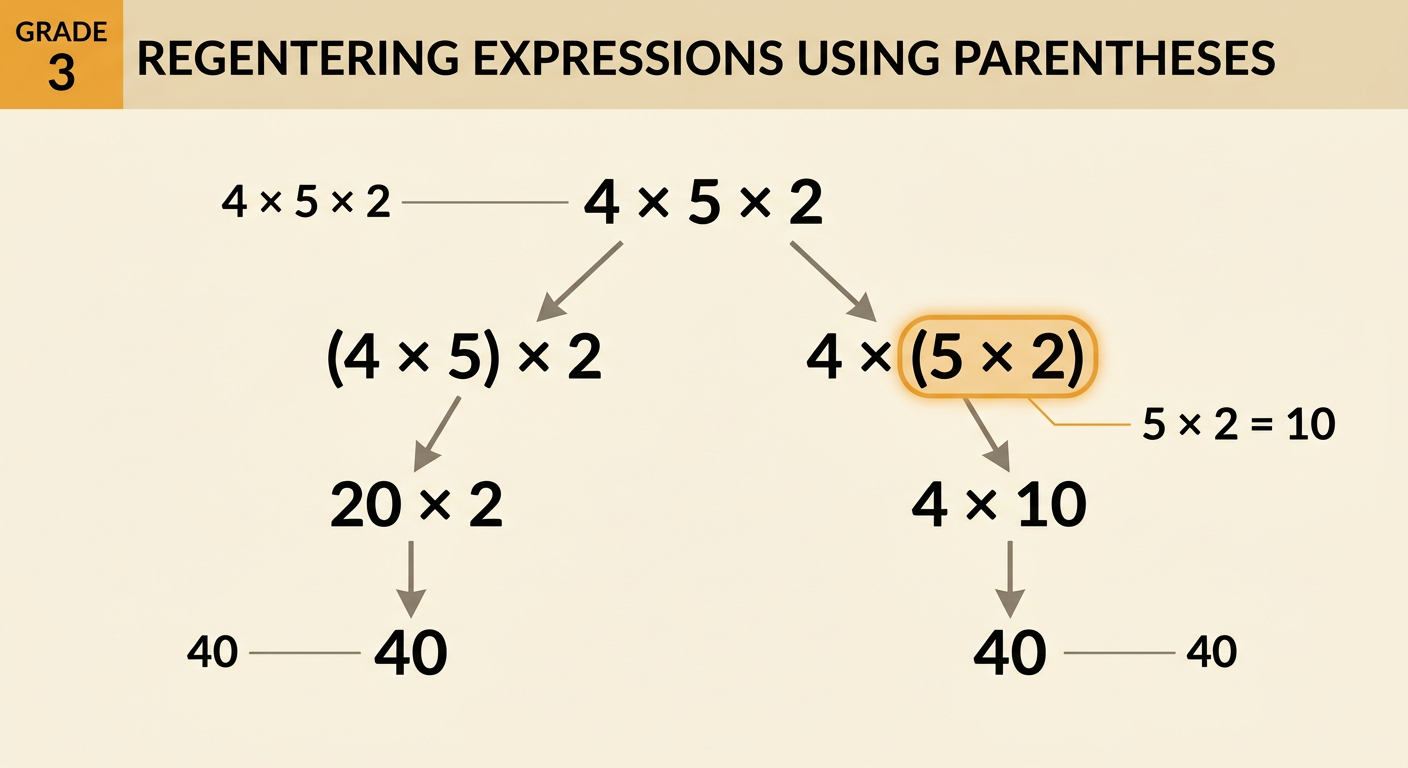
Regrouping can make a multiplication problem easier. Consider 4 × 5 × 2. Multiplying from left to right gives (4 × 5) × 2 = 20 × 2 = 40. A friendlier choice is 4 × (5 × 2). Since 5 × 2 = 10, the expression becomes 4 × 10 = 40. Both methods are correct, but making 10 may be quicker. Look for pairs of factors that create products you know well, such as 2 × 5 = 10, 4 × 5 = 20, or 3 × 10 = 30. When regrouping, keep every factor in the same order and use parentheses to show which pair you will multiply first.
Explain Why the Product Stays the Same
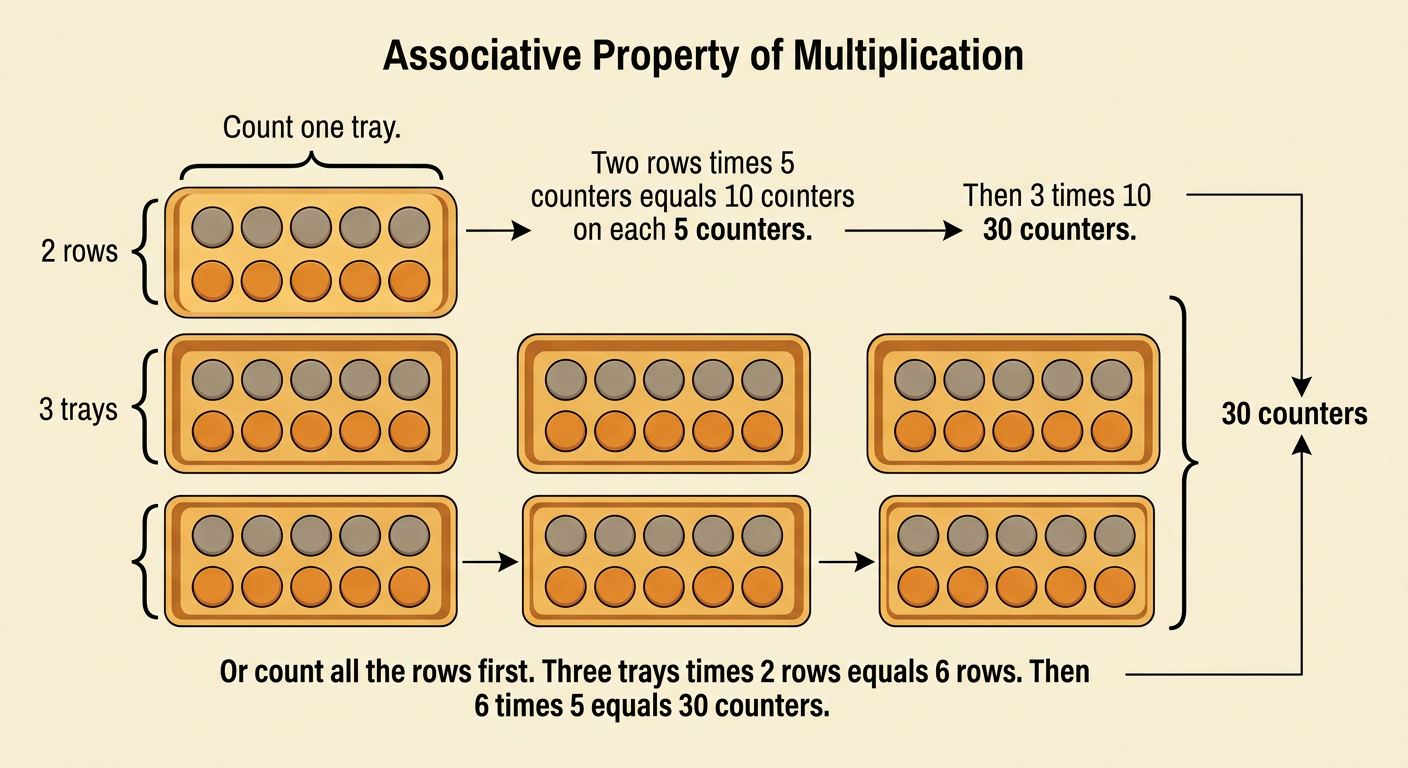
The product stays the same because regrouping does not add, remove, or change any objects. Suppose there are 3 trays, each tray has 2 rows, and each row has 5 counters. You can first count the counters on one tray: 2 × 5 = 10. Then 3 × 10 = 30, so 3 × (2 × 5) = 30. You can also count the total rows first: 3 × 2 = 6. Then 6 × 5 = 30, so (3 × 2) × 5 = 30. Both expressions describe the same trays, rows, and counters. The factors remain 3, 2, and 5. Only the pair multiplied first changes, so the total remains 30.