
Using the Associative Property of Multiplication
Students regroup three factors to make multiplication problems easier while recognizing that the product remains unchanged.
Illustrations are auto-generated and may be placeholders. They can be refreshed to match the narration.
Review Factors and Products
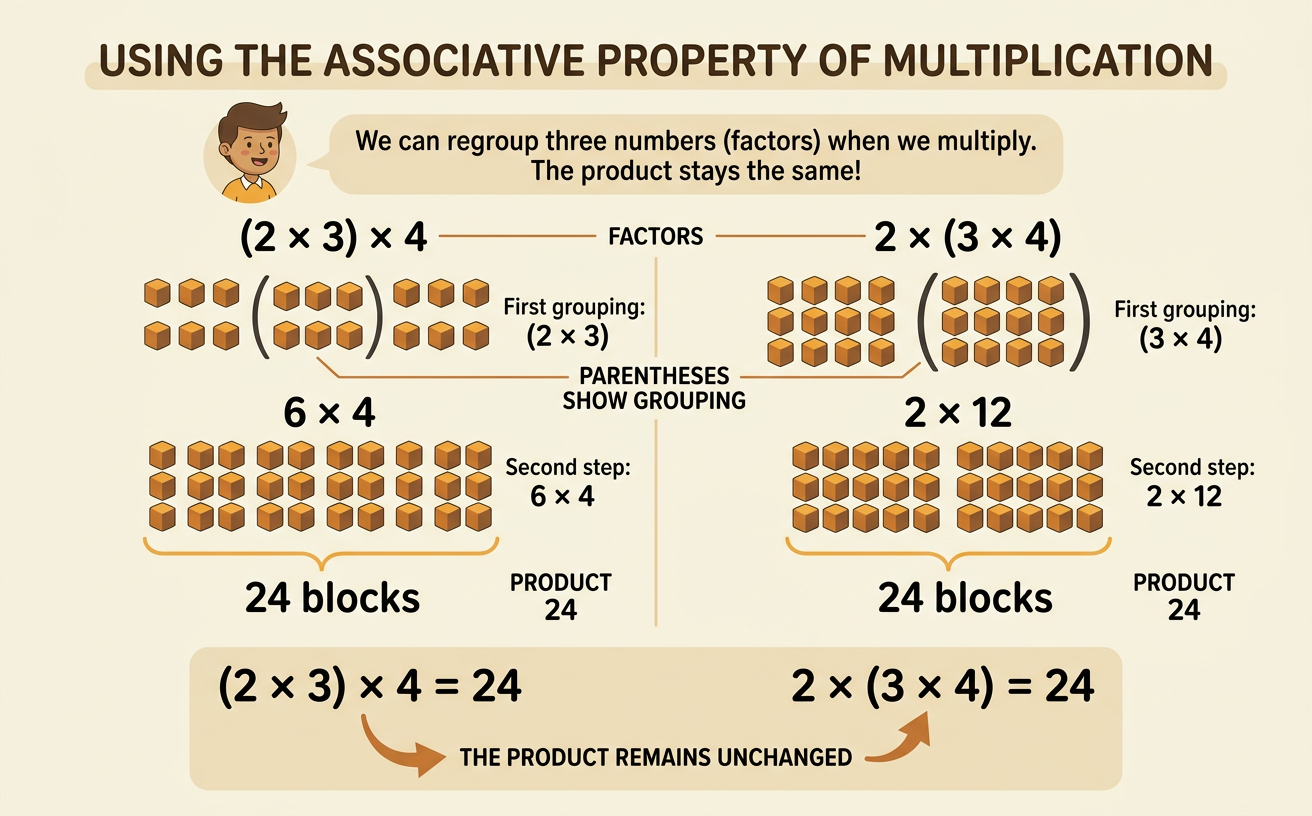
In a multiplication expression, the numbers being multiplied are called factors. The answer is called the product. For example, in 3 × 4 = 12, the factors are 3 and 4, and the product is 12. Multiplication can describe equal groups. Three groups with 4 objects in each group contain 12 objects altogether. When an expression has three factors, all three factors help determine the product. In 2 × 3 × 4, the factors are 2, 3, and 4. You can multiply the first two factors and then multiply by the third: 2 × 3 = 6, and 6 × 4 = 24. The product of 2 × 3 × 4 is 24.

Model Regrouping with Equal Groups
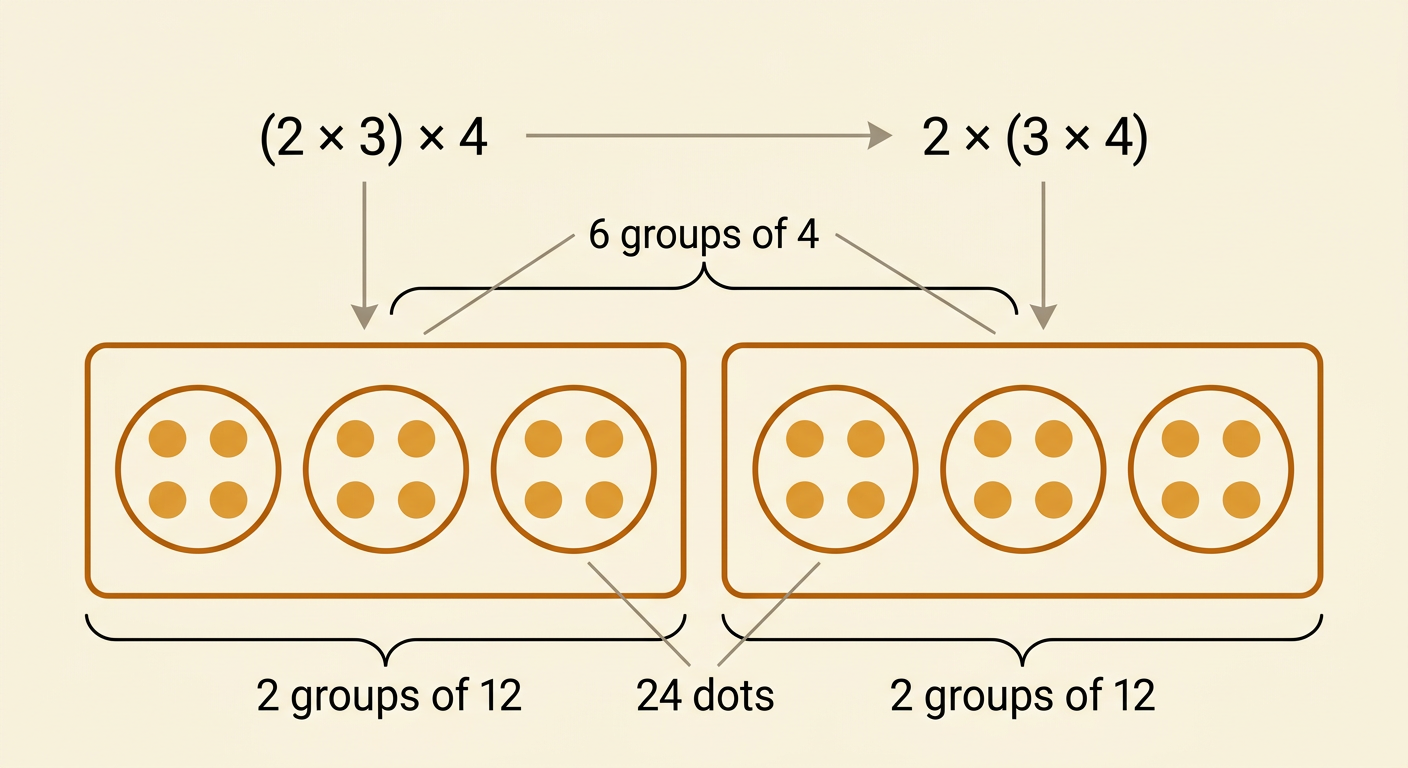
The associative property of multiplication says that you can change which factors are grouped together without changing their order or product. Consider (2 × 3) × 4. First, combine 2 groups of 3 to make 6. Then find 6 × 4, which equals 24. Now regroup the same factors as 2 × (3 × 4). First, combine 3 × 4 to get 12. Then find 2 × 12, which also equals 24. A model can show 2 large groups. Each large group has 3 smaller groups with 4 dots in each one. You may view the model as 6 groups of 4 or as 2 groups of 12. The grouping changes, but the 24 dots stay the same.
Write Equivalent Multiplication Expressions
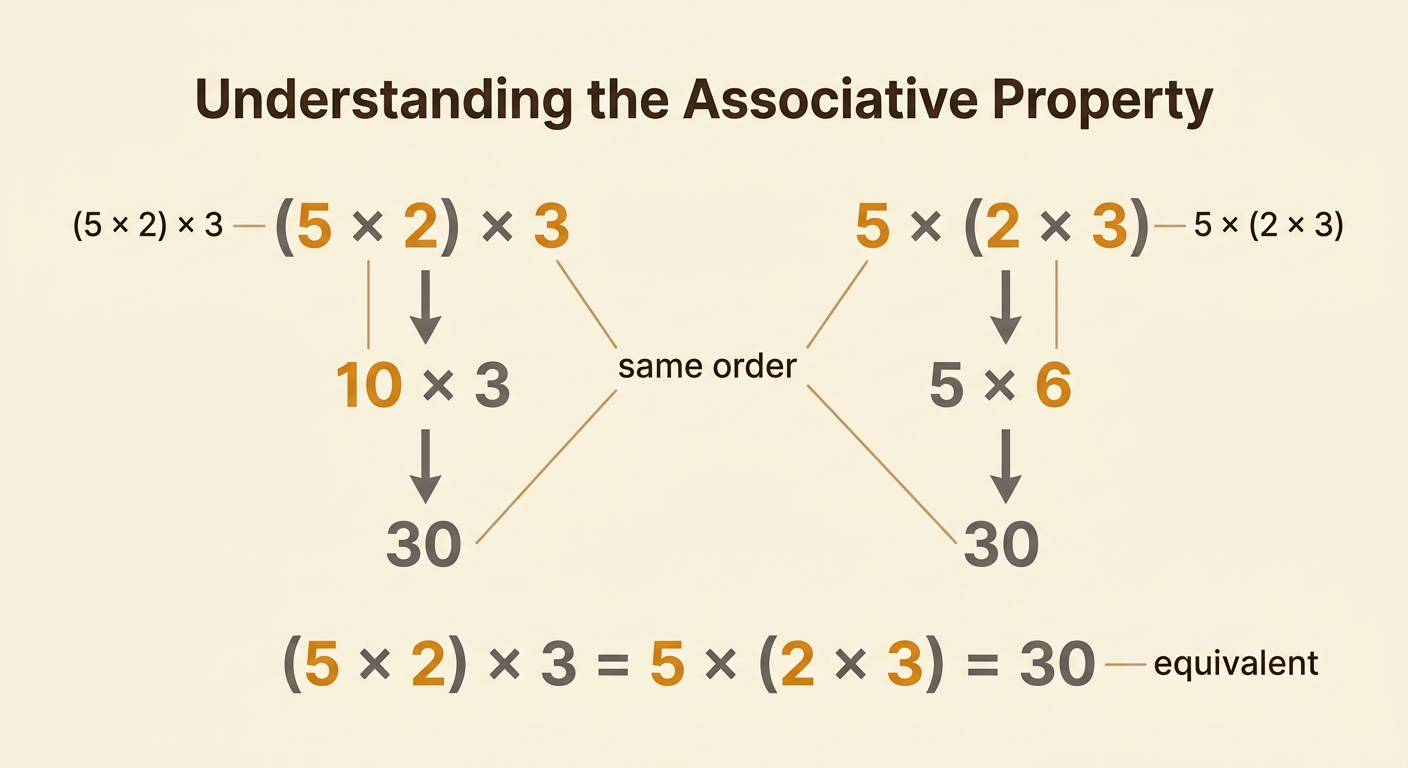
Expressions are equivalent when they have the same value. Parentheses show which factors to multiply first. The expressions (5 × 2) × 3 and 5 × (2 × 3) use the same factors in the same order, but they group the factors differently. For (5 × 2) × 3, calculate 5 × 2 = 10 and then 10 × 3 = 30. For 5 × (2 × 3), calculate 2 × 3 = 6 and then 5 × 6 = 30. Both expressions equal 30, so they are equivalent. You can write this relationship as (5 × 2) × 3 = 5 × (2 × 3). The associative property changes the grouping only. It does not change the order of the factors.
Choose Helpful Factor Groupings
Some factor groupings make a problem easier to solve mentally. Look for two factors that make a product you know well, such as 10. To solve 4 × 5 × 2, you could group the first two factors: (4 × 5) × 2 = 20 × 2 = 40. A quicker choice may be 4 × (5 × 2) because 5 × 2 = 10. Then 4 × 10 = 40. Both methods are correct, but making 10 may be easier. For 3 × 2 × 5, group 2 and 5 to write 3 × (2 × 5). Calculate 2 × 5 = 10, and then calculate 3 × 10 = 30. Choose a grouping that helps you use facts you already know.

Practice and Explain
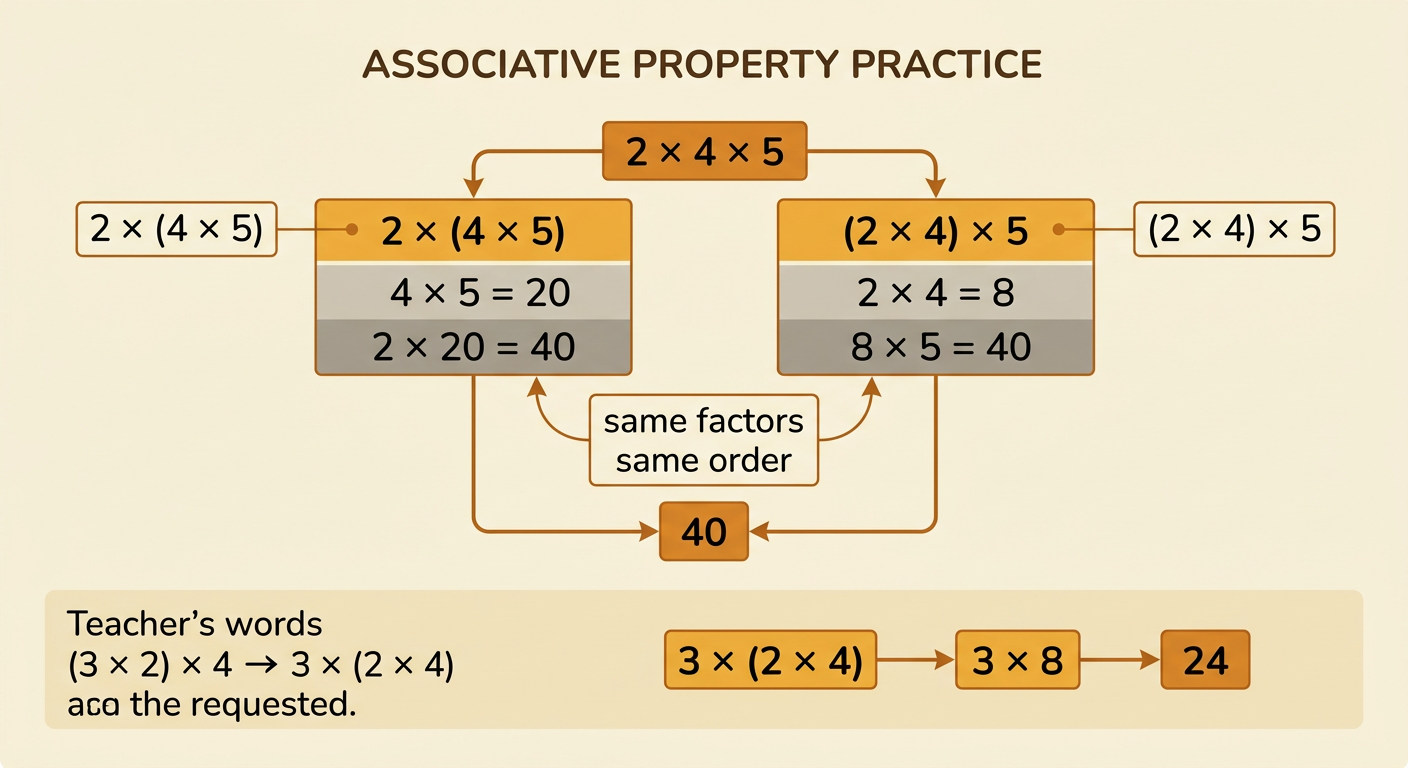
Solve each three-factor expression by choosing a helpful grouping, and explain why your choice works. Try 2 × 4 × 5. Group 2 and 5 mentally to make 10, but remember that changing their order would use the commutative property too. To practice only regrouping while keeping the order, start with 2 × (4 × 5): 4 × 5 = 20, and 2 × 20 = 40. You can compare it with (2 × 4) × 5: 2 × 4 = 8, and 8 × 5 = 40. A clear explanation is: “I regrouped the same factors. Both groupings have a product of 40.” Now solve (3 × 2) × 4 by rewriting it as 3 × (2 × 4), and explain why the product stays 24.
Exit Check
Use what you know about the associative property to complete this check. First, fill in the missing factor: (6 × 2) × 5 = 6 × (2 × ___). The missing factor is 5 because regrouping does not change the factors or their order. Next, solve using the easier grouping. The expression 6 × (2 × 5) becomes 6 × 10, which equals 60. Finally, decide whether (3 × 4) × 2 and 3 × (4 × 2) are equivalent. The first expression is 12 × 2 = 24. The second is 3 × 8 = 24. Yes, they are equivalent. Before finishing, ask yourself: Did I keep the factors in the same order? Did I change only the grouping? Did the product remain the same?
