Using the Associative Property of Multiplication
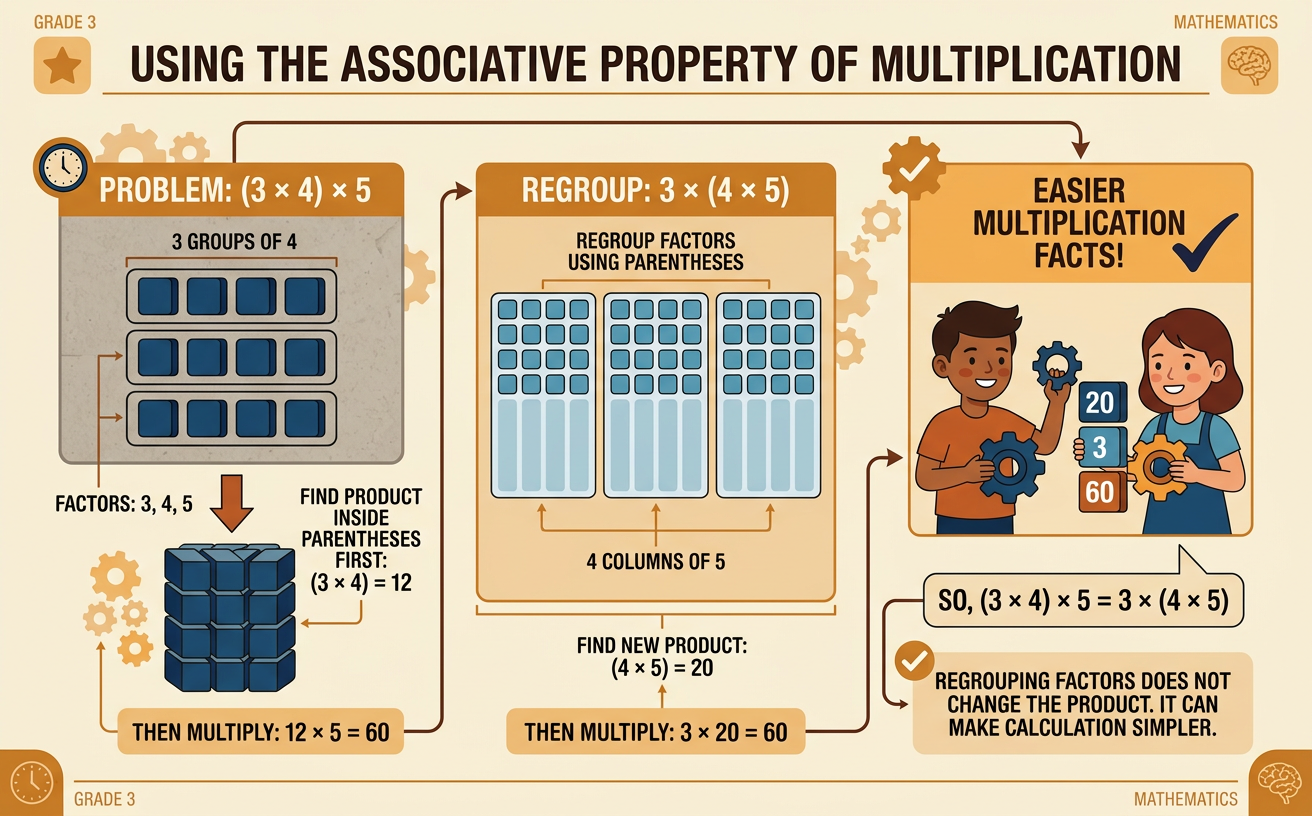
Students regroup three factors to create easier multiplication facts while keeping the product unchanged.
Illustrations are auto-generated and may be placeholders. They can be refreshed to match the narration.
Review Multiplication Factors
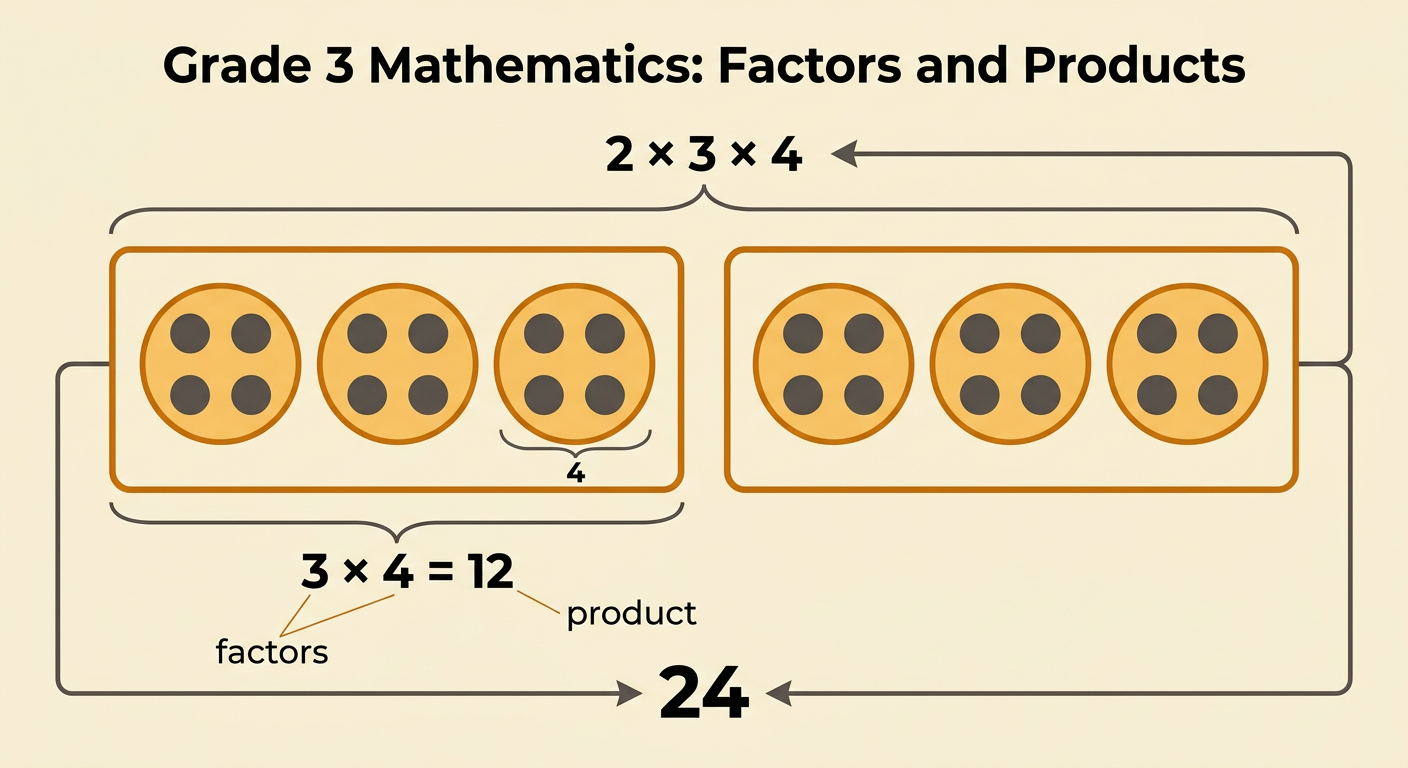
Multiplication combines equal groups. In the equation 3 × 4 = 12, the numbers 3 and 4 are factors, and 12 is the product. You can think of this equation as 3 groups with 4 objects in each group. Now look at 2 × 3 × 4. This expression has three factors: 2, 3, and 4. It can describe 2 sets, with each set containing 3 groups of 4 objects. To find the product, multiply the factors step by step. First, 2 × 3 = 6. Then, 6 × 4 = 24. The product of all three factors is 24. Knowing the factors and product will help you regroup factors without changing how many objects there are altogether.
Explore Different Groupings
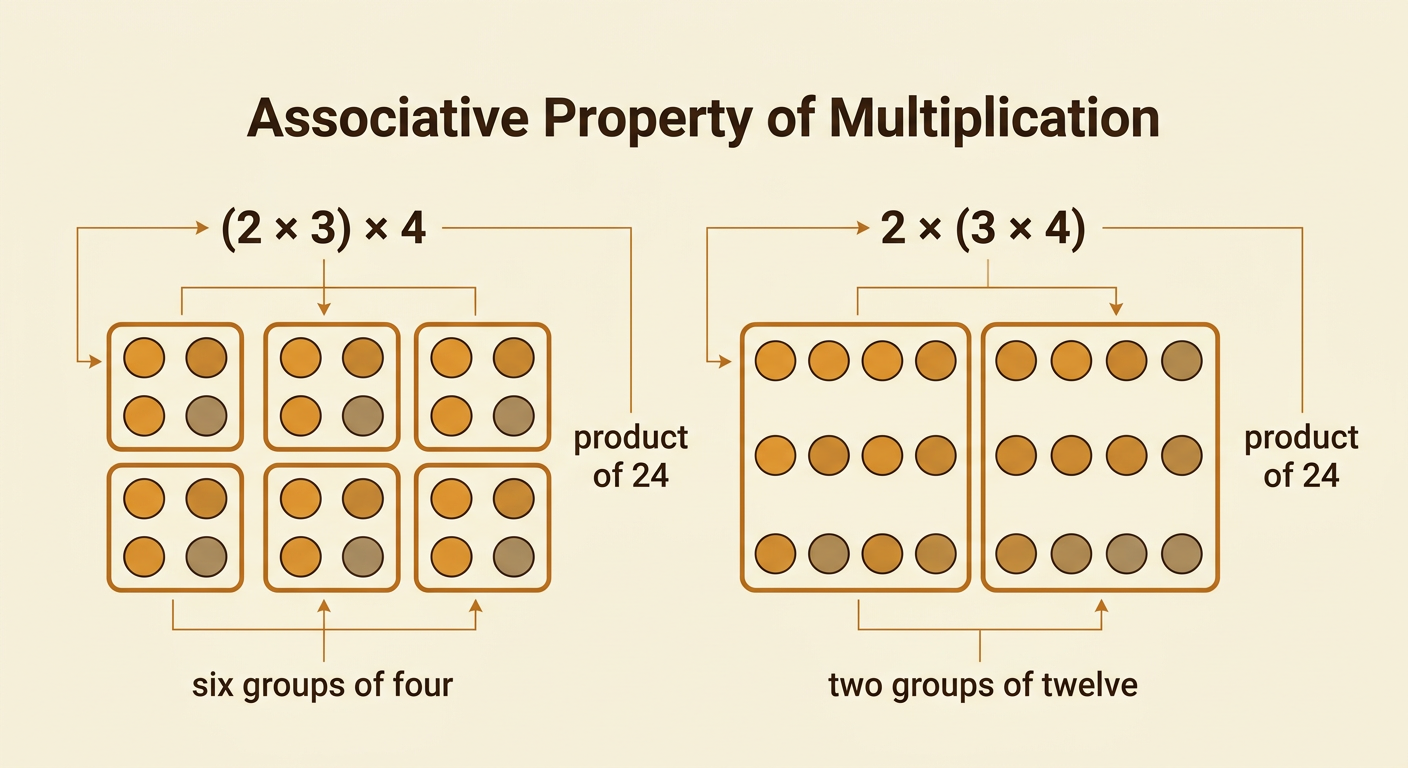
Parentheses show which two factors to multiply first. Consider (2 × 3) × 4. Multiply inside the parentheses first: 2 × 3 = 6. Then multiply 6 × 4 to get 24. Now group the same factors in another way: 2 × (3 × 4). First, 3 × 4 = 12. Then multiply 2 × 12 to get 24. The steps are different, but both expressions have the same product. The factors also stay in the same order: 2, 3, and 4. Only the grouping changes. A diagram can show this clearly. You may see six groups of four in the first grouping or two groups of twelve in the second grouping. Either way, there are 24 objects altogether.
State the Associative Property
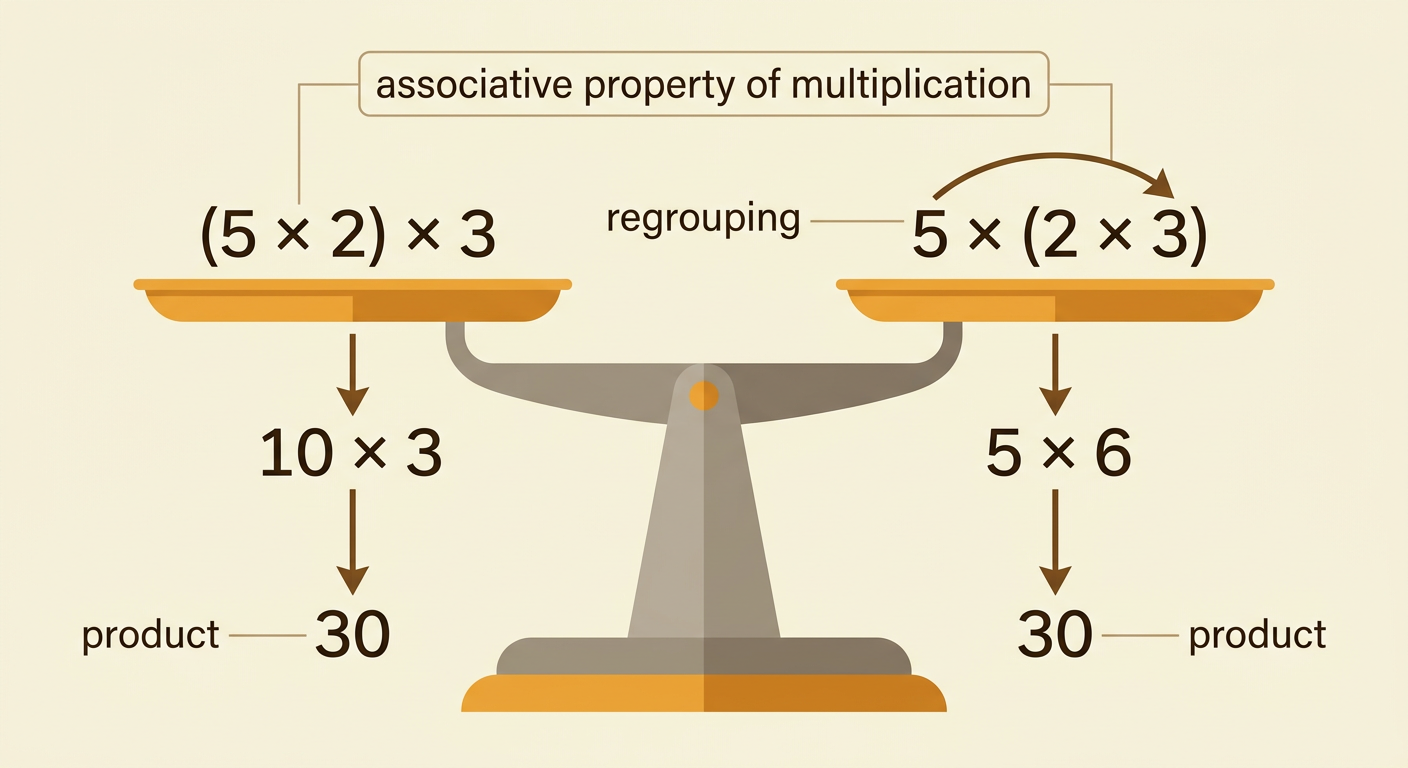
The associative property of multiplication says that when three or more factors are multiplied, you can change the grouping without changing the product. In symbols, (a × b) × c = a × (b × c). For example, (5 × 2) × 3 equals 5 × (2 × 3). On the left, multiply 5 × 2 to get 10, and then find 10 × 3 = 30. On the right, multiply 2 × 3 to get 6, and then find 5 × 6 = 30. Both sides equal 30. Notice that the factors remain in the order 5, 2, 3. The parentheses move, but the factors do not. This property is about regrouping. It helps you choose multiplication facts that are easier to solve first.
Regroup to Make Easier Facts
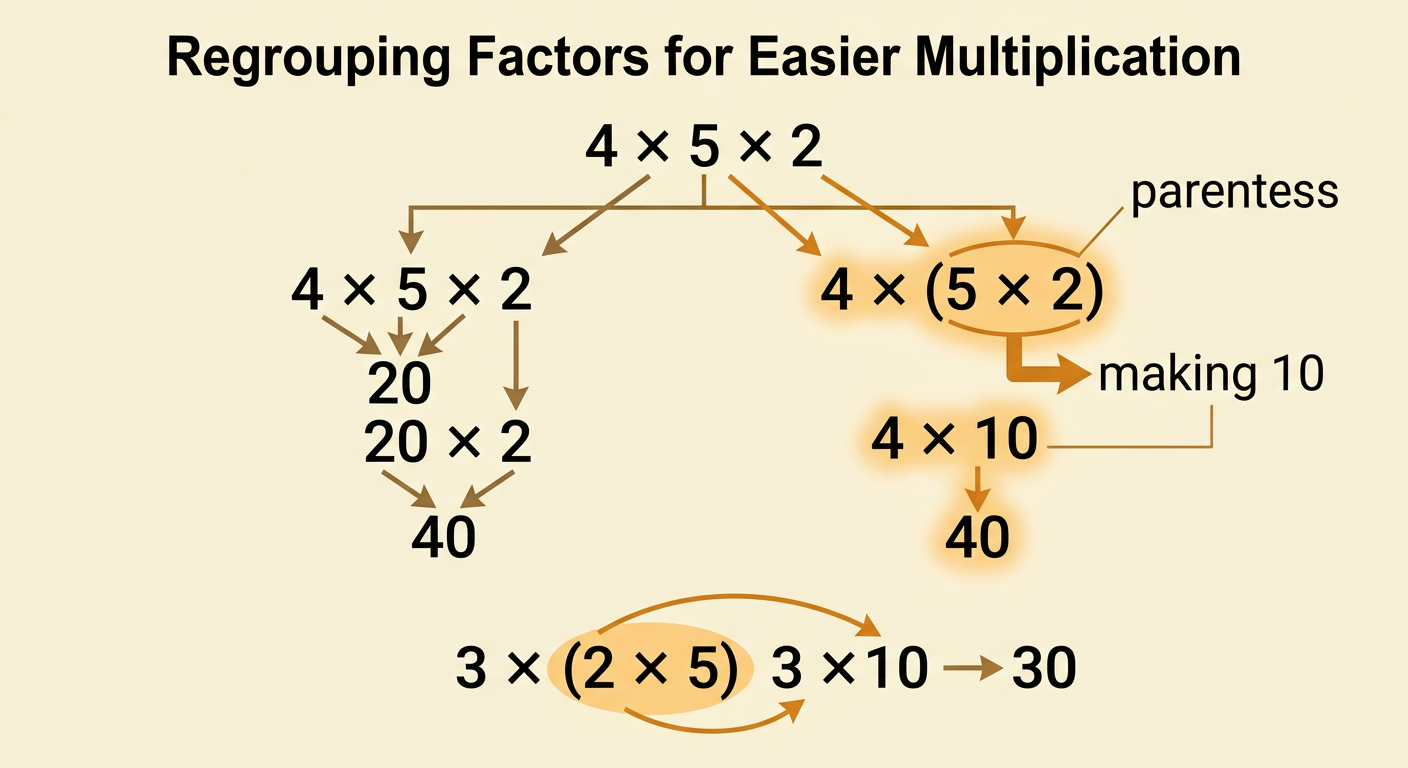
The associative property can help you make a familiar or easier fact. Suppose you need to find 4 × 5 × 2. If you multiply from left to right, you find 4 × 5 = 20 and then 20 × 2 = 40. You can also regroup the factors as 4 × (5 × 2). The fact 5 × 2 = 10 is easy to recognize. Then 4 × 10 = 40. The product stays the same because only the grouping changed. Look for pairs that make 10 or another fact you know well. For example, regroup (3 × 2) × 5 as 3 × (2 × 5). First find 2 × 5 = 10, and then find 3 × 10 = 30. Strategic grouping can make multiplication faster and simpler.
Guided Practice
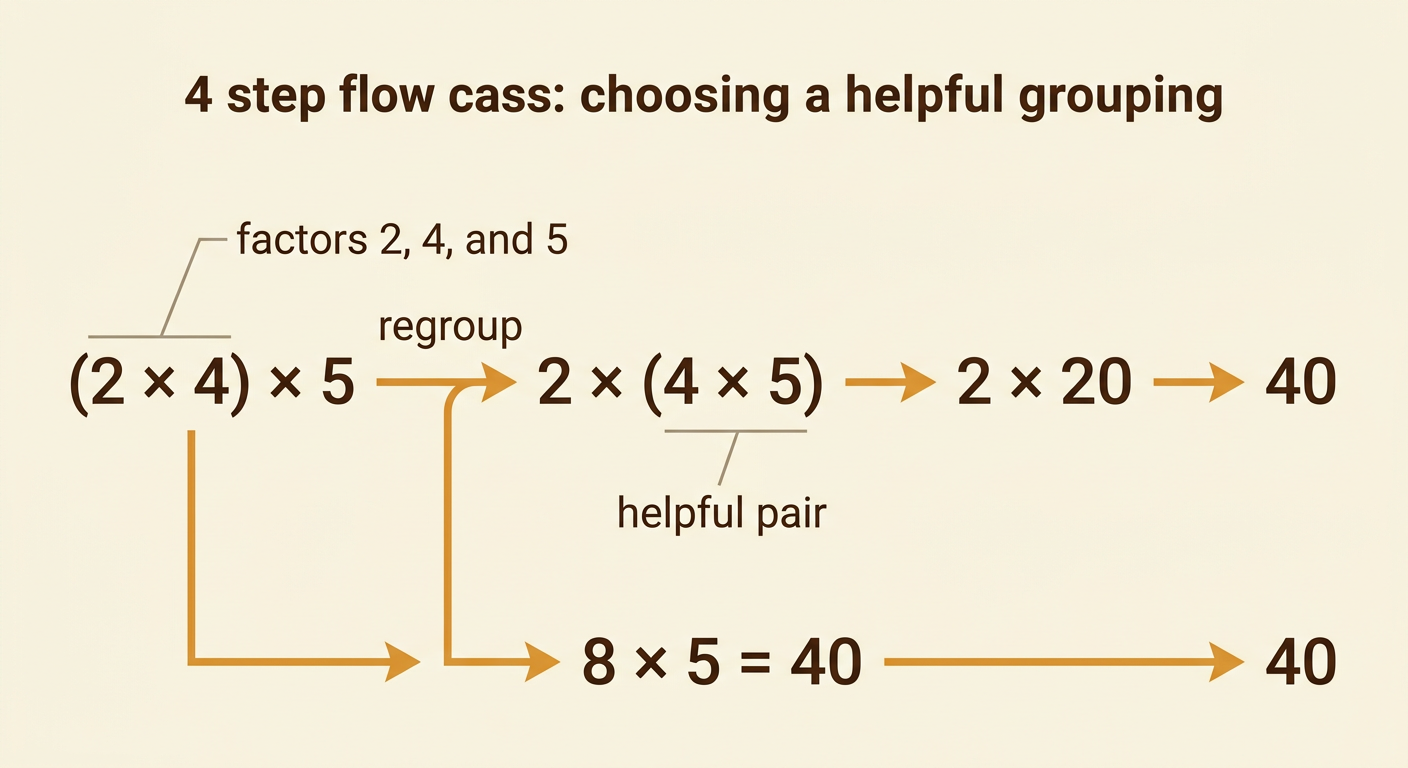
Let us solve (2 × 4) × 5 by choosing an easier grouping. The factors are 2, 4, and 5. Keep them in that order, but move the parentheses so that 4 and 5 are grouped: 2 × (4 × 5). First, calculate the expression inside the parentheses. Since 4 × 5 = 20, the expression becomes 2 × 20. Then 2 × 20 = 40. Check the original grouping to make sure the product matches. First, 2 × 4 = 8. Then 8 × 5 = 40. Both methods give a product of 40. The regrouped expression may feel easier because multiplying by 20 is a familiar fact. Remember: identify the factors, choose a helpful pair, move the parentheses, and multiply in two steps.
Independent Check
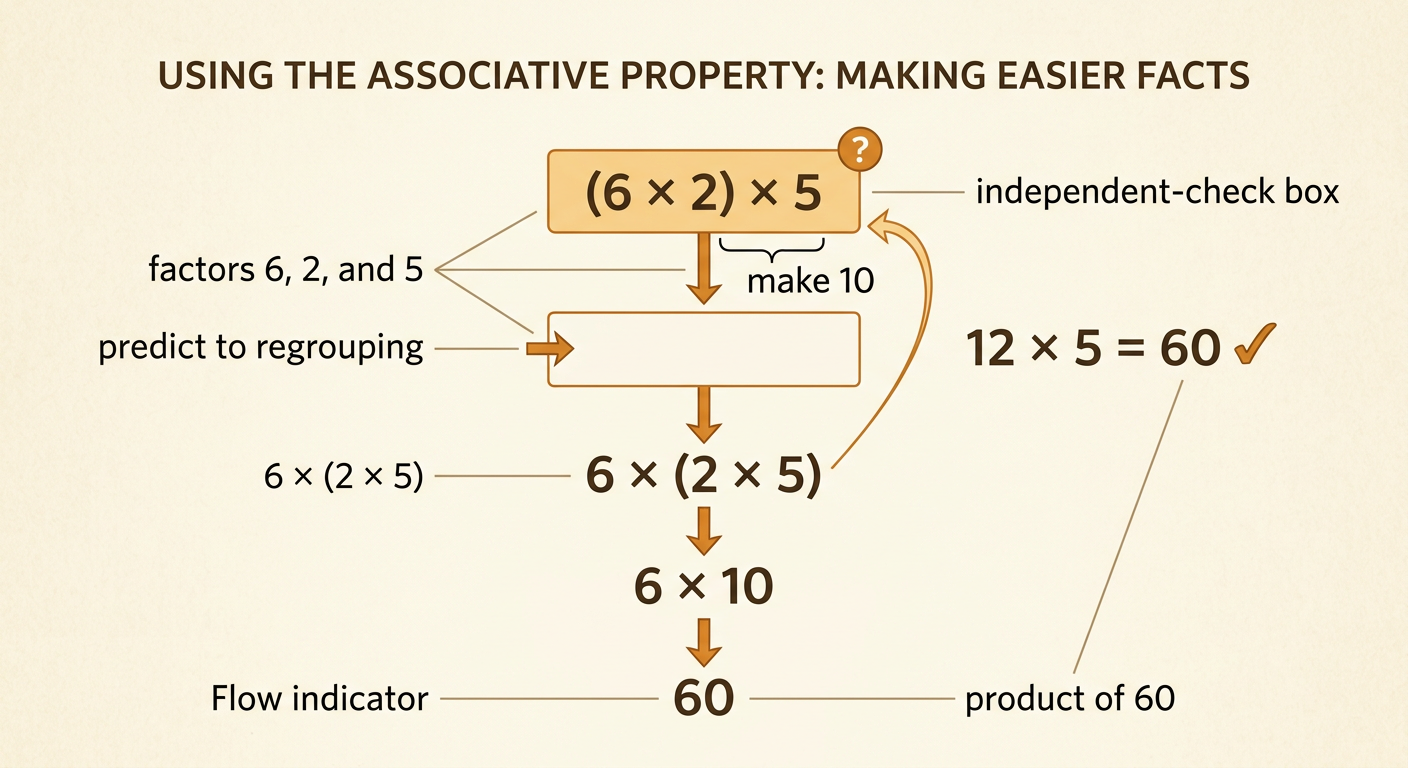
Try this problem on your own: regroup (6 × 2) × 5 to make an easier multiplication fact. First, identify the three factors: 6, 2, and 5. Which neighboring pair can make 10? The factors 2 and 5 make 10, so move the parentheses to write 6 × (2 × 5). Now multiply inside the parentheses: 2 × 5 = 10. Then multiply 6 × 10 = 60. Therefore, (6 × 2) × 5 = 6 × (2 × 5) = 60. Check by using the original grouping: 6 × 2 = 12, and 12 × 5 = 60. Ask yourself whether you kept the factors in the same order, changed only the grouping, and found the same product both ways. If so, you used the associative property correctly.