Using the Commutative Property of Multiplication
Students use arrays and equations to discover that changing the order of two factors does not change the product.

Illustrations are auto-generated and may be placeholders. They can be refreshed to match the narration.
Review Factors and Products
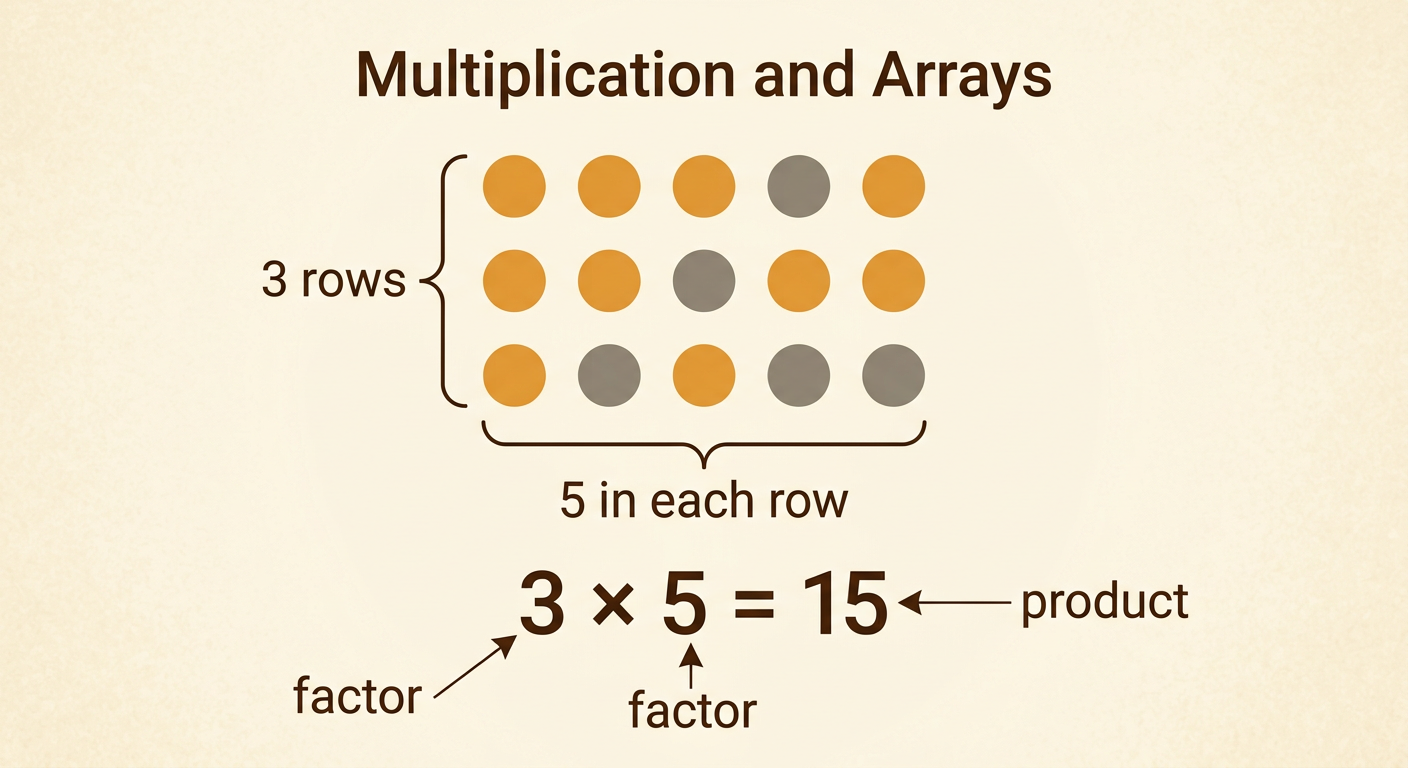
A multiplication equation has factors and a product. Factors are the numbers being multiplied. The product is the answer. In the equation 3 × 5 = 15, the numbers 3 and 5 are factors, and 15 is the product. You can show this equation with an array. An array is a group of objects arranged in equal rows and columns. An array with 3 rows and 5 dots in each row has 15 dots altogether. Count by fives: 5, 10, 15. You can also find the product by adding equal groups: 5 + 5 + 5 = 15. Equal rows make an array easy to count and help show what each factor means.
Build and Turn Arrays
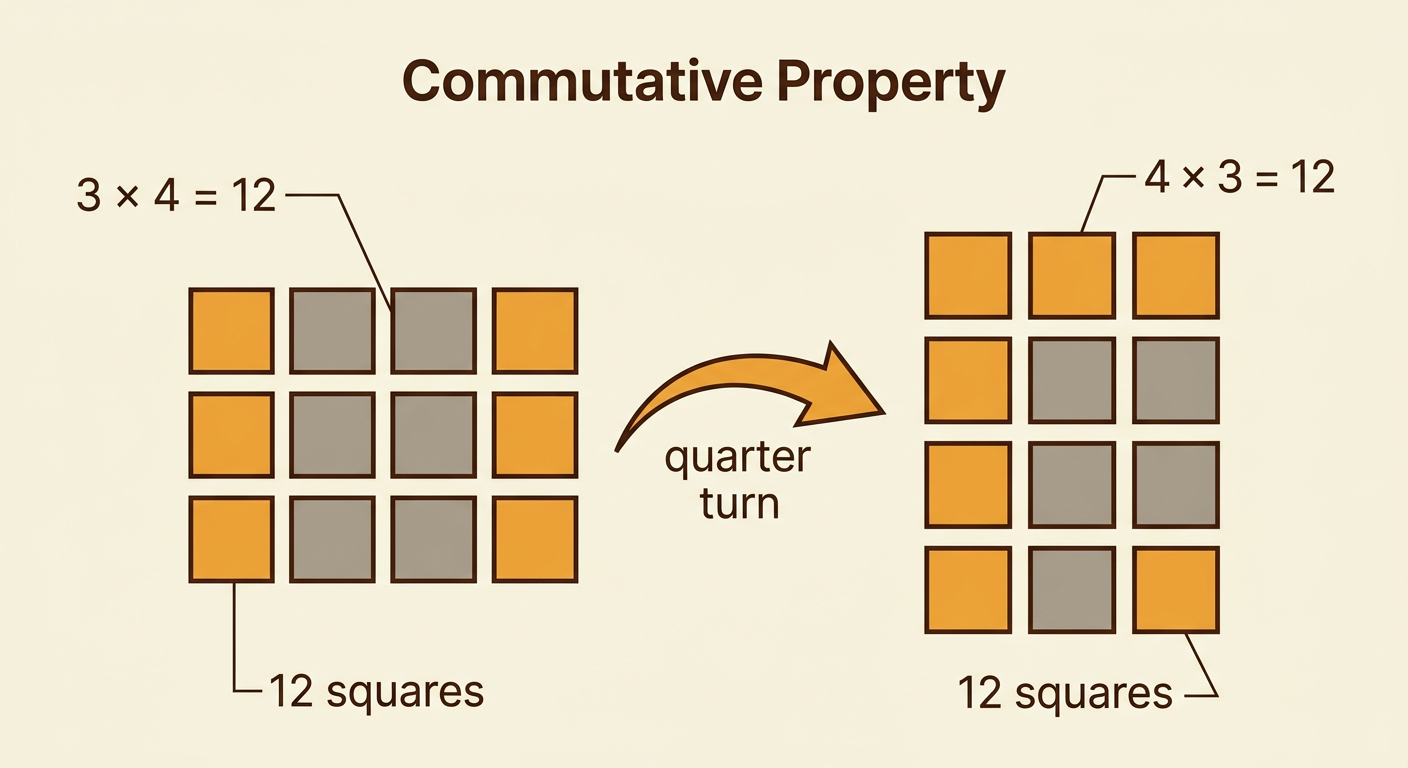
Build an array with 3 rows of 4 squares. There are 4 squares in each row, so the array represents 3 × 4 = 12. Now imagine turning the entire array one quarter turn. The turned array has 4 rows of 3 squares, so it represents 4 × 3 = 12. The rows and the number in each row have switched places, but no squares were added or removed. Both arrays contain the same 12 squares. This shows the commutative property of multiplication: two factors can change order without changing the product. Turning an array helps you see why the equations 3 × 4 and 4 × 3 have the same value.
Compare Related Equations
Equations such as 2 × 6 = 12 and 6 × 2 = 12 are called related equations. They use the same two factors in different orders. In the first equation, an array can have 2 rows with 6 stars in each row. In the second equation, it can have 6 rows with 2 stars in each row. Both arrays contain 12 stars. Compare the equations carefully: 2 and 6 switch positions, while the product stays 12. This pattern works for any two whole-number factors. For example, 5 × 3 = 15, so 3 × 5 = 15 too. Recognizing related equations helps you use facts you already know to solve other multiplication facts.

Apply the Commutative Property
Use the commutative property when one multiplication fact is easier to remember than another. Suppose you need to find 7 × 3. You may already know 3 × 7 = 21 from skip-counting by threes: 3, 6, 9, 12, 15, 18, 21. Because the factors can switch order, 7 × 3 also equals 21. Write 7 × 3 = 3 × 7 = 21. You can use the same strategy for a missing number. If 4 × 8 = 32, then 8 × 4 = 32. Always switch both factors, not a factor and the product. The factors may trade places, but the product remains unchanged.

Complete an Exit Check
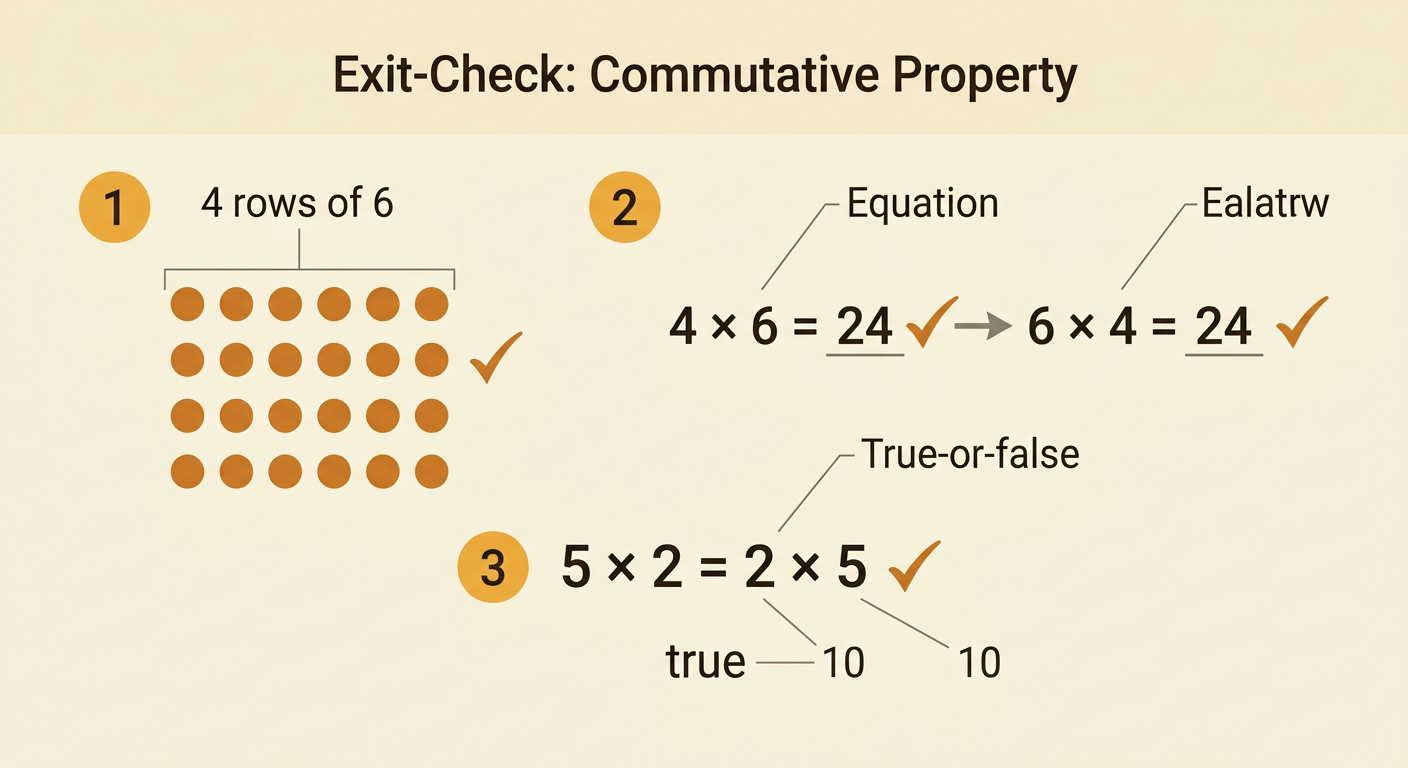
Show what you know by completing three quick tasks. First, solve 4 × 6. An array with 4 rows of 6 dots has 24 dots, so 4 × 6 = 24. Second, write the related equation by switching the factors: 6 × 4 = 24. Third, decide whether 5 × 2 = 2 × 5 is true. It is true because both sides equal 10. Check your work by asking two questions: Did the factors switch positions? Did the product stay the same? If both answers are yes, you used the commutative property correctly. Remember, changing the order of two factors does not change their product.