
Using the Distributive Property to Write Equivalent Expressions
Students use the distributive property to expand and factor algebraic expressions and verify that the resulting expressions are equivalent.
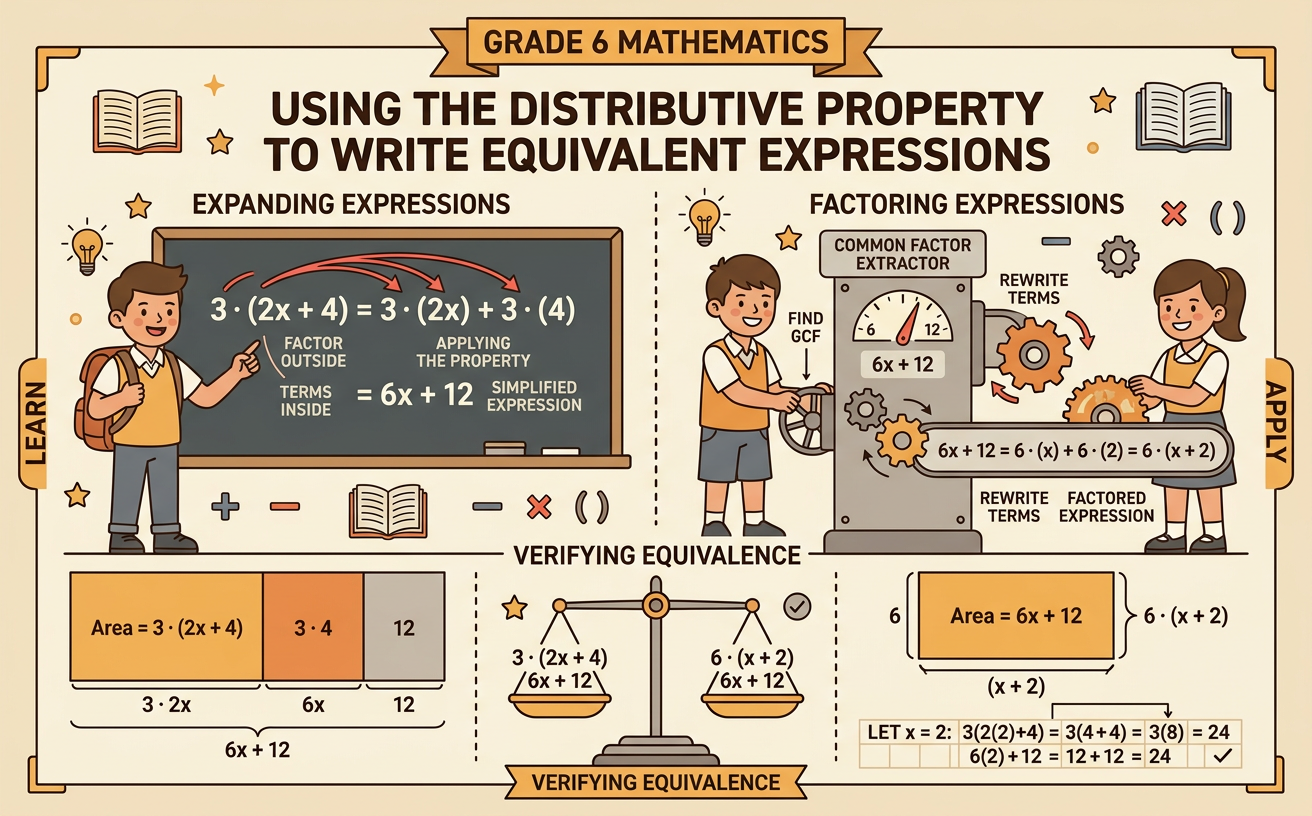
Illustrations are auto-generated and may be placeholders. They can be refreshed to match the narration.
Reviewing Factors and Terms
A factor is a number, variable, or expression that is multiplied by another quantity. A term is one part of an expression separated by addition or subtraction. In 4(x + 3), the number 4 and the expression (x + 3) are factors because they are multiplied. Inside the parentheses, x and 3 are terms. After the expression is expanded, 4x + 12 has two terms: 4x and 12. The number 4 is the coefficient of x. Factors can also be shared by multiple terms. For example, the terms in 3y + 15 share a factor of 3 because 3y = 3 times y and 15 = 3 times 5. Recognizing factors and terms helps you decide how to rewrite an expression.

Modeling the Distributive Property
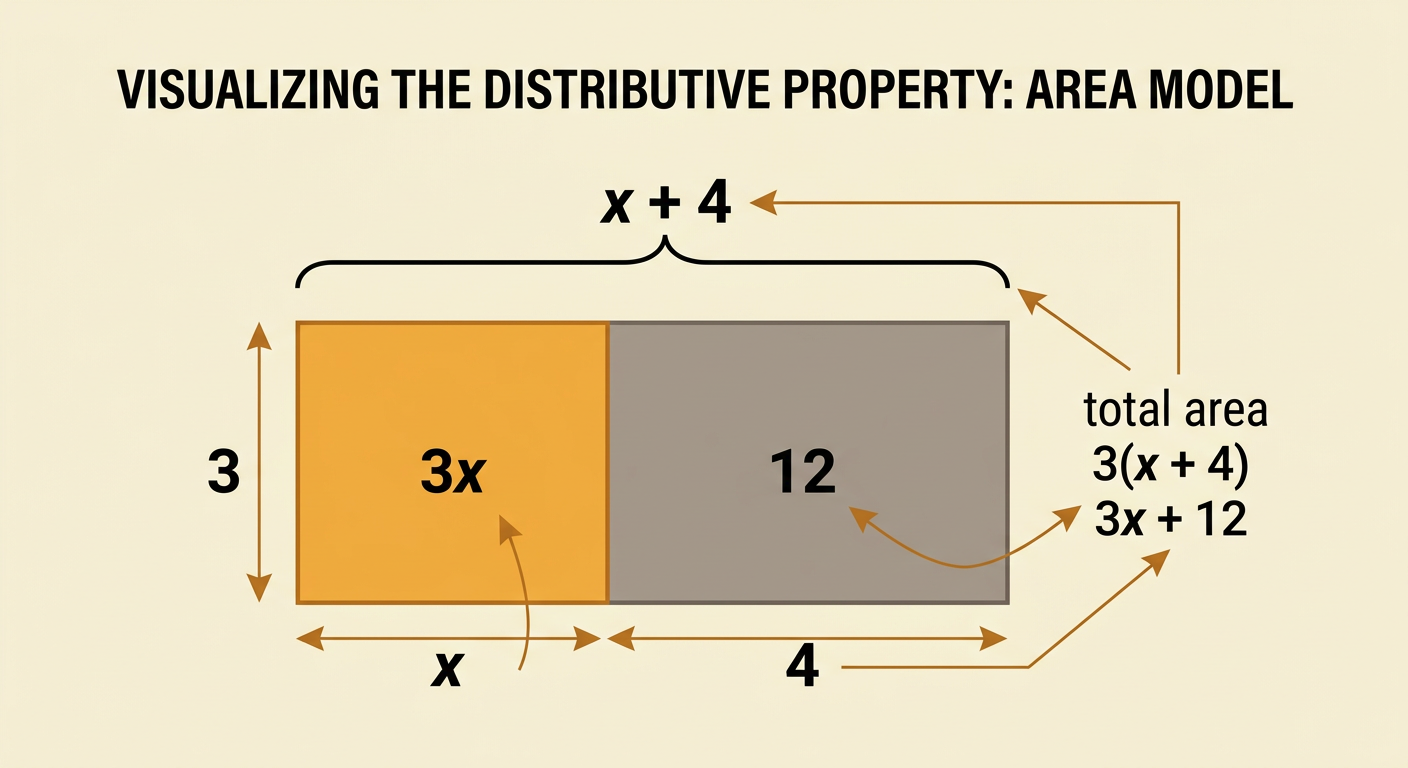
The distributive property can be modeled with the area of a rectangle. Suppose a rectangle has a height of 3 units and a total width of x + 4 units. Its total area is 3(x + 4) square units. Split the width into one part measuring x units and another part measuring 4 units. The first smaller rectangle has area 3 times x, or 3x. The second has area 3 times 4, or 12. Adding the smaller areas gives 3x + 12. Therefore, 3(x + 4) = 3x + 12. The factor 3 is distributed to both terms inside the parentheses. The model shows that the original expression and the expanded expression describe the same total area.
Expanding Algebraic Expressions
To expand an expression, multiply the factor outside the parentheses by every term inside. For example, expand 5(2a + 7). First multiply 5 by 2a to get 10a. Then multiply 5 by 7 to get 35. The expanded expression is 10a + 35. You can show the steps as 5(2a + 7) = 5(2a) + 5(7) = 10a + 35. Subtraction follows the same rule. In 6(y − 2), distribute 6 to both y and −2, giving 6y − 12. A common mistake is multiplying only the first term. Always check that the outside factor has been multiplied by each term within the parentheses.

Factoring Equivalent Expressions
Factoring reverses the distributive property. Instead of removing parentheses, you write an expression as a product. Begin by finding a common factor of all the terms. In 8x + 20, both terms share a factor of 4. Divide each term by 4: 8x divided by 4 is 2x, and 20 divided by 4 is 5. Place the results inside parentheses to get 4(2x + 5). You can verify the factoring by distributing: 4 times 2x is 8x, and 4 times 5 is 20. Thus, 8x + 20 and 4(2x + 5) are equivalent. Using the greatest common factor usually produces the simplest factored expression.

Checking for Equivalence
Equivalent expressions have the same value for every allowed value of the variable. You can check equivalence by using the distributive property and by substituting numbers. Consider 3(2 + x) and 6 + 3x. Distributing 3 gives 3 times 2 plus 3 times x, which simplifies to 6 + 3x. This proves the expressions are equivalent. You can also test a value. If x = 4, then 3(2 + 4) = 18, and 6 + 3(4) = 18. Matching for one value supports the check, but one test alone does not prove the expressions match for every value. An algebraic rewrite using valid properties provides the stronger verification.
