Using the Periodic Table to Predict Element Properties
Students connect valence-electron patterns to an element’s position on the periodic table and use those patterns to predict relative chemical properties.

Illustrations are auto-generated and may be placeholders. They can be refreshed to match the narration.
How the Periodic Table Developed
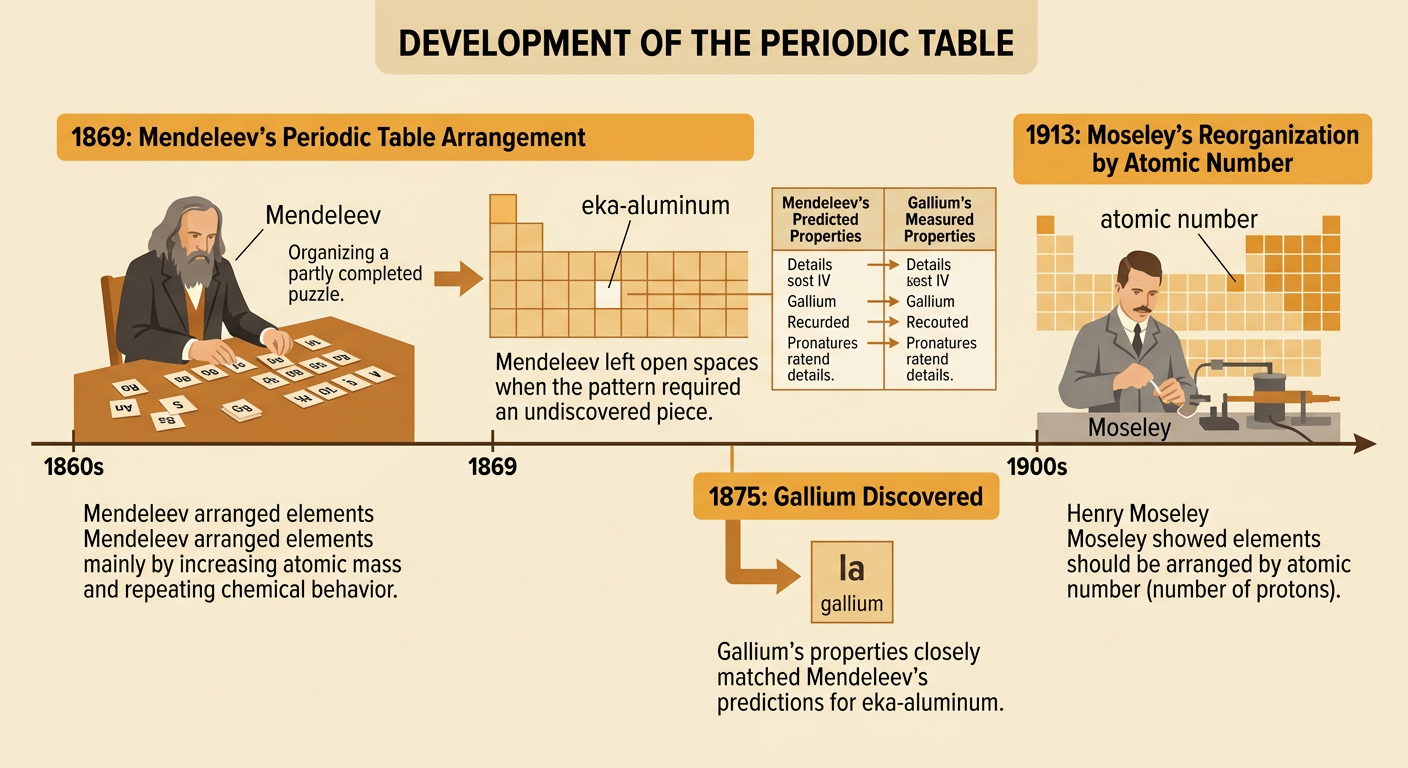
The periodic table was shaped by scientific evidence and the circumstances of its time. By the 1860s, many elements had been discovered, and chemists needed a useful way to organize their properties. Dmitri Mendeleev arranged elements mainly by increasing atomic mass and repeating chemical behavior. He left spaces when the pattern suggested that an element had not yet been discovered. For example, he predicted an element called “eka-aluminum,” including its approximate mass and properties. Gallium, discovered in 1875, closely matched his prediction. In the early 1900s, Henry Moseley showed that elements should instead be ordered by atomic number, or number of protons. This change corrected inconsistencies in the mass-based arrangement. The modern periodic table preserves repeating property patterns while reflecting improved knowledge of atomic structure.
Groups, Periods, and Valence Electrons
The periodic table is organized into vertical columns called groups and horizontal rows called periods. For main-group elements, members of the same group usually have the same number of valence electrons, which are electrons in the outermost occupied energy level. These electrons strongly influence bonding and chemical behavior. Group 1 elements have one valence electron, Group 2 elements have two, and Groups 13 through 18 generally have three through eight. Helium is an exception because its only energy level is full with two electrons. A period number indicates the highest main energy level occupied in a ground-state atom. For example, sodium is in Period 3 and Group 1, so it has three occupied energy levels and one valence electron. Chlorine is also in Period 3 but has seven valence electrons. Transition metals have more complex electron patterns.

Patterns in Atomic Radius
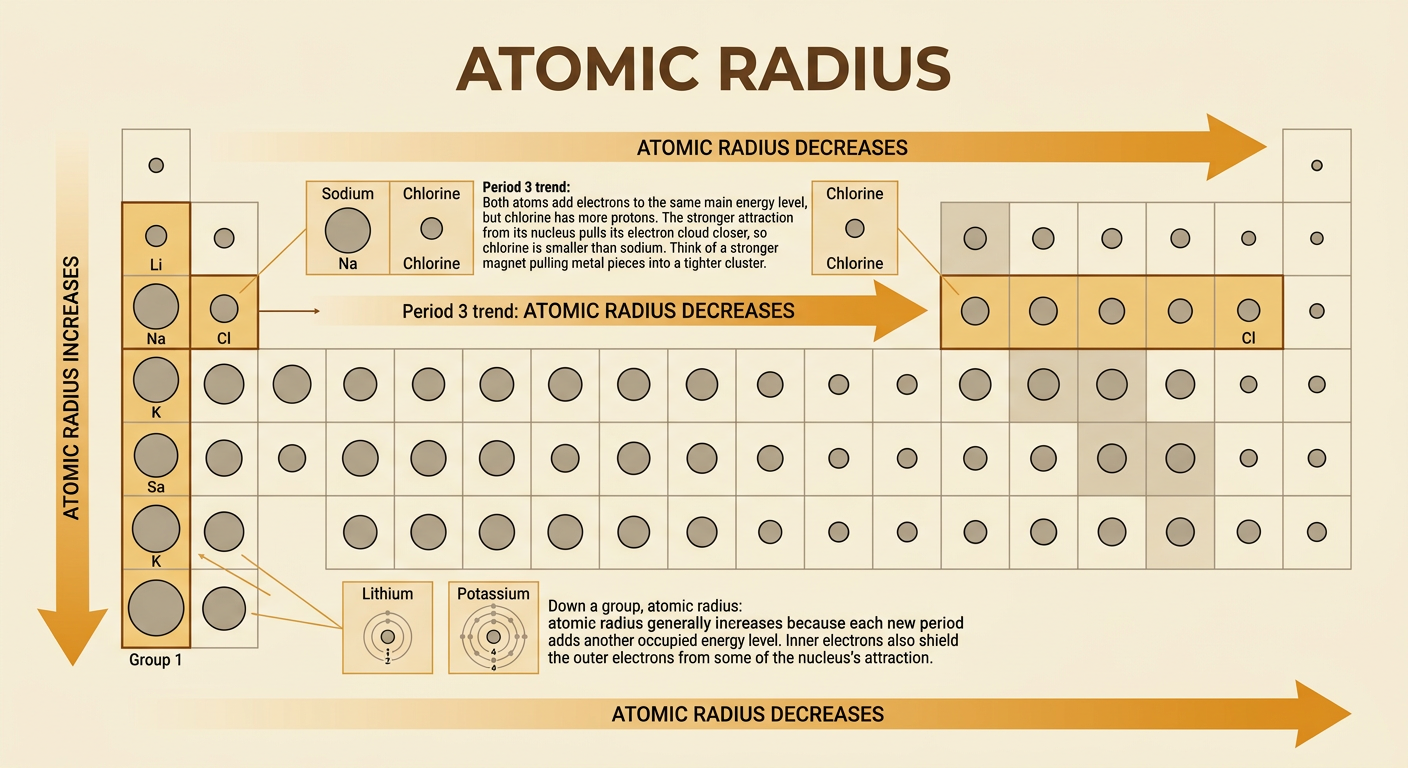
Atomic radius is a measure of an atom’s size. Across a period from left to right, atomic radius generally decreases. The number of protons increases, but the added electrons enter the same main energy level. The stronger nuclear attraction pulls the electron cloud closer to the nucleus. For example, a sodium atom is generally larger than a chlorine atom in the same period. Down a group, atomic radius generally increases because each new period adds another occupied energy level. Inner electrons also shield outer electrons from some nuclear attraction. Therefore, potassium is larger than lithium even though potassium has more protons. These trends compare relative sizes rather than giving an exact radius from position alone. Different measurement methods can produce somewhat different numerical values, but the overall periodic pattern remains useful for predictions.
Patterns in Reactivity
Reactivity depends largely on how easily atoms lose, gain, or share valence electrons. Group 1 metals are highly reactive because they need to lose only one electron to reach a more stable electron arrangement. Their reactivity generally increases down the group because the outer electron is farther from the nucleus and more shielded. For example, sodium usually loses its valence electron more easily than lithium. Group 17 halogens are reactive nonmetals because they need to gain one electron to fill their outer energy level. Their reactivity generally decreases down the group because larger atoms attract an added electron less strongly. Thus, fluorine is more reactive than chlorine. Group 18 noble gases are usually unreactive because their outer energy levels are full. These trends predict relative behavior, although temperature, physical form, and reaction partners also affect an actual reaction.

Predicting an Unknown Element’s Properties
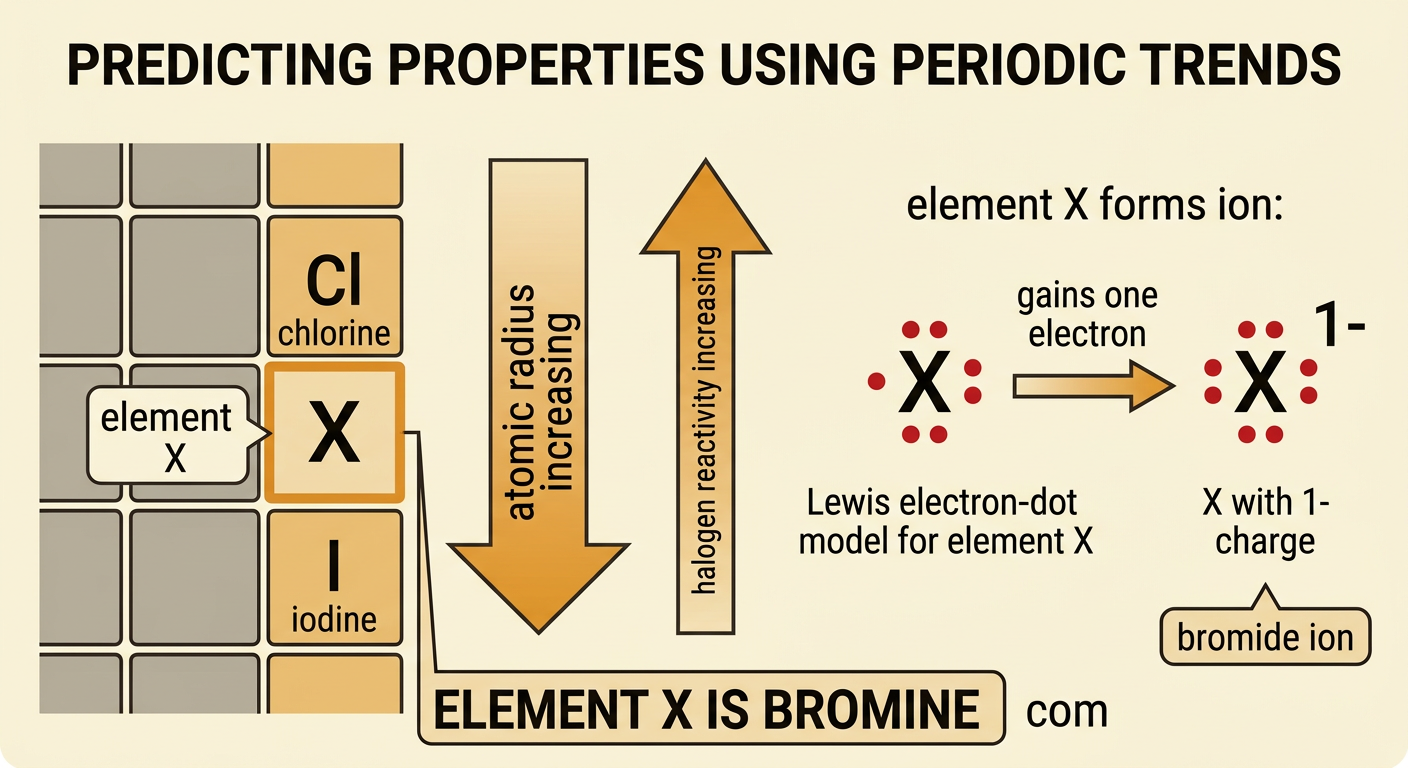
To predict an unknown element’s properties, first locate its group and period, then apply periodic trends. Suppose element X is in Period 4 and Group 17. Its group predicts seven valence electrons and a tendency to gain one electron, forming an ion with a 1− charge. Its period indicates that its ground-state atom has electrons occupying four main energy levels. Element X should be a reactive nonmetal with properties similar to other halogens. Because it is below chlorine, it should have a larger atomic radius and lower reactivity than chlorine. Because it is above iodine, it should have a smaller radius and higher reactivity than iodine. Its location identifies it as bromine, which commonly forms bromide compounds such as sodium bromide. This reasoning uses table position to make relative predictions without requiring every property to be memorized.