
Warm Packs: Chemical Energy Becomes Heat
Students activate a reusable hand warmer, measure its temperature change, and use observations to explain how stored chemical energy is transformed into thermal energy.

Illustrations are auto-generated and may be placeholders. They can be refreshed to match the narration.
What Is Inside a Hand Warmer?
A reusable hand warmer often contains a sealed solution of water and sodium acetate, plus a small flexible metal disk. The liquid stores energy because its particles are in an unstable arrangement. When the disk is clicked, sodium acetate begins forming solid crystals. As the particles move into an orderly crystal pattern, stored energy is released as thermal energy. The pack becomes warm even though no flame or battery is used. This type of crystallization does not create a new substance; it changes the arrangement and state of the material. For example, a clear liquid pack may become filled with white crystals after activation. Never cut open a warm pack. Before investigating, check that it is sealed and follow all safety directions.

Record the Starting Temperature
Before activating the warm pack, measure its starting temperature. Place the pack on a table away from direct sunlight, heaters, and cold windows. Lay the thermometer against the center of the pack and wait until the reading stops changing. Use the same thermometer and measurement spot each time so the test is fair. Record the temperature in degrees Celsius and note the time. For example, the starting temperature might be 22 degrees Celsius at 10:00 a.m. Touch the pack briefly and describe it with words such as cool, room temperature, soft, and liquid. Measurements are stronger evidence than touch alone because different people may describe the same temperature differently. Do not activate the pack until the starting data are recorded.

Activate and Observe the Warm Pack
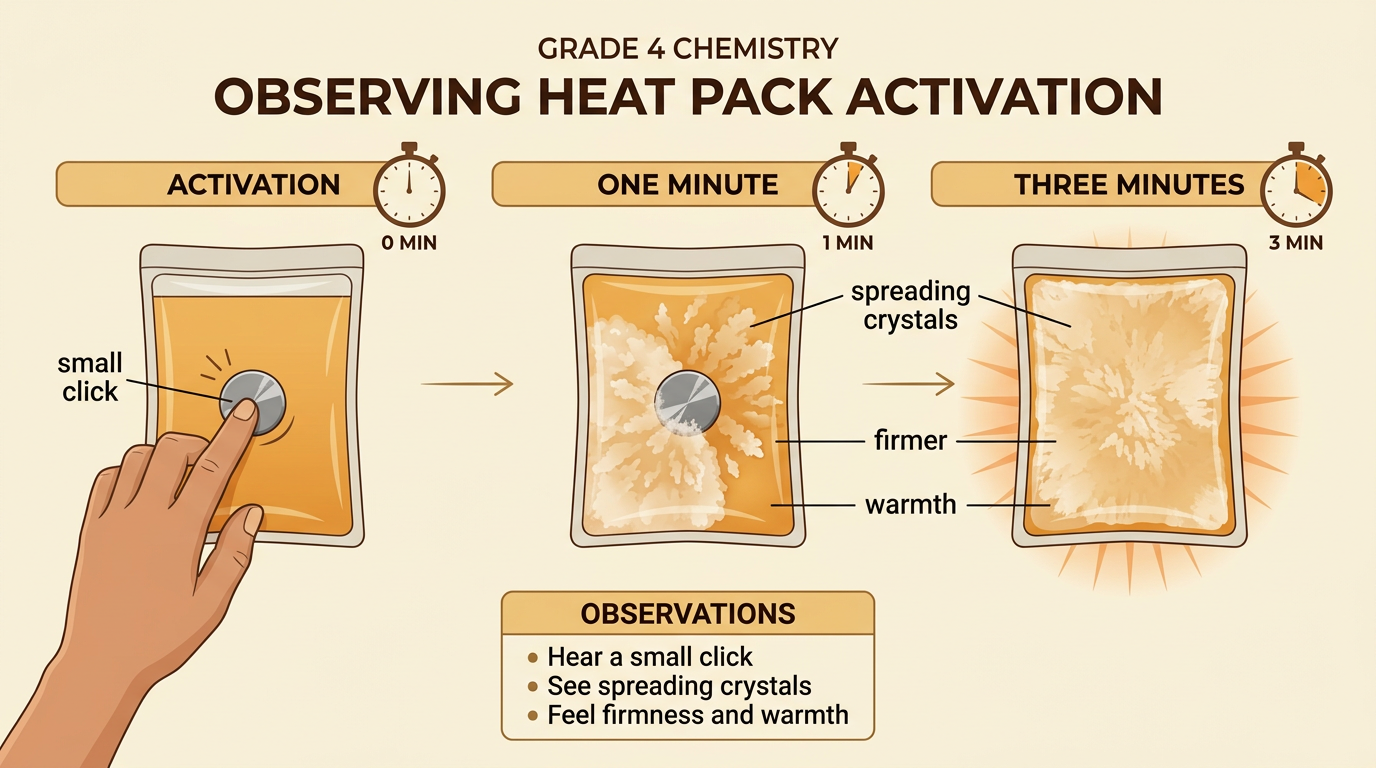
Follow the product directions to activate the reusable warm pack. For a disk-activated pack, gently bend or click the metal disk while keeping the pouch sealed. Watch closely as crystals spread outward from the disk through the liquid. Record what you see, hear, and feel without squeezing the pack hard. You might observe a small click, cloudy crystals, a firmer texture, and increasing warmth. Write observations at regular times, such as every minute for five minutes. For example, at one minute crystals may cover half the pack, while at three minutes the entire pack may look solid. The spreading crystals show where the change is happening. Handle the pack carefully, stop if it leaks, and tell the teacher immediately if the pack becomes damaged.
Measure and Compare Temperatures
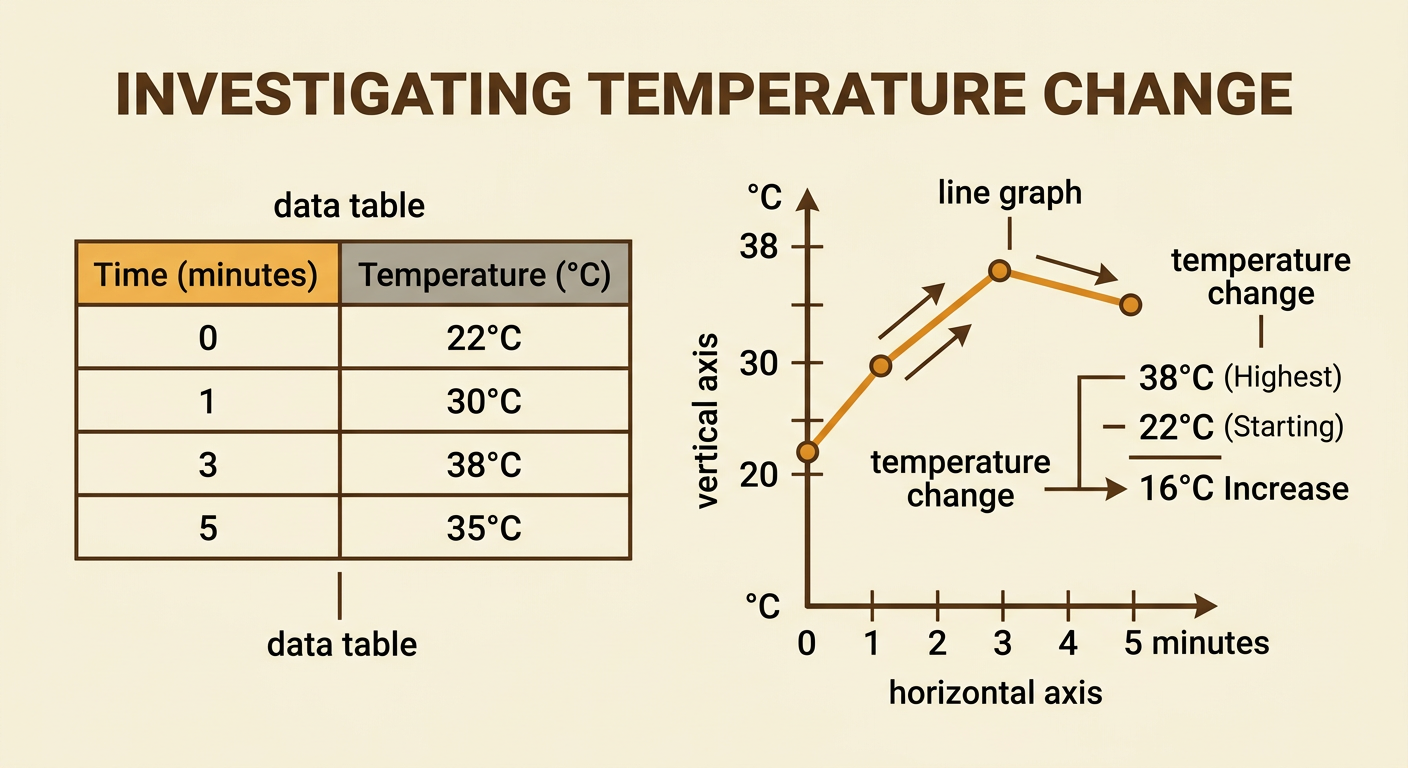
Measure the pack’s temperature at the same place and at equal time intervals. A sample data set might show 22 degrees Celsius before activation, 30 degrees Celsius after one minute, 38 degrees Celsius after three minutes, and 35 degrees Celsius after five minutes. Find the temperature change by subtracting the starting temperature from the highest temperature. In this example, 38 minus 22 equals a 16-degree Celsius increase. A table organizes the measurements, and a line graph makes the pattern easy to see. Put time on the horizontal axis and temperature on the vertical axis. The rising line shows warming, while a later falling line shows cooling. Compare your group’s results with another group’s data and discuss possible reasons for small differences.
Explain the Energy Change
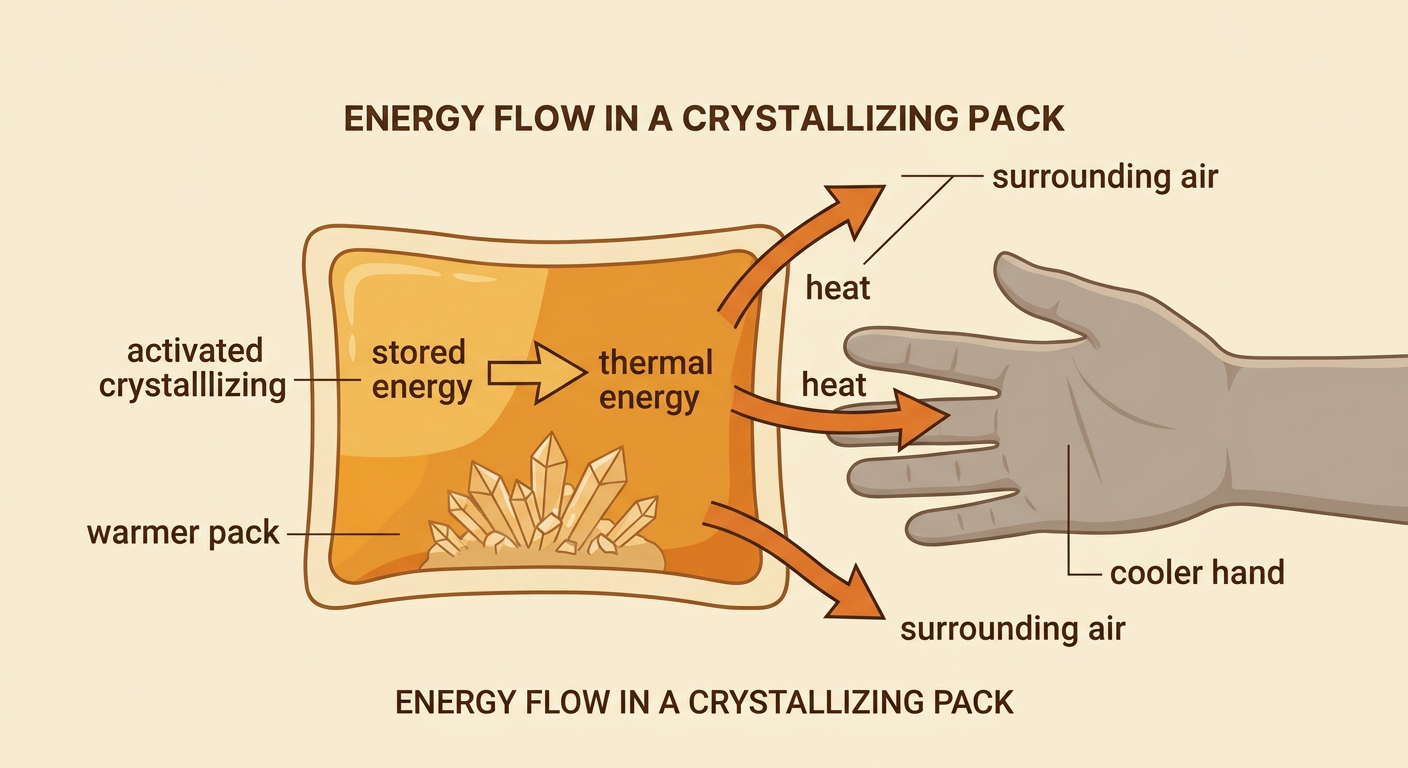
The warm pack contains stored energy in its material and particle arrangement. Activating the disk starts crystallization. As the particles settle into an orderly solid pattern, stored energy is transformed into thermal energy. Thermal energy moves from the warmer pack to cooler places, including your hand and the surrounding air. This transfer is called heat. Evidence for the energy change includes the measured temperature increase, the feeling of warmth, and the appearance of crystals. For example, if the pack rises from 22 degrees Celsius to 38 degrees Celsius, the 16-degree increase supports the claim that thermal energy was released. Energy was not created from nothing. It changed form and moved from the pack to its surroundings. The pack later cools as thermal energy continues spreading outward.
Compare Reusable and Disposable Warmers
Choosing a warmer involves both benefits and costs. A reusable sodium acetate warmer can be reset, usually by heating it in boiling water with adult supervision until the crystals dissolve. It can then cool and be used again. Reusing it may reduce trash and lower the cost per use, but resetting it requires time, water, and energy. A disposable air-activated warmer often contains iron powder that reacts with oxygen and releases thermal energy for several hours. It may be convenient and stay warm longer, but it creates waste and must be replaced after one use. For example, a hiker who needs many hours of warmth might choose a disposable warmer, while a student using a warmer repeatedly at home might choose a reusable one. A good decision compares safety, price, warming time, energy use, and waste.
