Wave Speed, Frequency, and Wavelength
Students use the wave equation to model how frequency, wavelength, and wave speed are related and apply the model to sound and communication technologies.
Illustrations are auto-generated and may be placeholders. They can be refreshed to match the narration.
Identifying Wave Properties
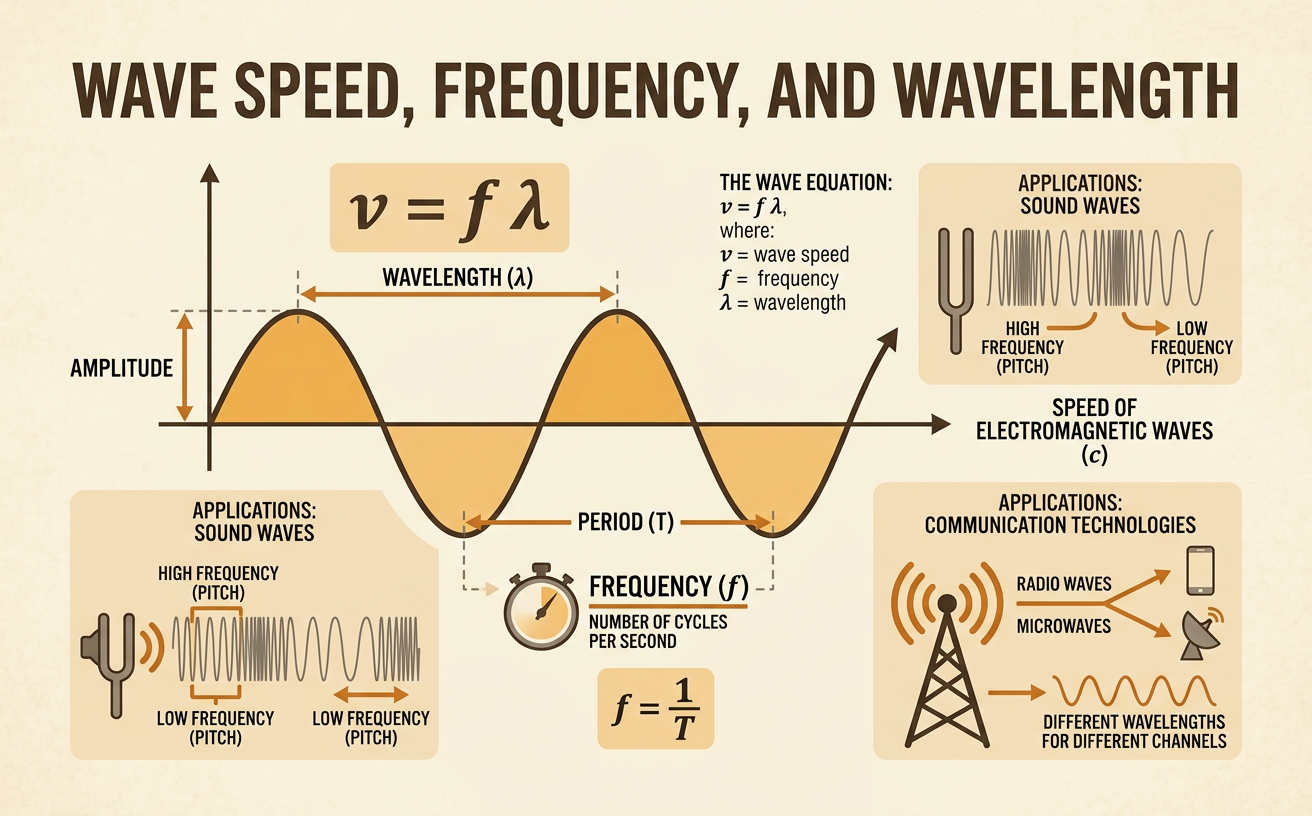
A wave transfers energy through a disturbance without permanently transporting matter from one place to another. Amplitude is the maximum displacement from the equilibrium position and is related to the energy carried by the wave. Wavelength, represented by λ, is the distance between matching points on consecutive cycles, such as crest to crest. Frequency, f, is the number of complete cycles passing a point each second and is measured in hertz. One hertz equals one cycle per second. The period, T, is the time required for one cycle, so T = 1/f. For example, if five crests pass a fixed point in one second, the wave has a frequency of 5 Hz and a period of 0.20 second. These measurable properties provide the foundation for describing and comparing waves mathematically.

Deriving the Wave Equation
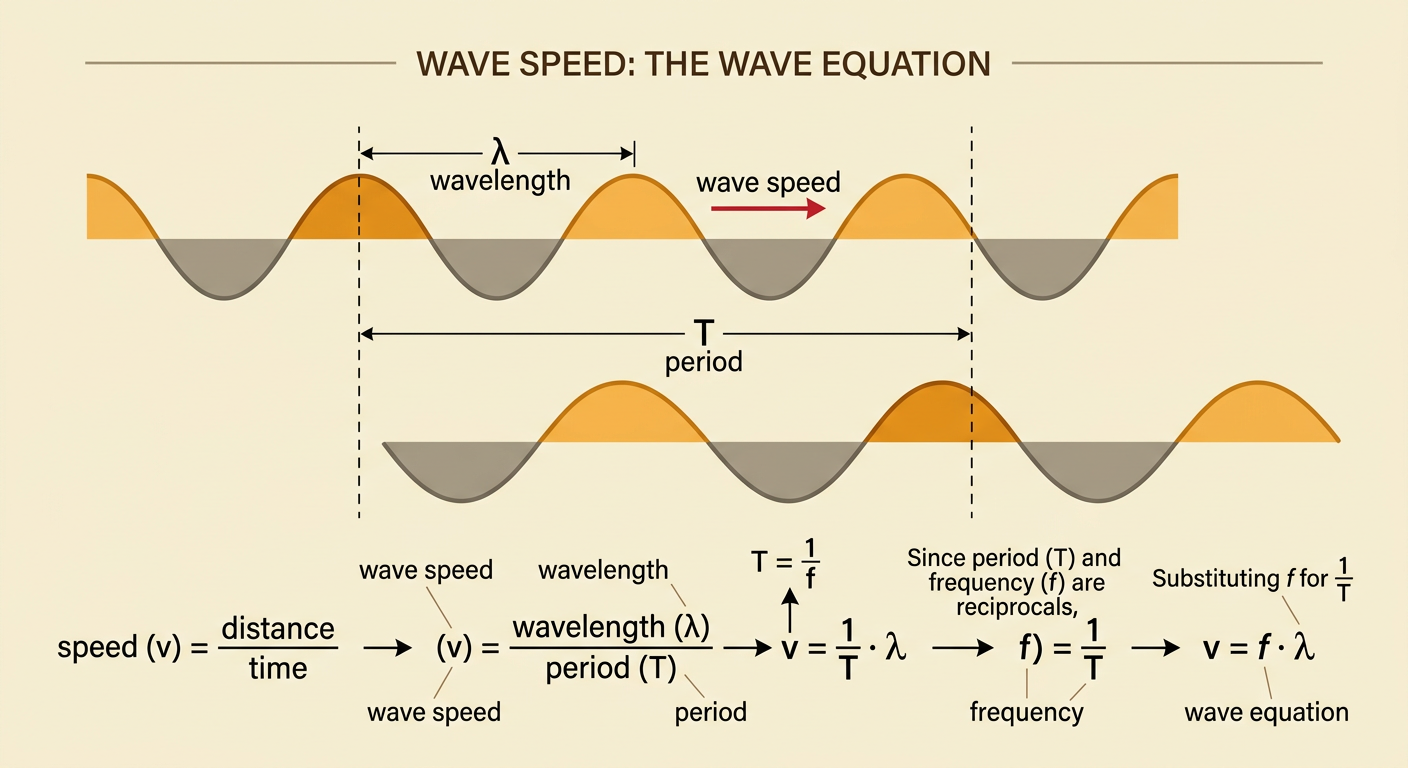
Wave speed describes how quickly a wave pattern travels. During one period, a wave advances by one wavelength. Because speed equals distance divided by time, wave speed can be written as v = λ/T. Frequency and period are reciprocals, so f = 1/T. Substituting frequency for 1/T gives the wave equation v = fλ. This equation shows that wave speed equals frequency multiplied by wavelength. The units also support the relationship: hertz is equivalent to cycles per second, and multiplying it by meters per cycle gives meters per second. For example, a water wave with a wavelength of 2.0 meters and a frequency of 3.0 Hz travels at 6.0 meters per second. The equation models the motion of many periodic waves, although the actual speed depends on the medium and wave type.
Calculating Frequency and Wavelength
The wave equation can be rearranged to isolate the quantity of interest. Starting with v = fλ, divide both sides by λ to find frequency: f = v/λ. Divide both sides by f to find wavelength: λ = v/f. Always use compatible units, usually meters, seconds, hertz, and meters per second. Suppose a wave travels along a rope at 24 meters per second and has a wavelength of 3.0 meters. Its frequency is f = 24/3.0 = 8.0 Hz. If the same rope conditions keep the speed at 24 meters per second but the source produces 12 Hz, the wavelength becomes λ = 24/12 = 2.0 meters. Thus, when wave speed is constant, increasing frequency decreases wavelength. This inverse relationship supports claims about how changing a source affects the resulting wave pattern.

Comparing Sound and Electromagnetic Waves
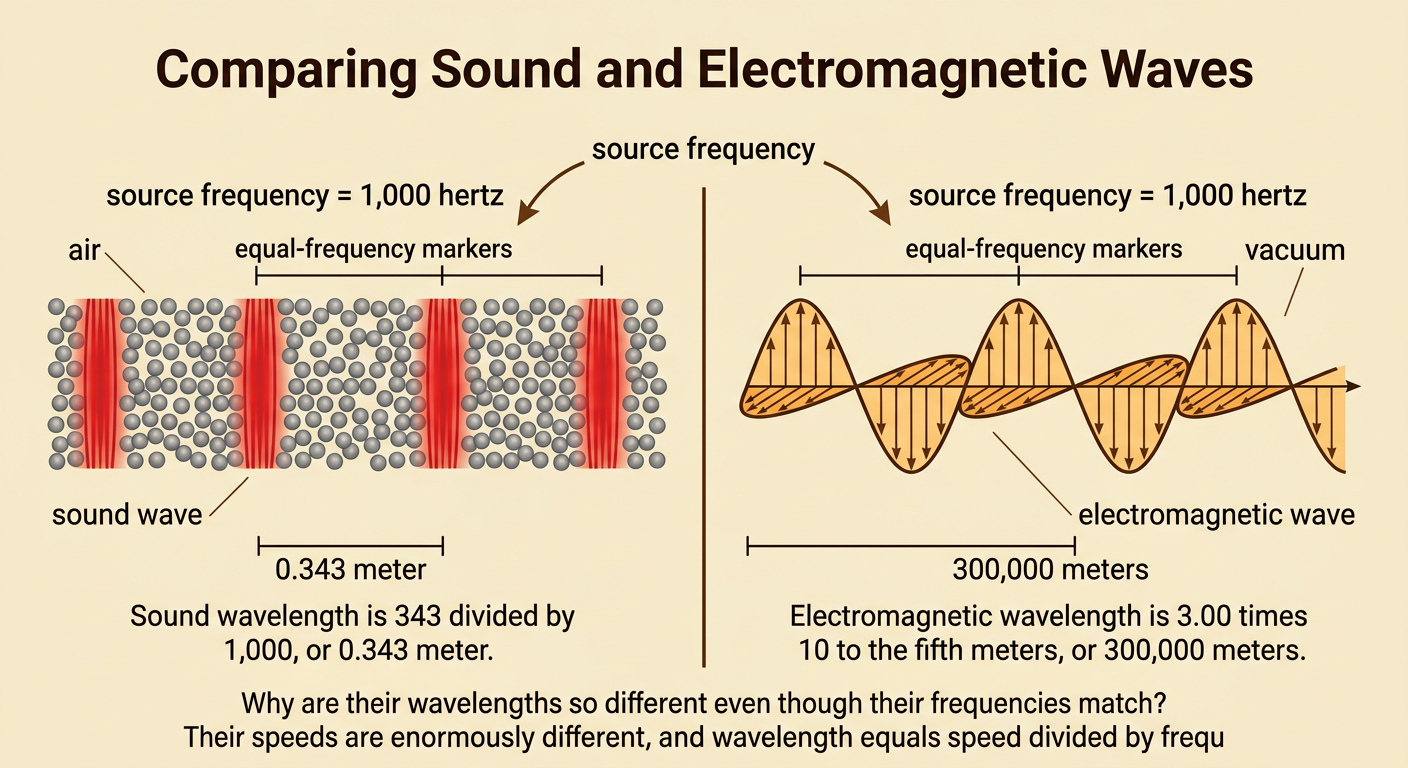
Sound waves and electromagnetic waves both follow v = fλ, but they travel differently. Sound is a mechanical wave and requires matter, such as air, water, or a solid. Its speed depends on the medium and conditions; in room-temperature air, sound travels at about 343 meters per second. Electromagnetic waves can travel through a vacuum at approximately 3.00 × 10^8 meters per second. Consider waves with a frequency of 1,000 Hz. In air, the sound wavelength is about 343/1,000 = 0.343 meter. In a vacuum, an electromagnetic wave at the same frequency has a wavelength of 3.00 × 10^8/1,000 = 3.00 × 10^5 meters. The very different wavelengths result from the enormous difference in speed. When either wave enters a new medium, its frequency is generally set by the source, while its speed and wavelength can change.
Connecting Waves to Communication Technology
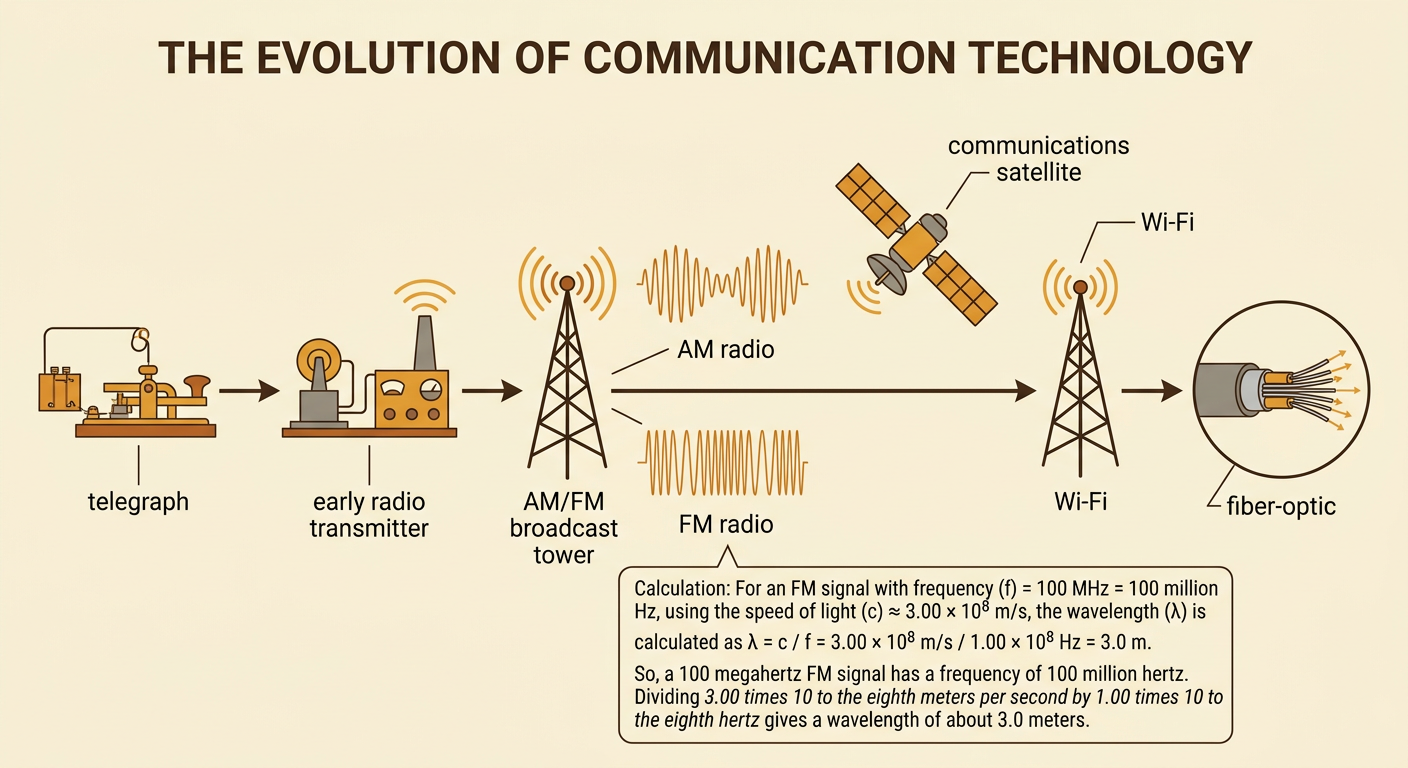
Communication technologies use waves to carry encoded information. In the 1800s, wired telegraph systems sent electrical pulses over conductors. By the late 1890s, wireless radio experiments demonstrated that electromagnetic waves could carry signals without a connecting wire. Later AM and FM broadcasting encoded sound by changing a carrier wave’s amplitude or frequency. Modern cellular networks, satellites, Wi-Fi, and fiber-optic systems continue the same basic goal but use different frequency bands, digital encoding, and transmission paths. For example, a 100 MHz FM radio signal traveling through air at approximately 3.00 × 10^8 meters per second has a wavelength of about 3.0 meters. Across this history, the need to encode, transmit, receive, and decode information shows continuity. Major changes include greater range, capacity, reliability, mobility, and speed, supported by improved control of wave frequency and wavelength.