
Wave Speed, Frequency, and Wavelength
Students analyze wave models and data to explain and apply the mathematical relationship among wave speed, frequency, and wavelength.
Illustrations are auto-generated and may be placeholders. They can be refreshed to match the narration.
Describing Periodic Waves
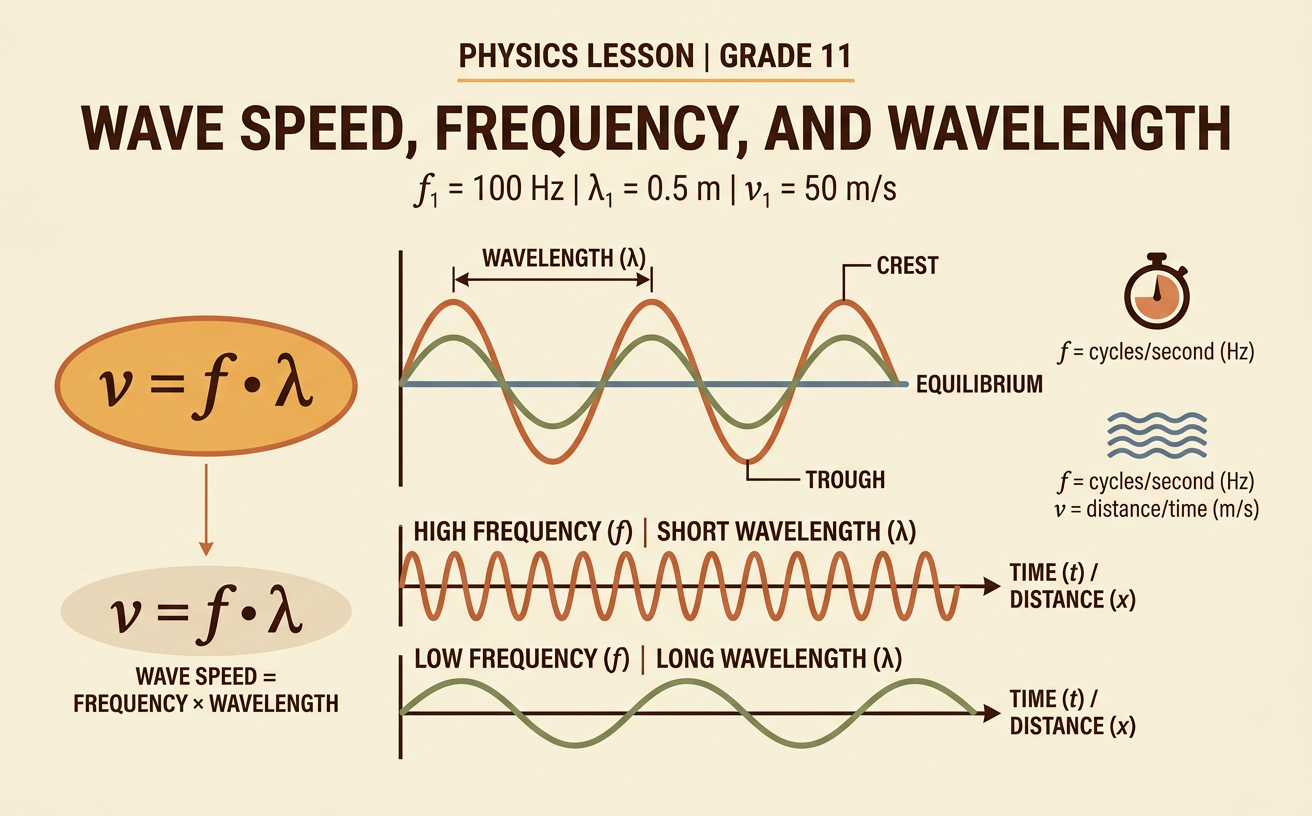
A periodic wave is a repeating disturbance that transfers energy without permanently transporting the material through which it travels. Frequency, f, is the number of complete cycles that pass a point each second and is measured in hertz, or Hz. Period, T, is the time for one cycle, so f = 1/T. Wavelength, λ, is the distance between matching points on neighboring cycles, such as crest to crest. Amplitude is the maximum displacement from equilibrium and is related to the wave’s energy, not directly to its speed. For example, if a water-wave crest passes a buoy every 0.50 second, the period is 0.50 s and the frequency is 1/0.50 s = 2.0 Hz. The buoy moves up and down while the wave pattern and its energy travel across the water.

Reading Wave Diagrams
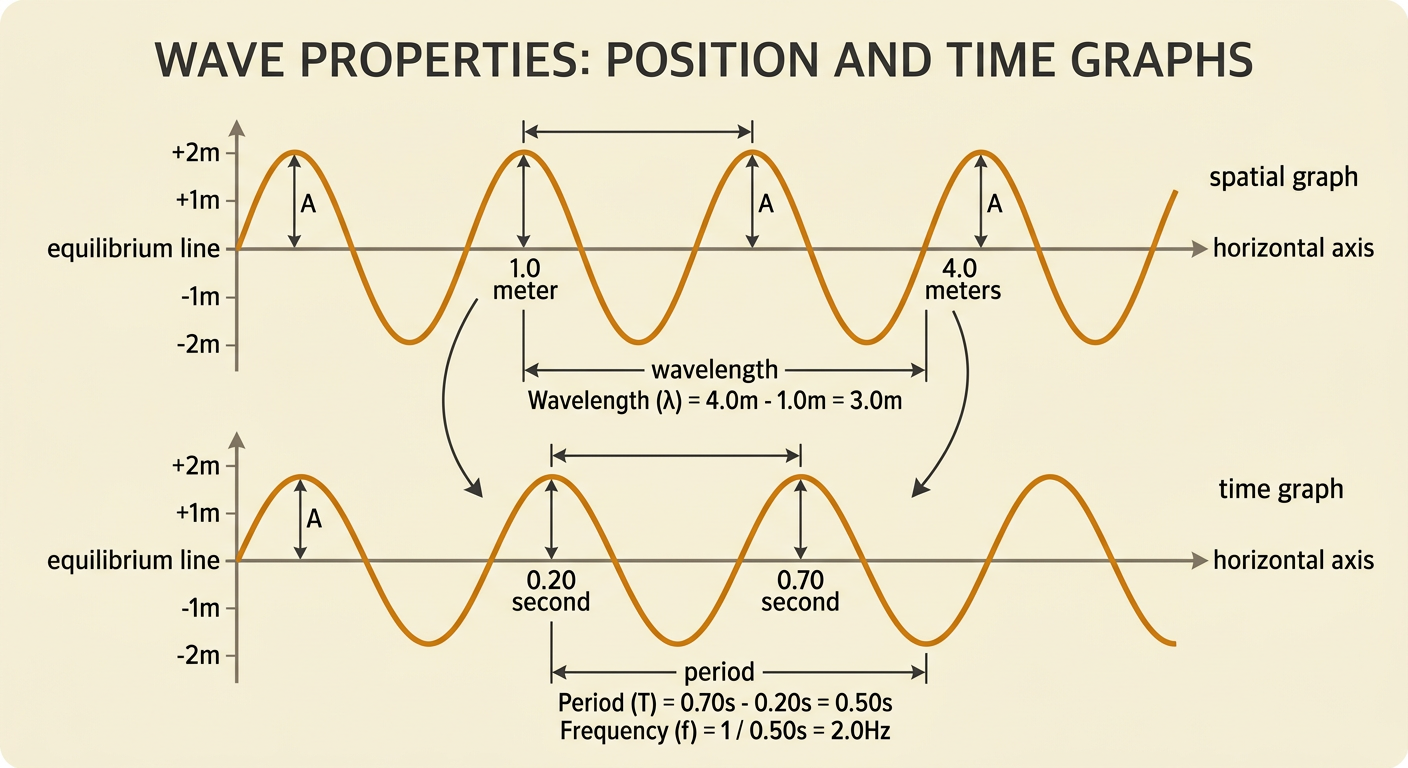
A spatial wave diagram shows displacement versus position at one instant. On this graph, wavelength is read along the horizontal position axis between two consecutive points in the same phase, such as two crests or two upward equilibrium crossings. Amplitude is read vertically from the equilibrium line to a crest or trough. A time graph is different: it shows displacement at one location as time passes, so the horizontal distance between crests represents the period, not wavelength. Suppose a spatial graph has crests at x = 1.0 m and x = 4.0 m. The wavelength is 3.0 m. If a time graph for the same wave has crests at t = 0.20 s and t = 0.70 s, its period is 0.50 s and its frequency is 2.0 Hz. Always check the horizontal axis before interpreting a wave graph.
Deriving v = fλ
Wave speed describes how quickly a recognizable point on a wave, such as a crest, moves through space. During one period, T, a crest advances by one wavelength, λ. Using speed equals distance divided by time gives v = λ/T. Because frequency and period are reciprocals, f = 1/T. Substituting f for 1/T produces the wave equation v = fλ. The units confirm the relationship: hertz means cycles per second, and multiplying s⁻¹ by meters per cycle gives meters per second. For example, a wave with frequency 5.0 Hz and wavelength 2.0 m travels at v = (5.0 s⁻¹)(2.0 m) = 10 m/s. For waves traveling in the same medium under unchanged conditions, speed is often constant, so increasing frequency causes wavelength to decrease.

Calculating Wave Quantities
The equation v = fλ can be rearranged to find any missing wave quantity: f = v/λ and λ = v/f. Before calculating, convert all measurements to compatible SI units, usually meters, seconds, hertz, and meters per second. Consider a sound wave traveling through air at 343 m/s with a frequency of 686 Hz. Its wavelength is λ = 343 m/s ÷ 686 s⁻¹ = 0.500 m. As another example, a wave with wavelength 1.5 m travels at 12 m/s. Its frequency is f = 12 m/s ÷ 1.5 m = 8.0 Hz. A useful reasonableness check is to substitute the result into v = fλ. Also include units and use a number of significant figures consistent with the given measurements.

Analyzing Frequency–Wavelength Data
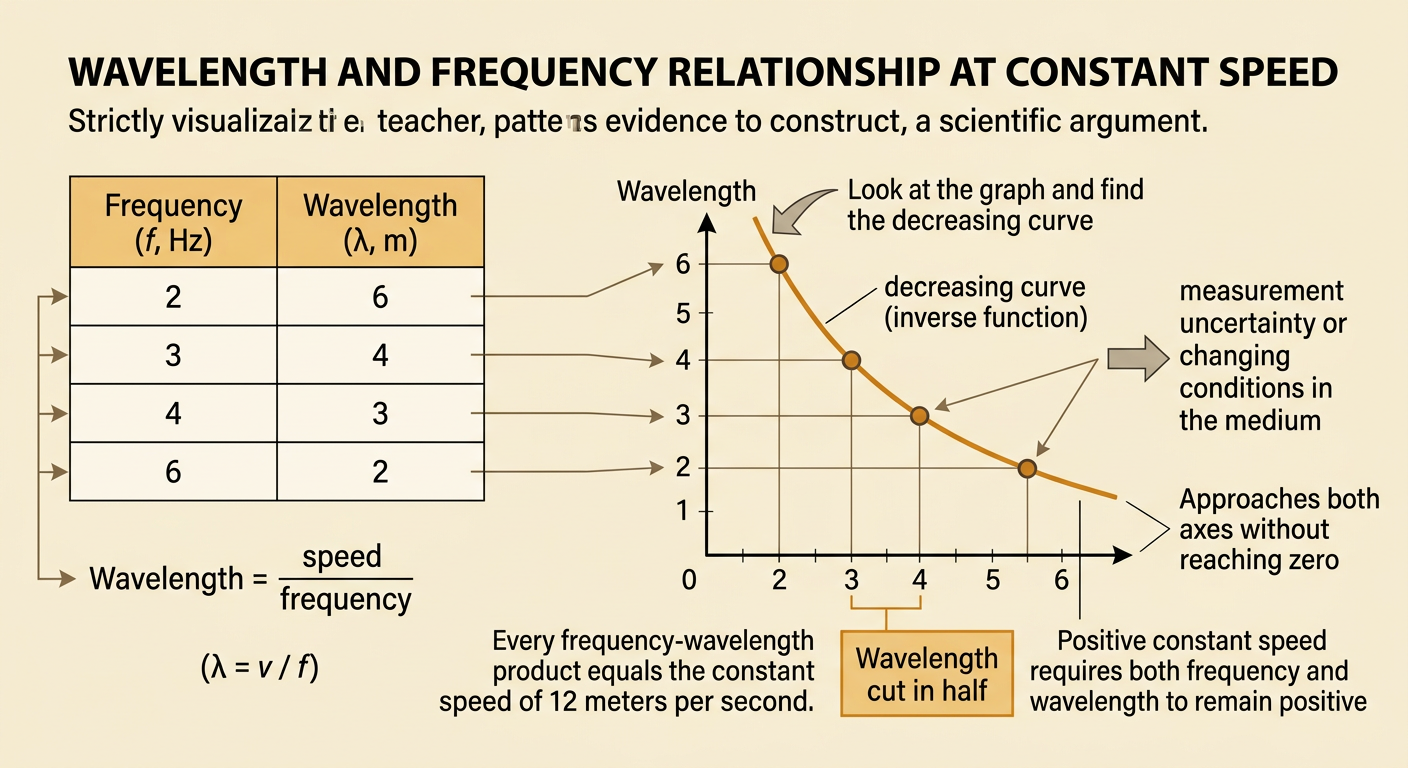
When wave speed stays constant, wavelength is an inverse function of frequency: λ = v/f. A graph of wavelength versus frequency therefore forms a decreasing curve rather than a straight line. For waves traveling at 12 m/s, frequencies of 2, 3, 4, and 6 Hz correspond to wavelengths of 6, 4, 3, and 2 m. In every row, the product fλ equals 12 m/s. Doubling frequency from 2 to 4 Hz halves wavelength from 6 to 3 m. The graph approaches both axes but does not reach zero because a positive constant speed requires positive frequency and wavelength. This pattern supports the interpretation that frequency and wavelength vary inversely when the medium and wave speed remain unchanged. If fλ differs noticeably across trials, measurement uncertainty or changing conditions may be involved.
Making an Evidence-Based Claim
A strong scientific argument includes a precise claim, relevant evidence, and reasoning that connects the evidence to a mathematical model. Consider wave data collected in one medium: at 5 Hz, λ = 4 m; at 10 Hz, λ = 2 m; and at 20 Hz, λ = 1 m. A supported claim is: As frequency increases, wavelength decreases inversely because the wave speed remains constant. The evidence shows that doubling frequency halves wavelength. It also shows that each product equals 20 m/s: 5 × 4 = 20, 10 × 2 = 20, and 20 × 1 = 20. The reasoning uses v = fλ: if v is constant, λ must decrease when f increases. A complete argument should identify the conditions, cite numerical patterns, include units, and avoid claiming that frequency alone determines speed in every medium.
