
Wave Speed: Frequency and Wavelength
Students analyze wave models and data to explain the mathematical relationship among wave speed, frequency, and wavelength and connect wave technologies to changes in communication.
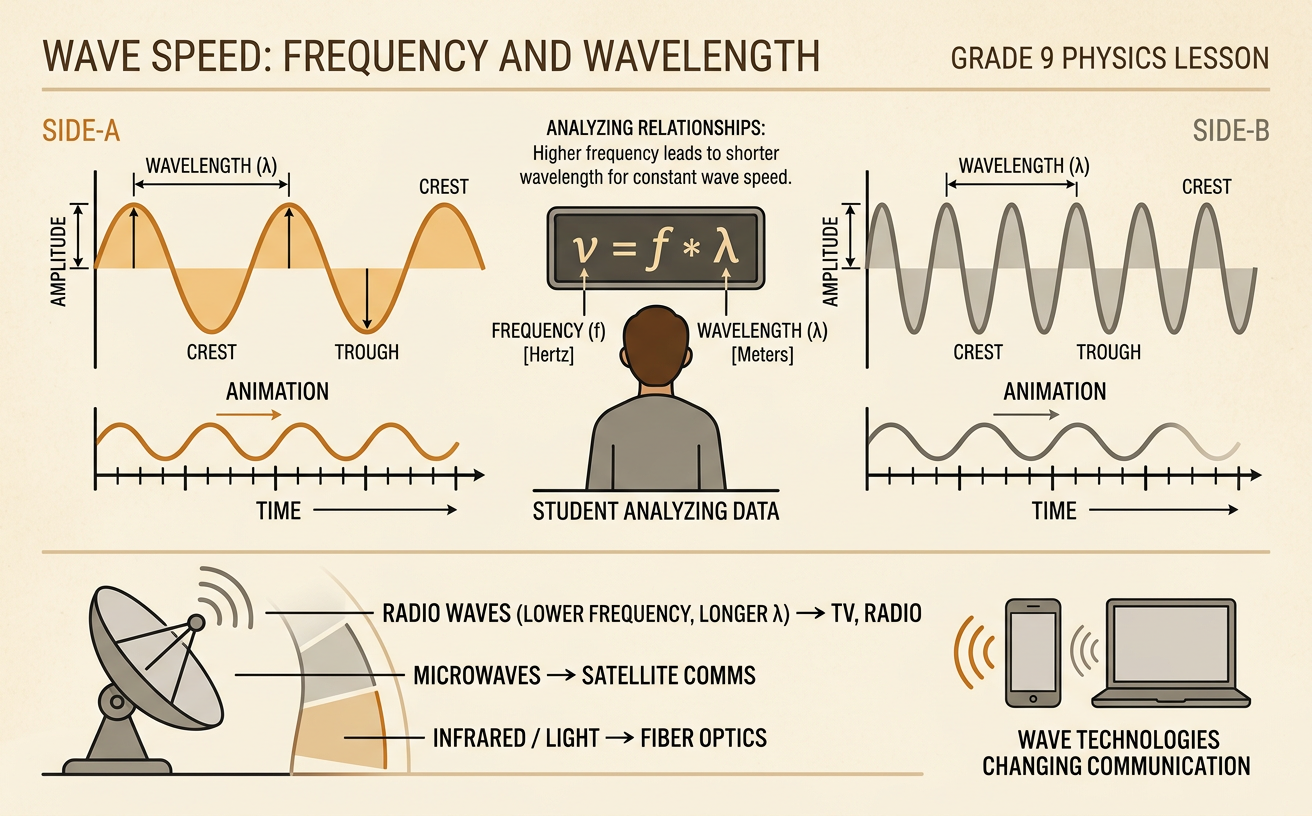
Illustrations are auto-generated and may be placeholders. They can be refreshed to match the narration.
Observing Wave Patterns
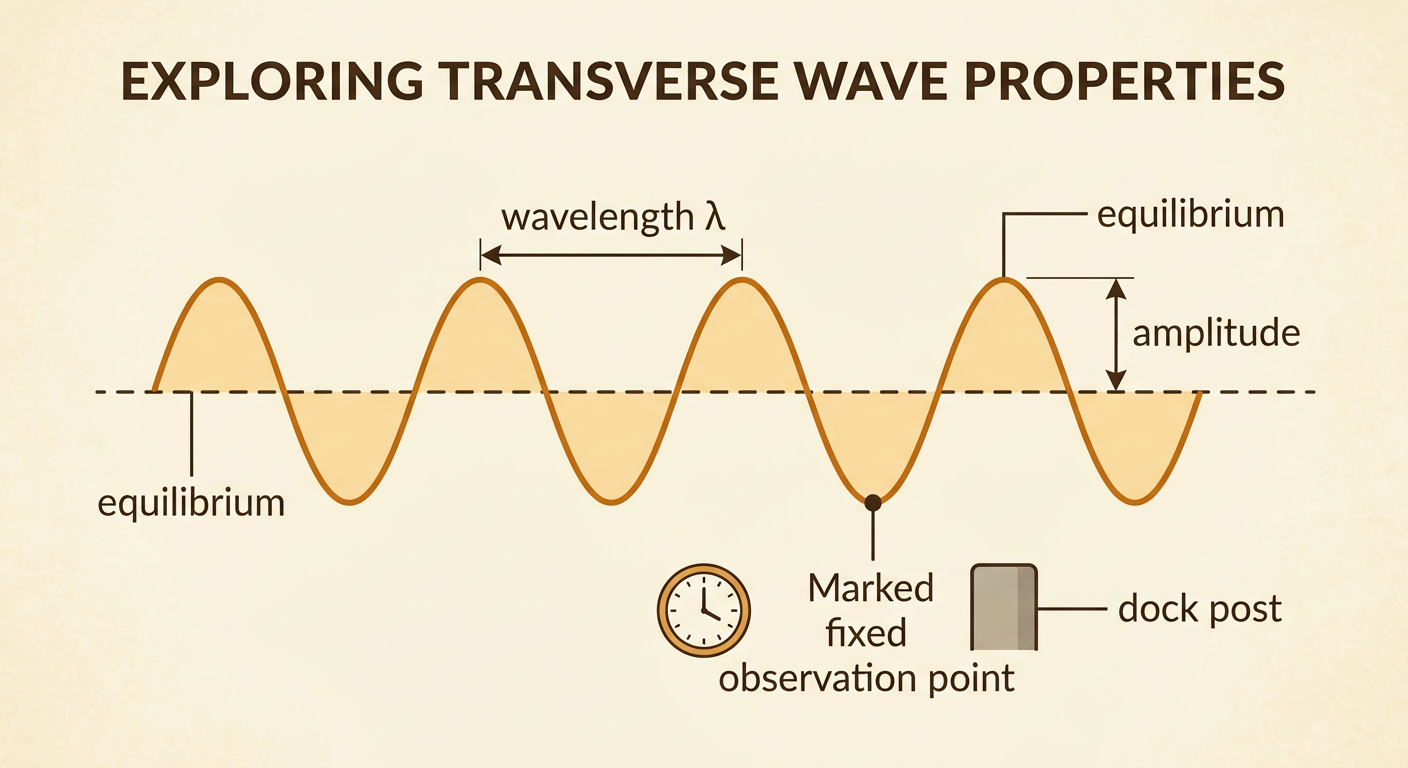
A wave is a repeating disturbance that transfers energy from one place to another without carrying matter along with it overall. A snapshot of a transverse wave shows a pattern of crests and troughs across distance. Observing one fixed point over time shows how often those crests pass that location. These two views describe different features of the same wave. For example, shake one end of a rope steadily while a partner holds the other end. If you begin shaking twice as quickly while the rope tension stays the same, more crests form along the rope and the crests are closer together. The wave speed remains approximately constant because the rope and its tension have not changed. Careful observations of spacing, timing, and motion provide evidence for a mathematical relationship among wave speed, wavelength, and frequency.

Defining Wavelength and Frequency
Wavelength, represented by the Greek letter λ, is the distance between matching points on neighboring wave cycles. It can be measured from crest to crest or from trough to trough and is usually expressed in meters. Frequency, represented by f, is the number of complete wave cycles that pass a point each second. Its unit is the hertz, where 1 hertz equals 1 cycle per second. Suppose six crests pass a dock post in three seconds. The wave frequency is 6 divided by 3, or 2 hertz. If the distance from one crest to the next is 1.5 meters, the wavelength is 1.5 meters. Amplitude is the maximum displacement from equilibrium, but it is not part of the wave speed equation. Keeping these quantities distinct helps students interpret wave diagrams and written descriptions accurately.
Using the Wave Speed Equation
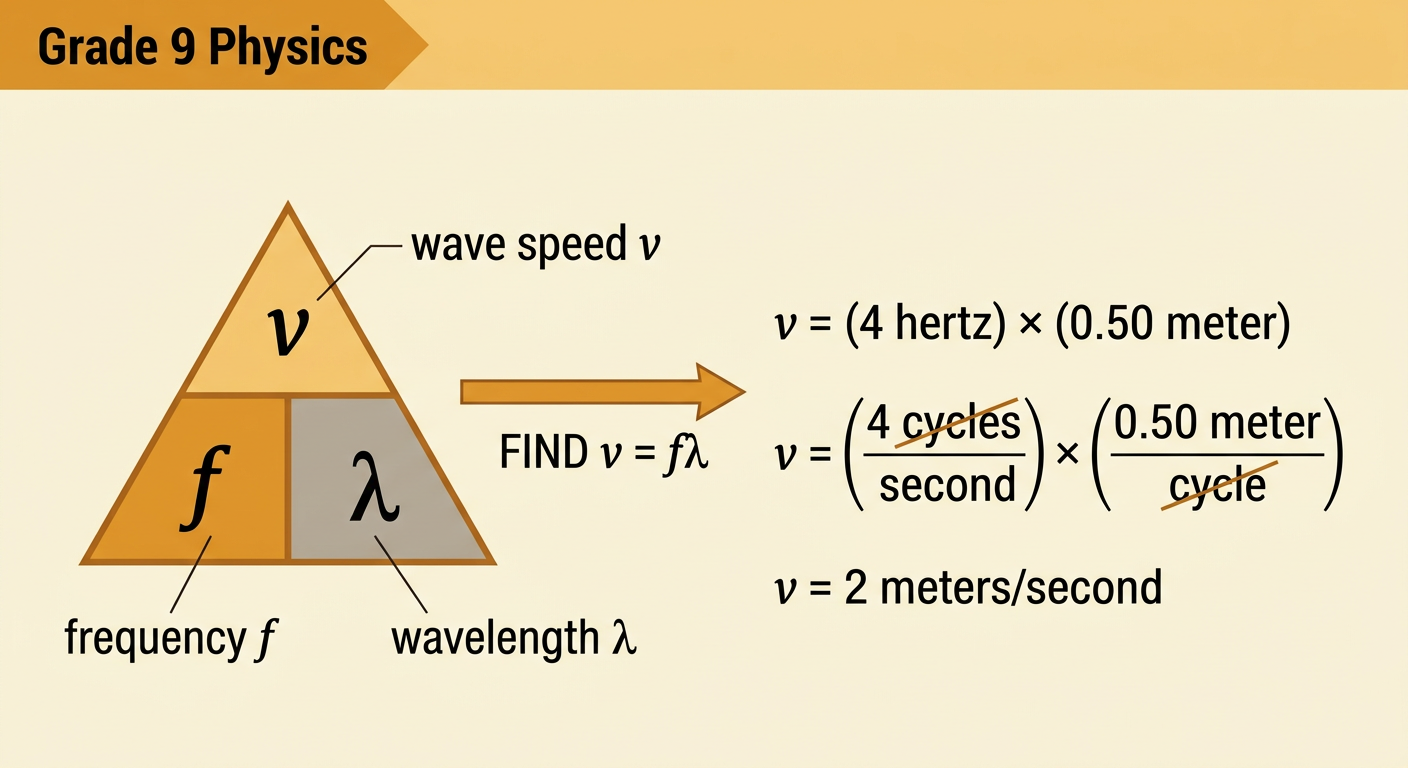
Wave speed is related to frequency and wavelength by the equation v = fλ. In this expression, v is wave speed in meters per second, f is frequency in hertz, and λ is wavelength in meters. The units support the relationship: cycles per second multiplied by meters per cycle gives meters per second. For example, a water wave with a frequency of 4 hertz and a wavelength of 0.50 meter has a speed of v = 4 × 0.50, or 2 meters per second. The equation can also be rearranged. Frequency is f = v/λ, and wavelength is λ = v/f. In a given medium where wave speed is constant, increasing frequency produces a shorter wavelength. This inverse relationship does not mean that frequency alone sets the speed; properties of the medium determine the wave speed.
Analyzing Wave Data
Data can reveal whether a wave model supports the equation v = fλ. Consider waves traveling through the same rope under constant tension. Trial A has a frequency of 2 hertz and a wavelength of 3 meters, so its speed is 6 meters per second. Trial B has a frequency of 3 hertz and a wavelength of 2 meters, which also gives 6 meters per second. Trial C has a frequency of 6 hertz and a wavelength of 1 meter, again giving 6 meters per second. The products are equal even though frequency increases and wavelength decreases. A graph of wavelength versus frequency forms a downward curve rather than a straight line because λ = v/f. These calculations support the claim that speed remains constant in the same medium and that frequency and wavelength are inversely related under those conditions.
Waves and Communication Technology
Communication technologies use waves to carry encoded information across distance. In the 1800s, wired telegraphs sent electrical pulses representing letters, greatly reducing the time needed to communicate compared with physical mail. Later, radio transmitted information with electromagnetic waves through the air, allowing wireless broadcasting to many receivers. Modern fiber-optic systems send rapid pulses of light through thin glass fibers and can carry enormous amounts of digital data. The technologies changed from electrical pulses in wires to radio signals and light pulses, but an important continuity remains: each system encodes a message in a controlled wave or signal and requires a transmitter and receiver. Engineers use frequency, wavelength, speed, and travel time when designing these systems. For example, higher-frequency electromagnetic waves have shorter wavelengths in the same medium, which affects antenna size and how signals interact with materials.
