
Waves, Sound, and Light
Students connect wave properties to energy transfer and use wave models to explain sound, interference, diffraction, and basic optics.
Illustrations are auto-generated and may be placeholders. They can be refreshed to match the narration.
Wave Properties
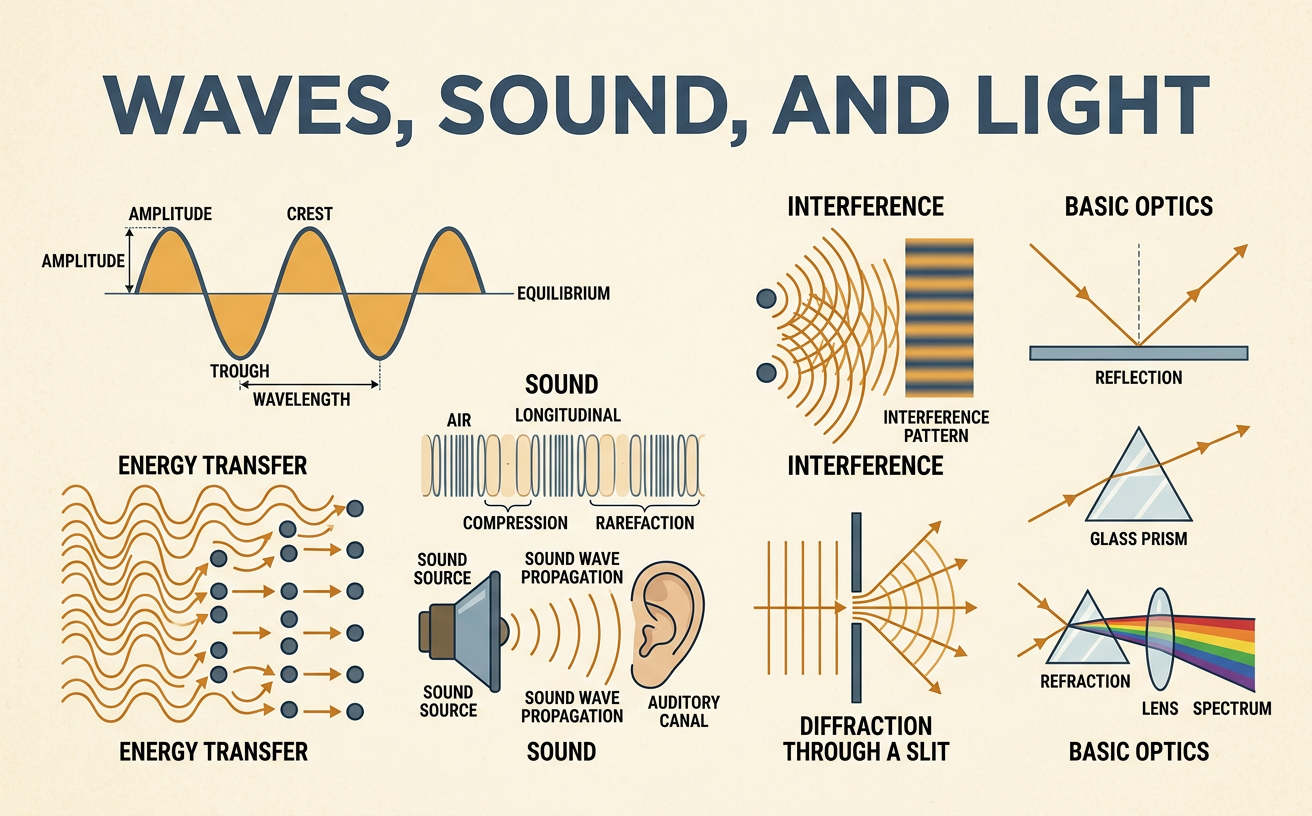
A wave is a repeating disturbance that transfers energy without producing a net transfer of matter. Amplitude is the maximum displacement from equilibrium, wavelength is the distance between matching points such as adjacent crests, and frequency is the number of cycles per second, measured in hertz. The period is the time for one cycle, so T = 1/f. A sinusoidal wave can be modeled by y = A sin(2πft), where A is amplitude. Greater amplitude generally means greater energy or intensity, although the exact relationship depends on the type of wave. For example, shaking one end of a rope more vigorously creates pulses with larger amplitudes, but the rope segments still oscillate around their original positions rather than traveling with the pulse.
The Wave Equation
Wave speed, frequency, and wavelength are related by v = fλ. Wave speed v is measured in meters per second, frequency f in hertz, and wavelength λ in meters. If the speed remains constant, frequency and wavelength are inversely related: increasing frequency decreases wavelength. For example, a sound wave traveling through room-temperature air at 343 m/s with a frequency of 686 Hz has a wavelength of λ = v/f = 343/686 = 0.50 m. A graph of displacement against time can be modeled with a trigonometric function such as y = A sin(2πft + φ), where φ represents phase. This mathematical model predicts repeating values and helps compare waves that begin at different points in their cycles.
Sound and Resonance
Sound is a mechanical longitudinal wave produced by vibrating matter. In air, particles oscillate parallel to the direction of travel, creating alternating compressions and rarefactions. Frequency determines perceived pitch, while amplitude is related to sound intensity and perceived loudness. Resonance occurs when a periodic force drives a system near one of its natural frequencies, producing a large-amplitude response. For example, blowing across the top of a bottle makes the air column resonate. Adding water shortens the vibrating air column, raising its resonant frequency and pitch. In a tube open at both ends, the fundamental standing wave has antinodes at both ends and a node at the center, so the tube length equals one-half wavelength. Musical instruments use tube length and resonance to select and amplify particular frequencies.
Interference and Diffraction
Interference occurs when waves overlap and their displacements add according to superposition. In constructive interference, crests align with crests and produce a larger amplitude. In destructive interference, a crest aligns with a trough and reduces or cancels the amplitude. Diffraction is the spreading of waves around an obstacle or through an opening, and it is strongest when the opening is similar in size to the wavelength. For example, water waves passing through a narrow gap spread into nearly circular wavefronts. In 1801, Thomas Young used a double-slit experiment to produce alternating bright and dark bands of light. This evidence supported a wave model of light during a period when Newton’s particle model remained influential, showing how existing scientific authority and new experimental tools shaped the debate.
Reflection and Refraction
Reflection occurs when a wave returns from a boundary. For a smooth surface, the angle of incidence equals the angle of reflection, with both angles measured from the normal line. Refraction is a change in direction caused by a change in wave speed as a wave enters another medium. Light entering glass from air slows and bends toward the normal. Snell’s law, n1 sin θ1 = n2 sin θ2, relates refractive indices and angles. For example, light traveling from air into glass at 30° bends to about 19° if the glass has a refractive index of 1.5. Seventeenth-century improvements in lenses, prisms, and angle measurement helped scientists such as Willebrord Snell and Christiaan Huygens develop quantitative explanations of light. Their work shows how improved instruments and expanding optical technology influenced scientific discovery.