
We Need Light to See
Students observe that objects can be seen only when light illuminates them or travels from them to the eye.

Illustrations are auto-generated and may be placeholders. They can be refreshed to match the narration.
What Helps Us See?
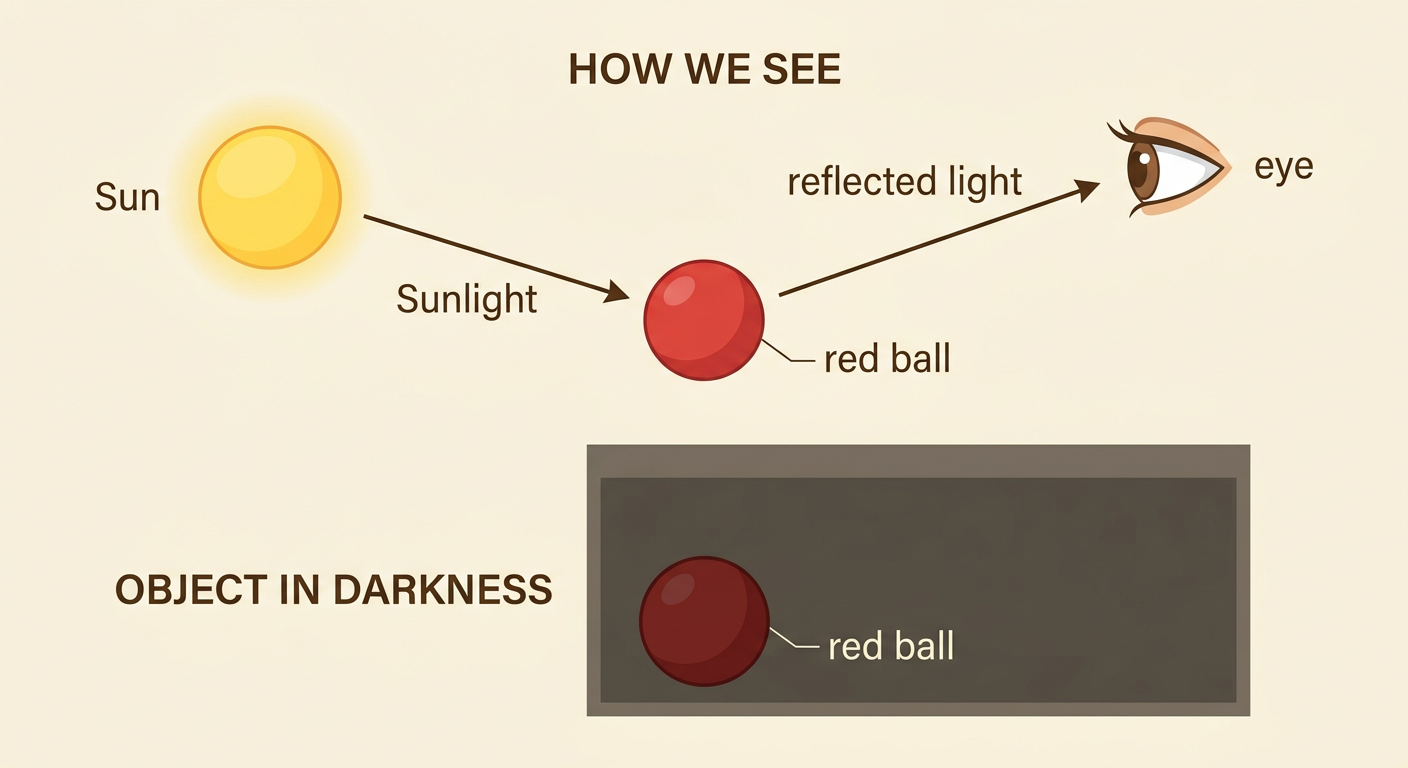
We need light to see objects. Some things, such as the Sun, a lamp, or a flashlight, give off light. Most objects do not make their own light. Light from a source shines on an object and reflects, or bounces, toward our eyes. Then we can see the object. For example, you can see a red ball outside because sunlight shines on the ball and reflected light travels to your eyes. In a room with no light, the same ball is still there, but you cannot see it. Our eyes do not send out light. They receive light. Talk with a partner about objects you can see now. What light source is helping you see them?
Observe an Object in Low Light
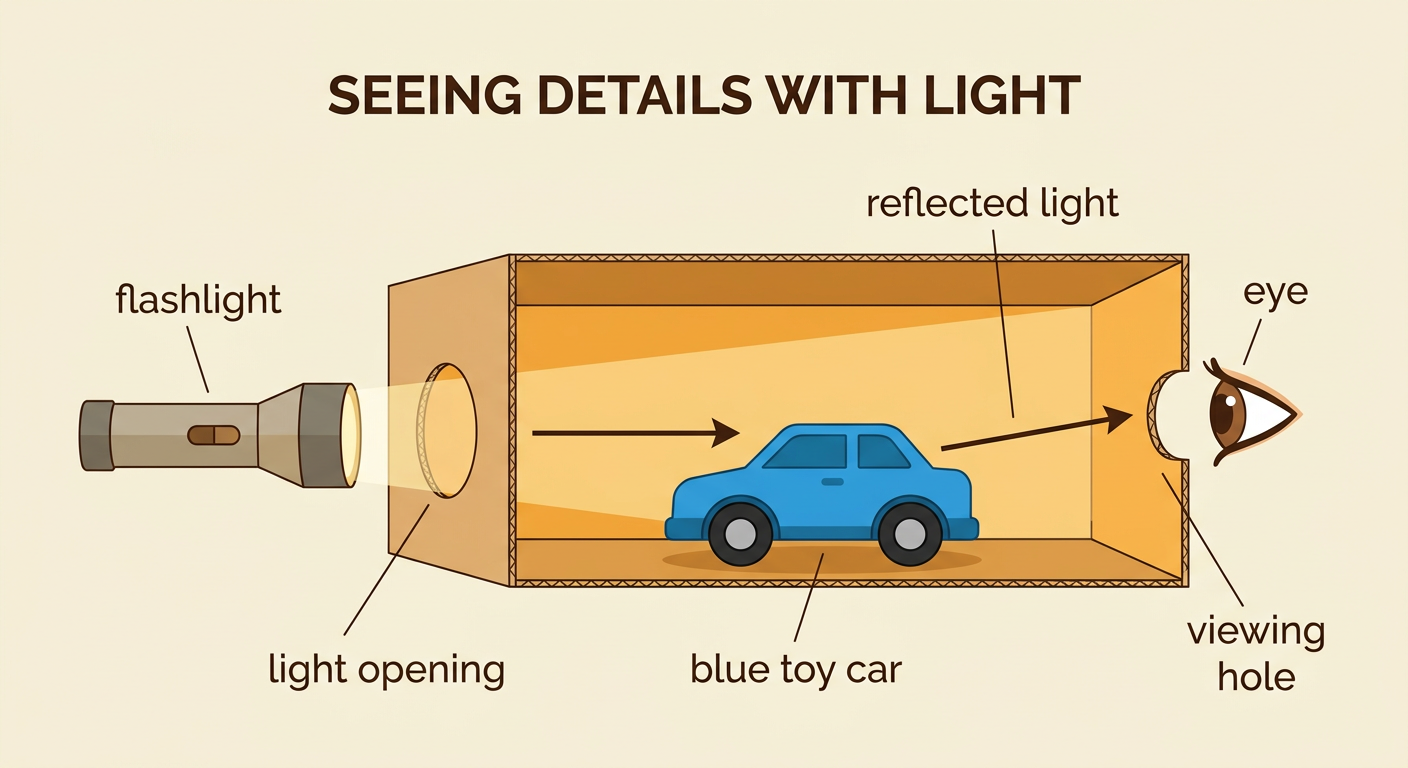
Now make a careful observation in low light. Your teacher can place a small toy inside a shoebox with a viewing hole. With the lid closed and the light opening covered, look through the viewing hole. Do not open the box yet. Ask yourself: Can I see the toy clearly, see only a little, or not see it? Tell a partner exactly what you observe. Do not guess the toy's color or shape if you cannot see it. For example, you might know that a toy car is inside, but in darkness you may not see its wheels or color. Record your observation. Your own careful observation is a useful source of information because it helps answer the question, “Can an object be seen without light?”

Add Light and Observe Again
Keep the same toy in the same place. Now your teacher uncovers the light opening and shines a flashlight through it. Never shine a flashlight into anyone's eyes. Look through the viewing hole again. What can you see now? Notice the toy's color, shape, and parts. For example, the toy car that was hidden in darkness may now look blue and have four black wheels. The toy did not change. The amount of light changed. Flashlight light traveled to the car, reflected from the car, and traveled into your eye. Compare this observation with your first one. Tell a partner one new detail you can see. Record whether you can now see the object clearly, see a little, or not see it.
Sort the Observation Results
Combine the class observations and sort them into three categories: could see clearly, could see a little, and could not see. Make one chart for the low-light test and one chart for the test with added light. Place a tally mark in the correct category for each observation. Then count the marks. For example, the low-light chart might show one child could see a little and nine could not see. The added-light chart might show all ten children could see clearly. Compare the numbers using words such as more, fewer, and same. Ask, “Which category has more observations after light was added?” A chart is a useful information source because it organizes everyone's observations and makes the pattern easier to notice.
Explain the Evidence
Use the observations to answer the question: What helps us see an object? Make a claim: We can see an object when light illuminates it and reflected light reaches our eyes. Then give evidence. You might say, “I could not see the toy when the box was dark, but I could see its blue color and wheels after the flashlight was added.” Explain why the evidence matters: the toy stayed in the same place, but adding light made it visible. Listen as classmates share their evidence, and ask a question if an idea is unclear. The before-and-after observations and class chart are useful sources because they show what happened. Together, the evidence supports the idea that eyes need incoming light to see an object.