We Need Light to See Objects
Students investigate objects under different lighting conditions, graph their observations, and explain that objects are visible only when light shines on them.

Illustrations are auto-generated and may be placeholders. They can be refreshed to match the narration.
Can We See in the Dark?
To see an object, light must reach it and then travel from the object to our eyes. In a room with no light at all, we cannot see the objects around us. Our eyes may adjust to dim light, but they cannot see in complete darkness. Try thinking about a red toy car inside a closed box. When the box is shut and no light enters, you cannot see the car through a viewing hole. When a flashlight shines through another hole, light hits the car and reflects toward your eyes. Now the car becomes visible. The car did not disappear in the dark. It was there the whole time, but there was no light traveling from the car to your eyes. Never look directly into a flashlight or shine one into someone’s eyes.

Test Different Lighting Conditions
We can investigate how lighting changes what we see. Place the same object, such as a blue block, inside a box with a viewing hole. First, observe it with all openings covered and no light entering. Next, let a small amount of light enter through a narrow opening. Finally, shine a flashlight through a side opening so the block is brightly illuminated. After each test, record whether the block is not visible, hard to see, or easy to see. Keep the object, box, viewing position, and observer the same so that light is the only condition that changes. This makes the test fair. A likely result is that the block cannot be seen with no light, is hard to see in dim light, and is easy to see in bright light. Use the flashlight safely and keep its beam away from people’s eyes.

Record and Graph Observations
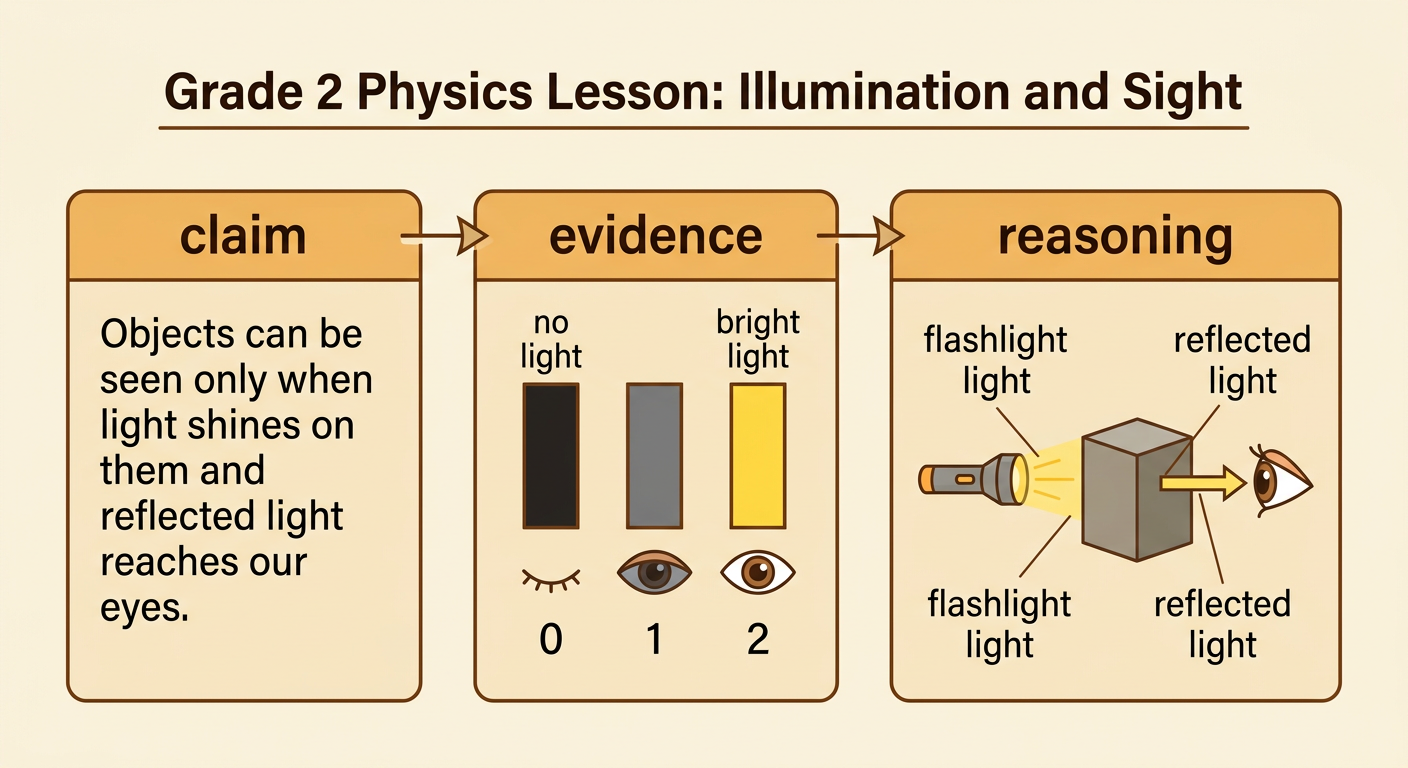
Scientists record observations so they can compare results. Make a table with three rows: no light, dim light, and bright light. For each condition, write what you observed or use a symbol. For example, you might record 0 for not visible, 1 for hard to see, and 2 for easy to see. Then make a bar graph. Label the bottom with the lighting conditions and the side with the visibility rating from 0 to 2. Draw one bar for each condition. If your results were 0, 1, and 2, the bright-light bar will be tallest. You could also make a picture graph in which each eye symbol represents one visibility point. Give the graph a title and check that each bar matches your observations. The graph makes the pattern easy to notice: greater illumination usually makes the object easier to see.

Explain How Light Helps Us See
Light can come from the Sun, a lamp, a candle, or a flashlight. A source gives off light, and the light travels outward. When light reaches an object, some of it reflects, or bounces, off the object. If that reflected light enters our eyes, we can see the object. Imagine reading a book near a lamp. Light travels from the lamp to the pages. Some light reflects from the white paper and dark letters into your eyes, so you can see the words. The book does not make its own light. It is visible because it is illuminated by the lamp. In complete darkness, no light reaches the pages and reflects to your eyes, so you cannot see the words. In dim light, less reflected light reaches your eyes, and the words may be harder to see.

Compare Lighting Then and Now
People in the past also needed light to see after sunset. Long ago, many families used candles, oil lamps, or light from a fireplace. These sources gave less light than many electric lamps used today. They also had open flames, which could start fires. A child doing schoolwork by candlelight might have kept the book close to the small area of light. Today, a child may use an electric desk lamp that brightly illuminates a larger area. Modern homes may also have ceiling lights and battery-powered flashlights. Both past and present lighting serve the same basic purpose: they illuminate objects so people can see them. However, the sources, brightness, safety, and ways people power the lights have changed over time. Comparing these details helps us understand how daily life was different in the past.

Make an Evidence-Based Claim
An evidence-based claim answers a question using observations from an investigation. Ask, “Do objects need to be illuminated for us to see them?” A clear claim is: Objects can be seen only when light shines on them and reflected light reaches our eyes. Next, give evidence from your test. For example: “I could not see the block with no light. It was hard to see in dim light and easy to see in bright light. My graph showed ratings of 0, 1, and 2.” Finally, explain why the evidence supports the claim: Light from the flashlight hit the block and reflected toward my eyes, making the block visible. This response uses what you did, saw, and recorded. Another student’s results may use different words or symbols, but the claim should match the observed pattern and explain the role of light.