
Weather Patterns Around Us
Students observe and classify local weather conditions, identify simple patterns, and discuss how weather affects what people wear and do.
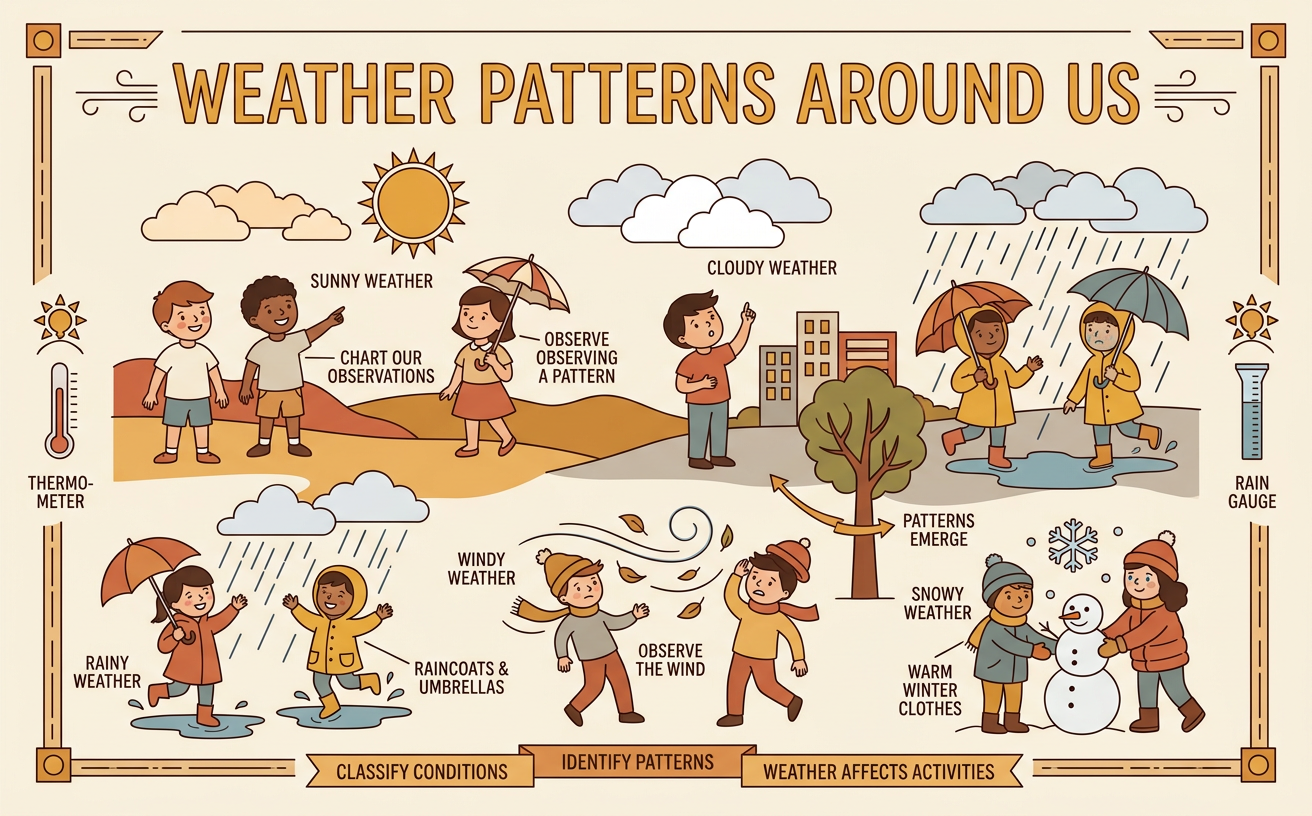
Illustrations are auto-generated and may be placeholders. They can be refreshed to match the narration.
Notice Today’s Weather
Weather tells what the air and sky are like at a certain place and time. Go outside with an adult or look safely through a window. Notice the sky, wind, temperature, and precipitation. Precipitation is water that falls from clouds, such as rain or snow. Use your senses safely: look at tree branches for wind and notice whether the air feels warm or cool. Do not look directly at the sun. For example, you might observe gray clouds, moving leaves, cool air, and light rain. Record only what you notice today. Weather can change later in the day, so include the time with your observation. Share your observation with the class using a sentence such as, “This morning is cool, cloudy, windy, and rainy.”
Name Weather Types
Weather can be described with words that name what we observe. Sunny means the sun is shining with few clouds blocking it. Cloudy means much of the sky is covered by clouds. Rainy means water drops are falling from clouds. Snowy means ice crystals are falling as snow. Windy means the air is moving strongly enough to move flags, leaves, or branches. A day can fit more than one weather type. For example, a day can be cloudy, windy, and rainy at the same time. Temperature words add more information. The air may feel hot, warm, cool, or cold. Choose words that match the evidence you see. If dark clouds cover the sky but no rain is falling, call the weather cloudy, not rainy.
Sort Weather Picture Cards
Sorting means putting things into groups by a shared feature. Look closely at each weather picture card and find its strongest clue. A bright sun can go in the sunny group. Dark clouds covering the sky can go in the cloudy group. Falling drops can go in the rainy group, and falling snowflakes can go in the snowy group. Place cards with flags or trees bending strongly in the windy group. Agree on one sorting rule before you begin. For example, the class may sort each card by the main weather symbol shown. A real day can have several conditions, but each card goes into one group for this activity. After sorting, check every card. Explain your choice by saying, “I put this card here because I see falling raindrops.”
Count Each Weather Group
After sorting the weather cards, count how many cards are in each group. Touch each card once as you say the counting numbers. Write the total beside the group. For example, suppose there are 4 sunny cards, 2 cloudy cards, 3 rainy cards, 1 snowy card, and 2 windy cards. The sunny group has the most because 4 is greater than every other total. The snowy group has the fewest because it has only 1 card. Cloudy and windy have the same number, so their counts are equal. Put the categories in order from most cards to fewest cards. If two groups have equal counts, place them together. Counting and comparing help the class describe which weather types appear more often in the card set.
Find a Weather Pattern
A weather pattern is something that repeats or happens often over time. Record the local weather at the same time each day. Then look across the observations. For example, a seven-day chart might show sunny, sunny, rainy, rainy, sunny, cloudy, and sunny. Sunny appears on 4 days, more than any other type. There are also two rainy days in a row. These are patterns in the week’s observations. A pattern does not promise exactly what tomorrow’s weather will be, but it helps us describe what has happened. Use evidence from the chart when you share a pattern. You might say, “Sunny weather happened most often this week,” or, “Rainy weather happened on two days in a row.” Keep recording for more days to see whether a pattern continues or changes.
Connect Weather to Daily Life
Weather affects what people wear and what they do. On a rainy day, a person may wear a raincoat and boots and carry an umbrella. Outdoor games may move indoors if there is heavy rain or lightning. On a cold, snowy day, people may wear coats, hats, and gloves. They may clear snow from sidewalks. On a hot, sunny day, people may choose light clothing, drink water, and rest in the shade. Wind can help a kite fly, but very strong wind can make outdoor activities unsafe. People in different places prepare for the weather they often experience. Always choose clothing and activities with help from a trusted adult. For example, if today is cool and rainy, wearing boots and playing a board game indoors may be sensible choices.