
What Artifacts Reveal About Community Life
Students examine photographs and everyday artifacts to compare past and present community life, then define requirements for a museum display that would protect and explain one artifact.
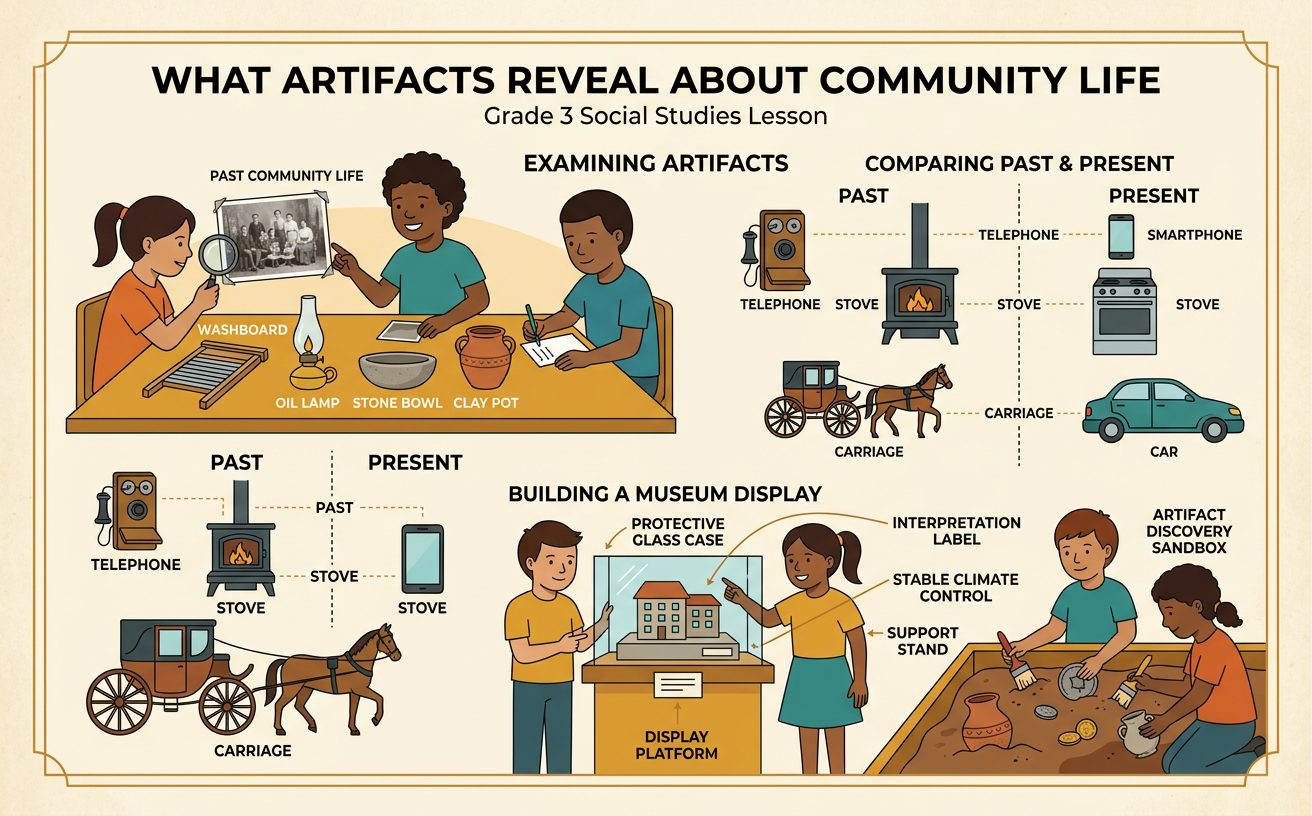
Illustrations are auto-generated and may be placeholders. They can be refreshed to match the narration.
Meet the Mystery Artifact
An artifact is an object made or used by people in the past. It can give clues about how people lived, worked, traveled, learned, or played. Imagine that you see a wooden board with rows of metal ridges. Do not name it right away. First, notice its size, shape, parts, and materials. The worn wood and scratched metal suggest that people handled it many times. A museum label later identifies the object as a washboard used for cleaning clothes. People rubbed wet, soapy fabric against the ridges to loosen dirt. This artifact reveals that washing clothes once required more work by hand than it often does today. One object cannot tell a whole story, but it can begin an investigation of community life.

Observe Details and Ask Questions
Careful historians separate observations from ideas. An observation tells what you can directly see, such as, “The washboard has metal ridges and worn wooden edges.” An inference is an idea supported by observations, such as, “The washboard was probably used often.” Next, ask questions that could lead to more evidence. Who used this object? When and where was it used? How did it work? Was it used at home or in a business? Some questions may not be answered by the artifact alone. For example, scratches show that the washboard was used, but they do not identify its owner. Record each observation and connect it to a question. This process helps you avoid guessing and prepares you to search photographs, labels, books, and other sources for answers.

Use Sources to Gather Evidence
Historians use several sources to learn what an artifact means. A museum label may give the object’s name, date, place, and purpose. A historical photograph may show people using a similar object. An informational text may explain daily work during that period. Read each source closely and ask questions before, during, and after reading. For example, ask, “How did families wash clothes before electric washing machines?” A photograph might show a person using a washboard beside a tub. A text might state that clothes were soaked in soapy water, scrubbed, rinsed, and hung to dry. Answer the question with evidence from both sources. Also note who created each source and when, because a source made long afterward may contain different information from one created at the time.

Compare Past and Present Life
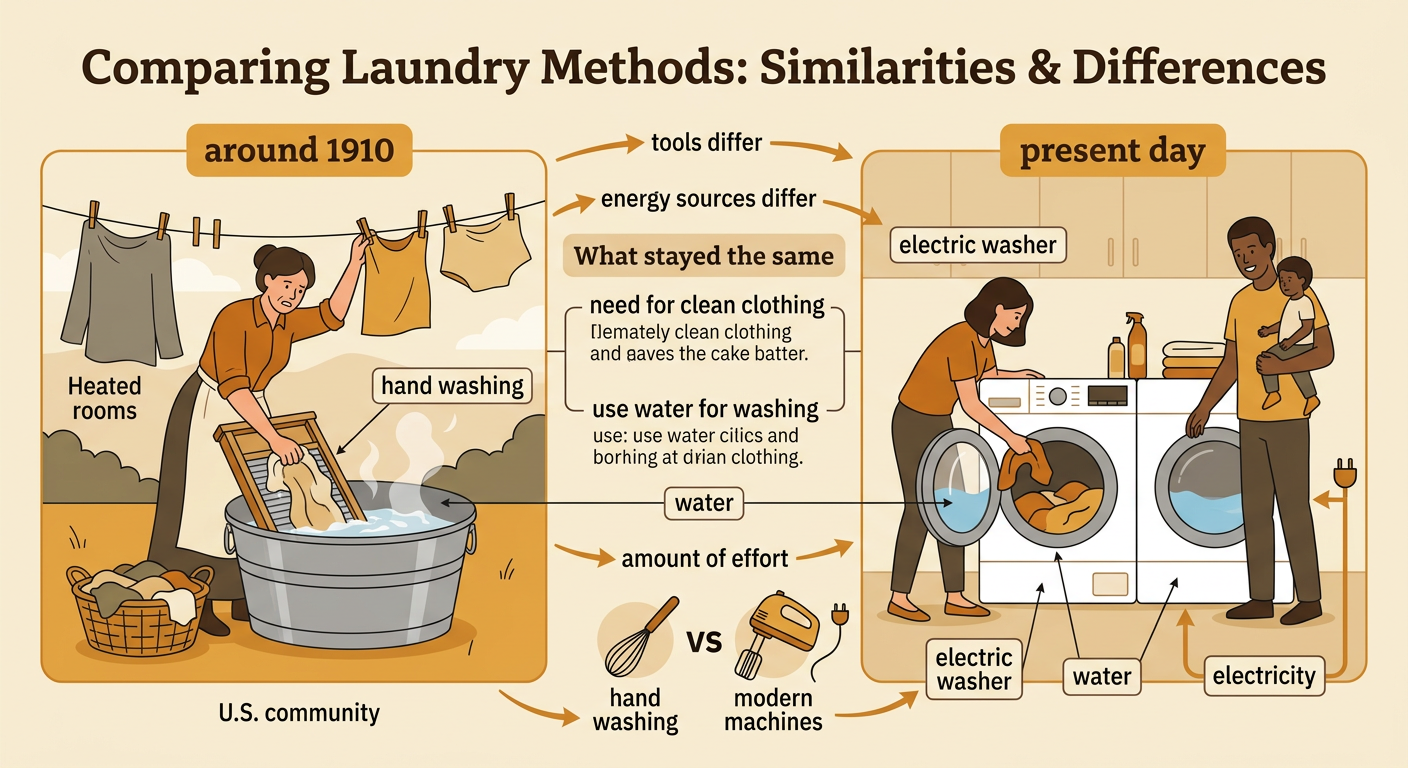
Artifacts and photographs can help you compare a specific historical period with life today. Suppose a photograph from a U.S. community around 1910 shows people washing clothes with tubs, washboards, and a clothesline. A present-day photograph shows a family using an electric washer and dryer. In both periods, people need clean clothing and use water to wash it. However, the tools, time, and energy sources are different. Hand washing required repeated scrubbing and lifting, while a modern machine performs much of the motion using electricity. Avoid saying that every family had the same experience. Some people today still wash clothing by hand, and not every family in 1910 used identical tools. Base each comparison on evidence from the particular artifacts, images, dates, and places you study.
Plan a Protective Museum Display
A museum display must protect an artifact and explain why it matters. Begin by defining the design problem, criteria for success, and constraints. For a washboard display, the criteria might be that visitors can see the front and back, read a clear label, and understand how the object was used without touching it. The display must also keep the artifact stable and away from spilled liquids. Constraints are limits such as a $20 materials budget, an 18-inch tabletop space, and two class periods for building. One solution is a clear cover over a padded, supportive base with a picture and short label beside it. Sketch the design and label each part. Then check every choice against the criteria and constraints. A successful design both protects the artifact and communicates evidence about community life.
