
What Dissolves in Water?
Students test salt, sugar, and sand in water, record what they observe, and identify materials that appear to dissolve.
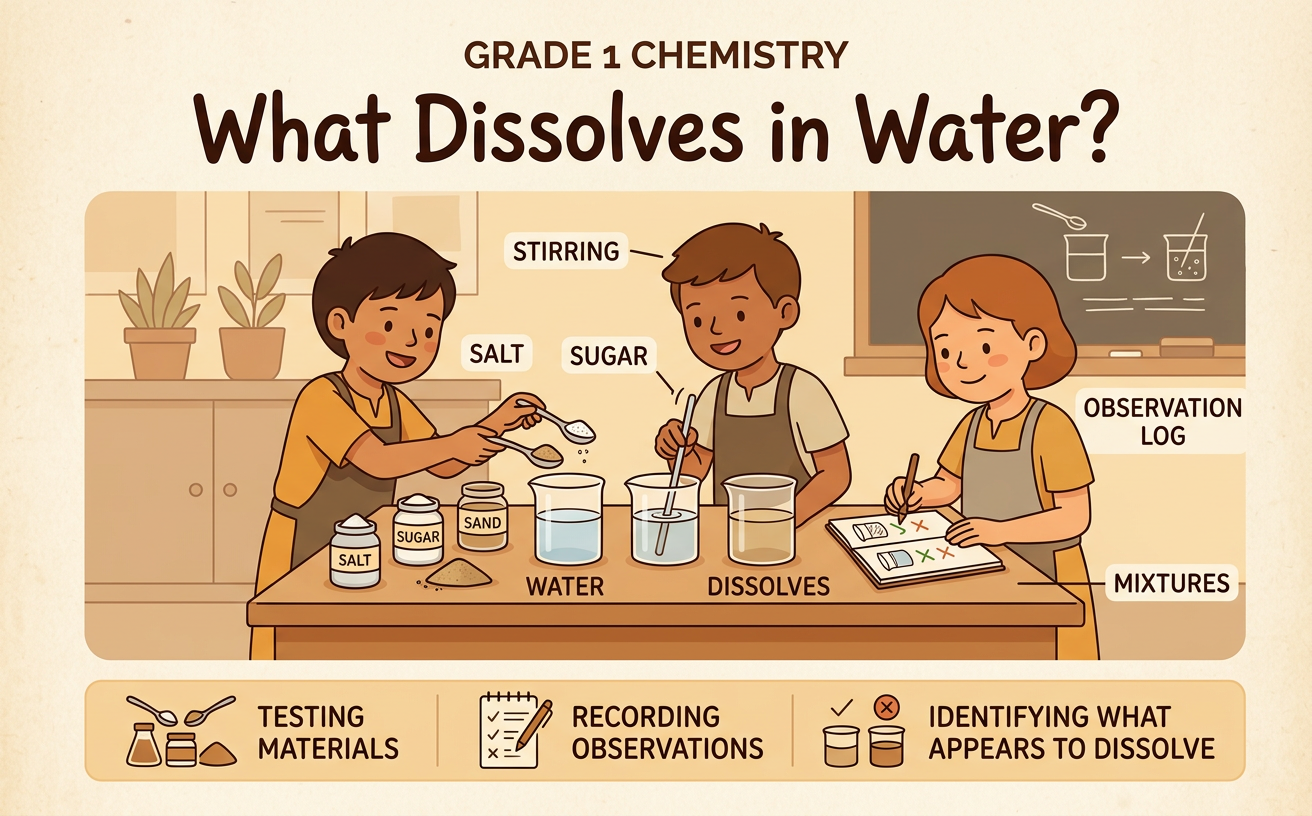
Illustrations are auto-generated and may be placeholders. They can be refreshed to match the narration.
Notice Materials in Water
Water can look different when another material is added. Put a spoonful of salt into water and stir. After a short time, the salt grains may no longer be visible. The salt has dissolved, which means it mixed evenly throughout the water. The salt is still there even though you cannot see it. Sugar can also dissolve in water. Sand acts differently. It may make the water cloudy while it is moving, but most sand grains eventually sink to the bottom. Scientists use their senses, especially sight, to notice these properties. They do not taste materials during an investigation. Careful observations help scientists describe and classify what materials do in water.

Make a Prediction
Before testing, make a prediction about each material. A prediction tells what you think will happen and can be based on something you already know. You might predict, “I think sugar will dissolve because I have seen sugar mixed into a drink.” For salt, sugar, and sand, choose one result: will dissolve, might dissolve, or will not dissolve. Share your ideas with a partner. Take turns speaking and listen while your partner explains. Partners may make different predictions, and that is okay. A prediction is not a guess that must be correct. The investigation will provide evidence. Record your predictions before you begin so you can compare them with what actually happens.

Test Salt, Sugar, and Sand
Use three clear cups with the same amount of room-temperature water. Label the cups salt, sugar, and sand. Add one level teaspoon of the correct material to each cup. Stir every cup gently for the same amount of time, such as 20 slow stirs. Using equal amounts and equal stirring makes the test fair. Watch each cup while you stir and again after one minute. Look for grains floating, disappearing from view, or settling at the bottom. Do not taste the water or touch your eyes. Ask an adult to help with spills. For example, the sand may move through the water during stirring and then collect at the bottom when the cup is left still.

Record What Happens
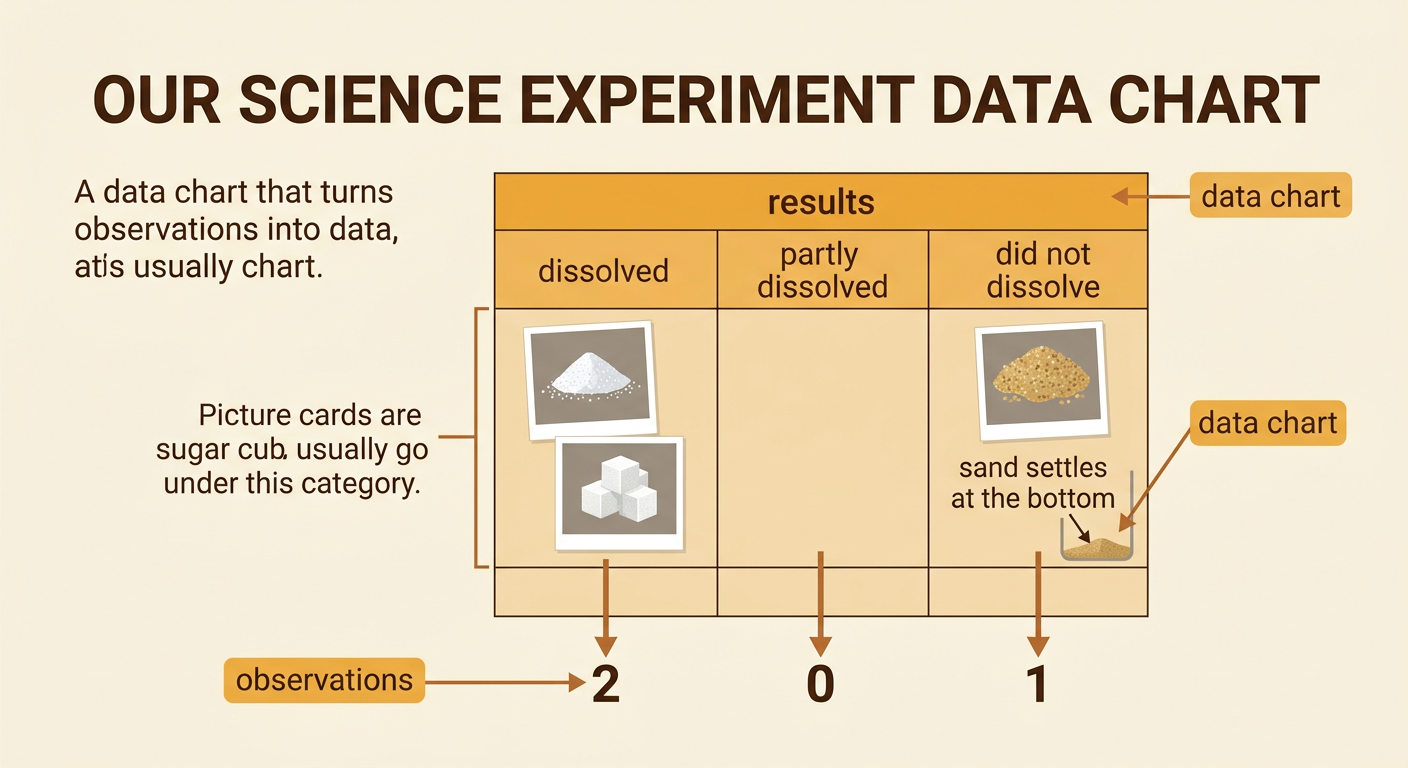
Record observations in a three-category data chart. The categories can be dissolved, partly dissolved, and did not dissolve. Write or draw what you see after stirring and waiting. If no grains are visible and the water looks evenly mixed, mark dissolved. If some grains disappear but some remain, mark partly dissolved. If the material stays visible or settles, mark did not dissolve. With small spoonfuls in enough water, salt and sugar will usually be placed in the dissolved category. Sand will usually be placed in the did not dissolve category. Count the marks in each category. For example, your class may record two materials as dissolved, zero as partly dissolved, and one as not dissolved.
Compare Results
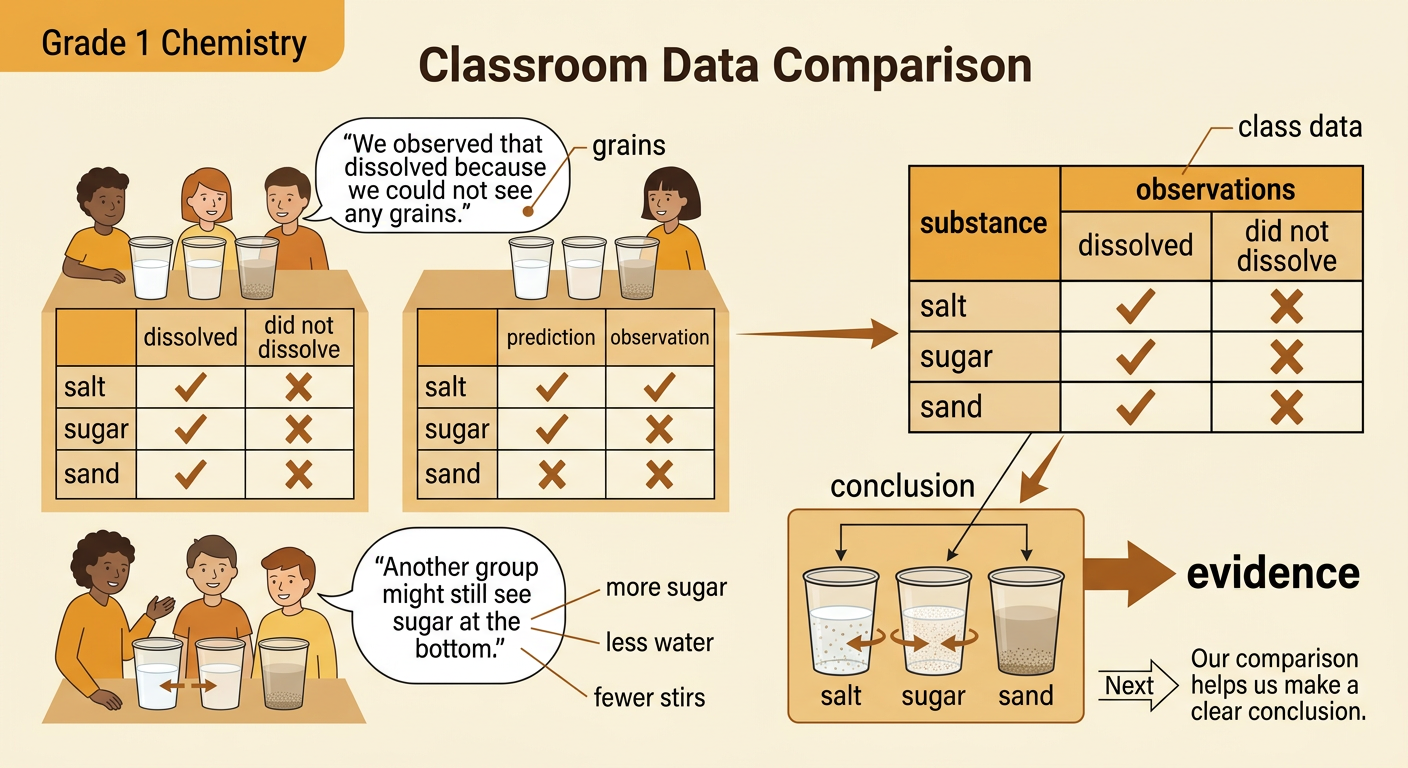
Compare your results with your predictions and with another group’s results. Use conversation rules: face the speaker, listen carefully, take turns, and ask questions kindly. You might say, “We observed that the sugar dissolved because we could not see any grains.” Another group may have some sugar left at the bottom. Ask whether they used more sugar, less water, or fewer stirs. These differences can change what is observed. Look for patterns in the class data. Salt and sugar usually mix evenly and are no longer visible when the amount is small enough. Sand does not dissolve in water and usually settles. Use evidence from the cups and chart to explain each classification, not only what you predicted.
Connect Dissolving to Everyday Jobs
Many workers use knowledge about dissolving to make goods or provide services. Cooks and bakers measure salt or sugar and mix it into foods. Drink makers dissolve sugar and flavoring evenly in water to produce beverages. Water treatment workers test water and remove materials that should not be there. They must know that some materials dissolve while others, such as sand, can settle or be filtered out. These jobs require skills such as measuring, observing, stirring, following steps, and recording results. For example, a drink maker must measure the same recipe each time so every bottle tastes the same. The finished drink is a good people can buy. Keeping community water clean is a service people depend on.
