What Do Chemical Formulas Tell Us?
Students use chemical formulas and particle models to identify the types and numbers of atoms in simple molecules and compare molecules with extended atomic structures.
Illustrations are auto-generated and may be placeholders. They can be refreshed to match the narration.
Elements, Atoms, and Symbols
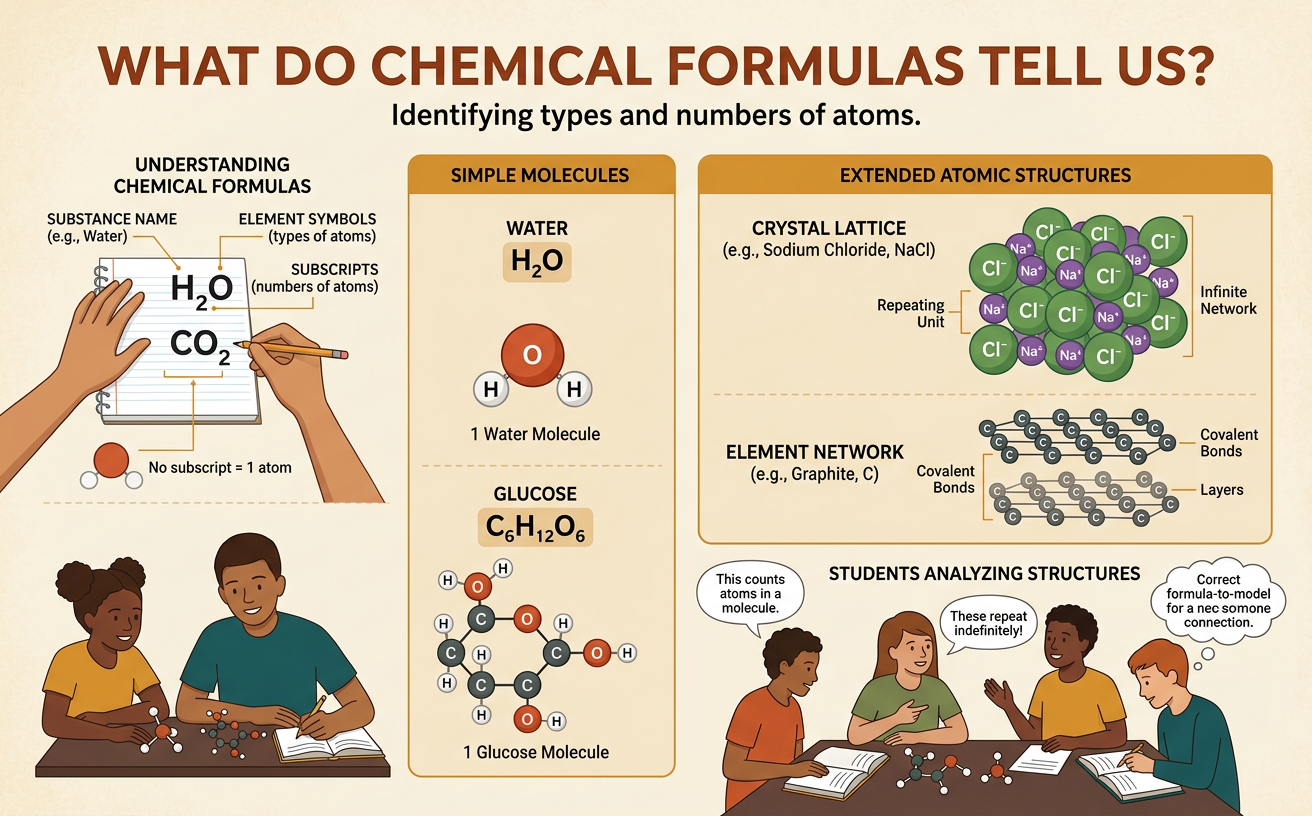
An element is a pure substance made of only one kind of atom. An atom is the smallest unit of an element that still has that element’s properties. Scientists use chemical symbols as short names for elements. A symbol begins with a capital letter and may have a second, lowercase letter. For example, C means carbon, O means oxygen, and Na means sodium. Capitalization matters: Co represents cobalt, but CO contains carbon and oxygen. In a chemical formula, each different element symbol identifies a type of atom. The formula CO2 includes the symbols C and O, so it contains carbon atoms and oxygen atoms. Reading symbols correctly is the first step in connecting a written chemical formula to a particle model.

Reading Subscripts in Formulas
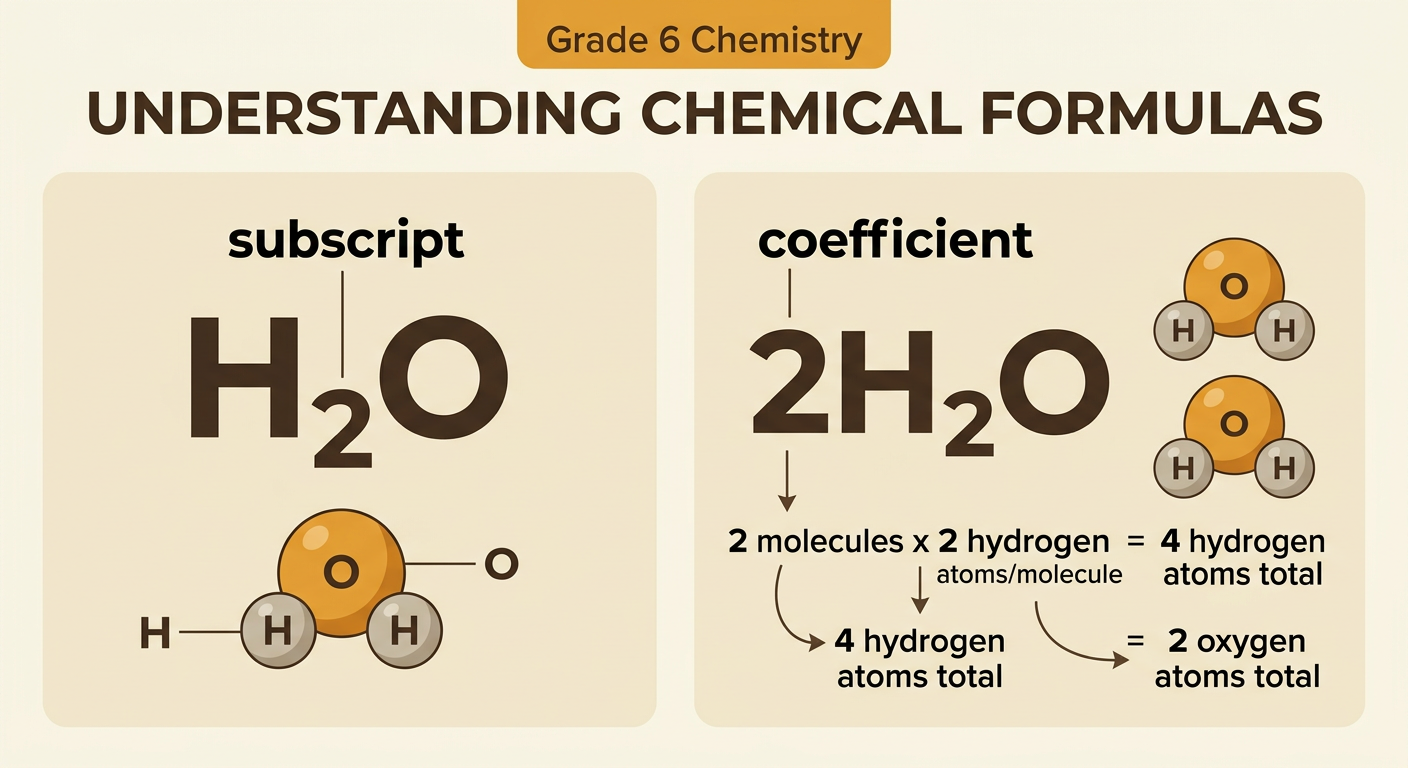
A subscript is a small number written to the lower right of an element symbol. It tells how many atoms of that element are in one molecule or formula unit. If a symbol has no subscript, its understood subscript is 1. In H2O, the 2 after H means there are two hydrogen atoms, while O without a subscript means there is one oxygen atom. Therefore, one water molecule has three atoms total. In CO2, there is one carbon atom and two oxygen atoms. Do not confuse a subscript with a coefficient written before a formula. The coefficient 2 in 2H2O means two water molecules. Together, those molecules contain four hydrogen atoms and two oxygen atoms.
Building Particle Models
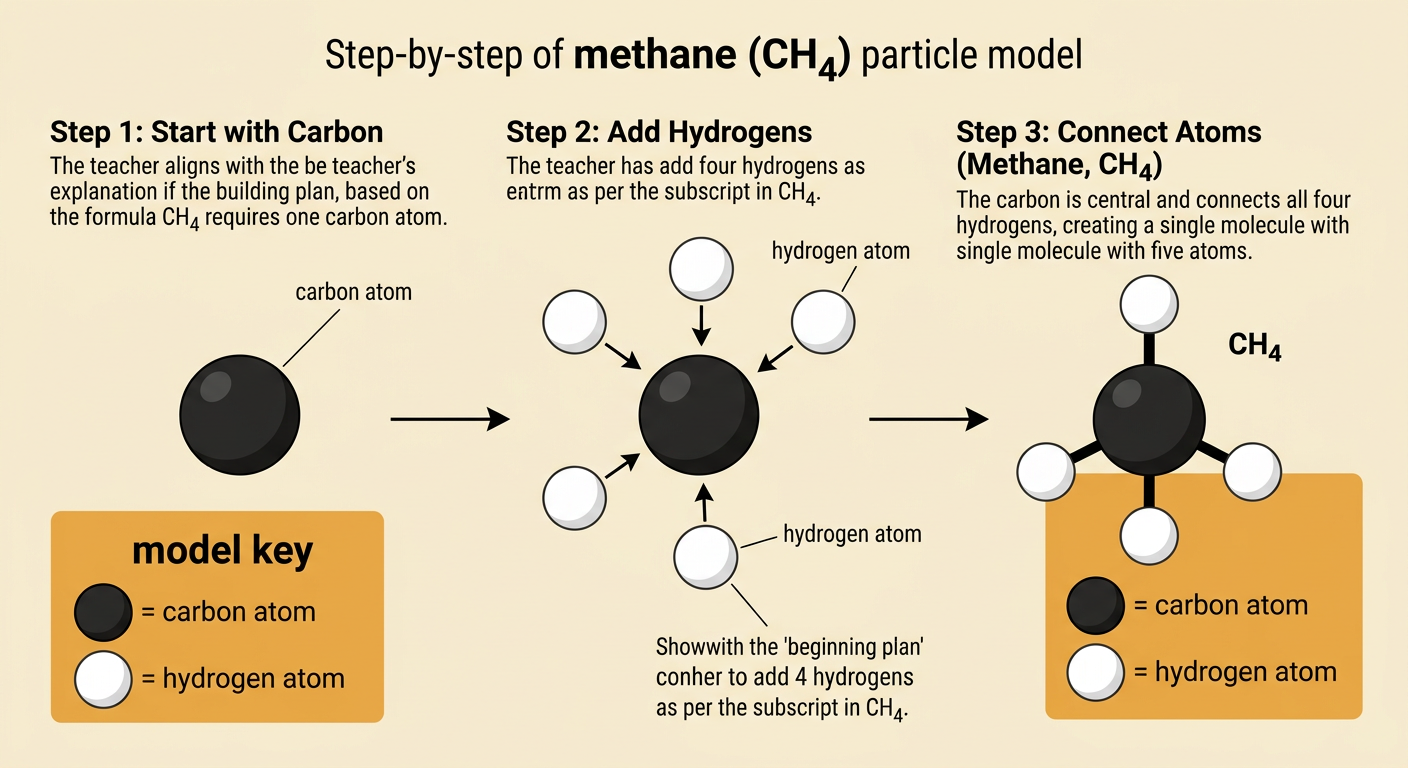
A particle model uses shapes, usually colored circles or spheres, to represent atoms. Each element must have one consistent color or label, and each atom named by the formula must appear. To model methane, CH4, begin with one carbon atom because C has no written subscript. Then add four hydrogen atoms because H has a subscript of 4. Place the carbon in the center and connect the four hydrogen atoms to it. The finished model contains five atoms and represents one methane molecule. A useful model key explains which color stands for each element. Although model colors and sizes are chosen for clarity and are not the atoms’ actual appearance, the number and type of spheres must match the formula. Checking the model against the formula helps reveal missing or extra atoms.
Molecules Versus Extended Structures
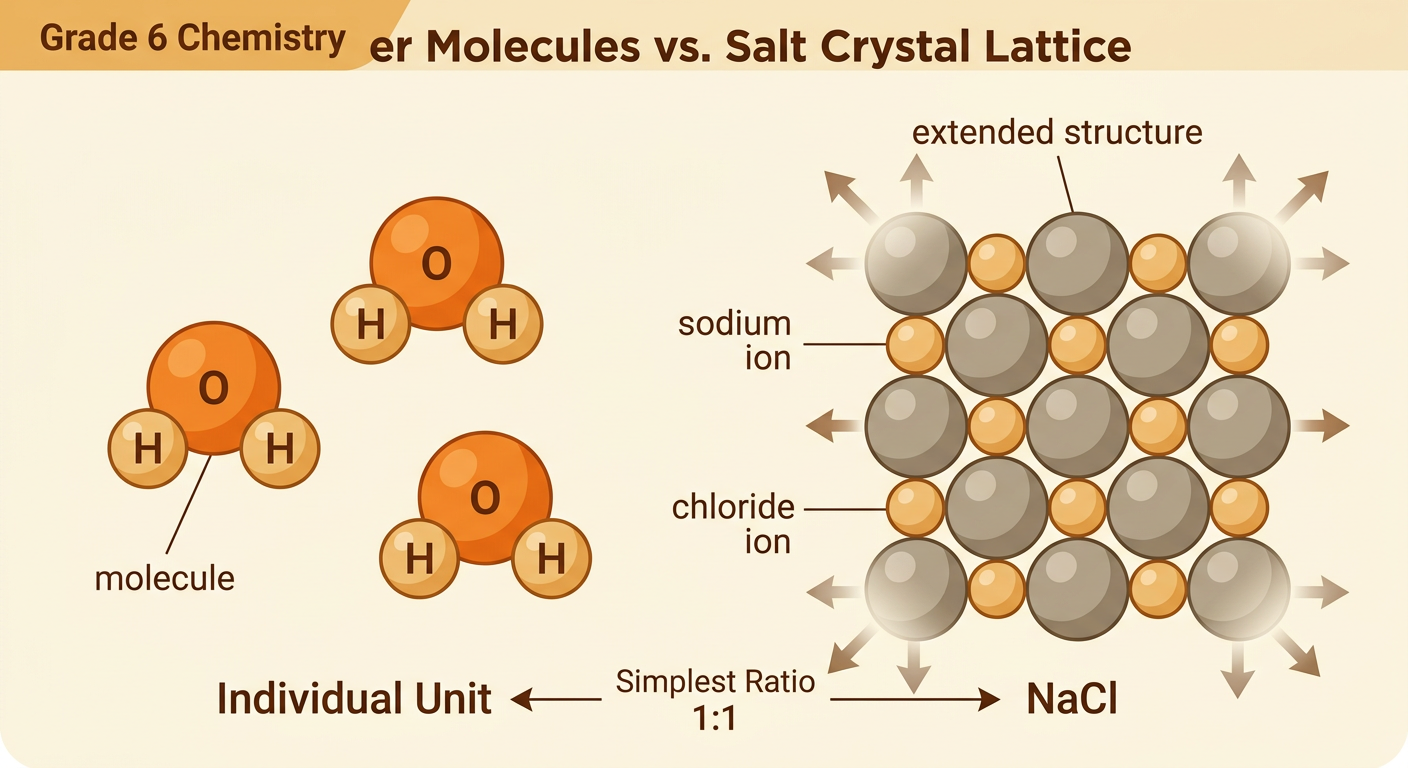
A molecule is a separate group of atoms held together in a specific arrangement. Water, H2O, forms individual particles, each with two hydrogen atoms and one oxygen atom. Some substances do not consist of separate molecules. Instead, their atoms or ions repeat in an extended structure. Table salt, written NaCl, forms a repeating three-dimensional arrangement of sodium ions and chloride ions. The formula NaCl gives the simplest ratio: one sodium ion for every one chloride ion. It does not mean that solid salt is made of separate two-atom NaCl molecules. Diamond is another extended structure. Its formula is C because it contains only carbon atoms connected in a repeating network. Particle models help show this difference: molecules appear as separate groups, while extended structures continue in a repeating pattern beyond the small part pictured.
Formula-to-Model Check
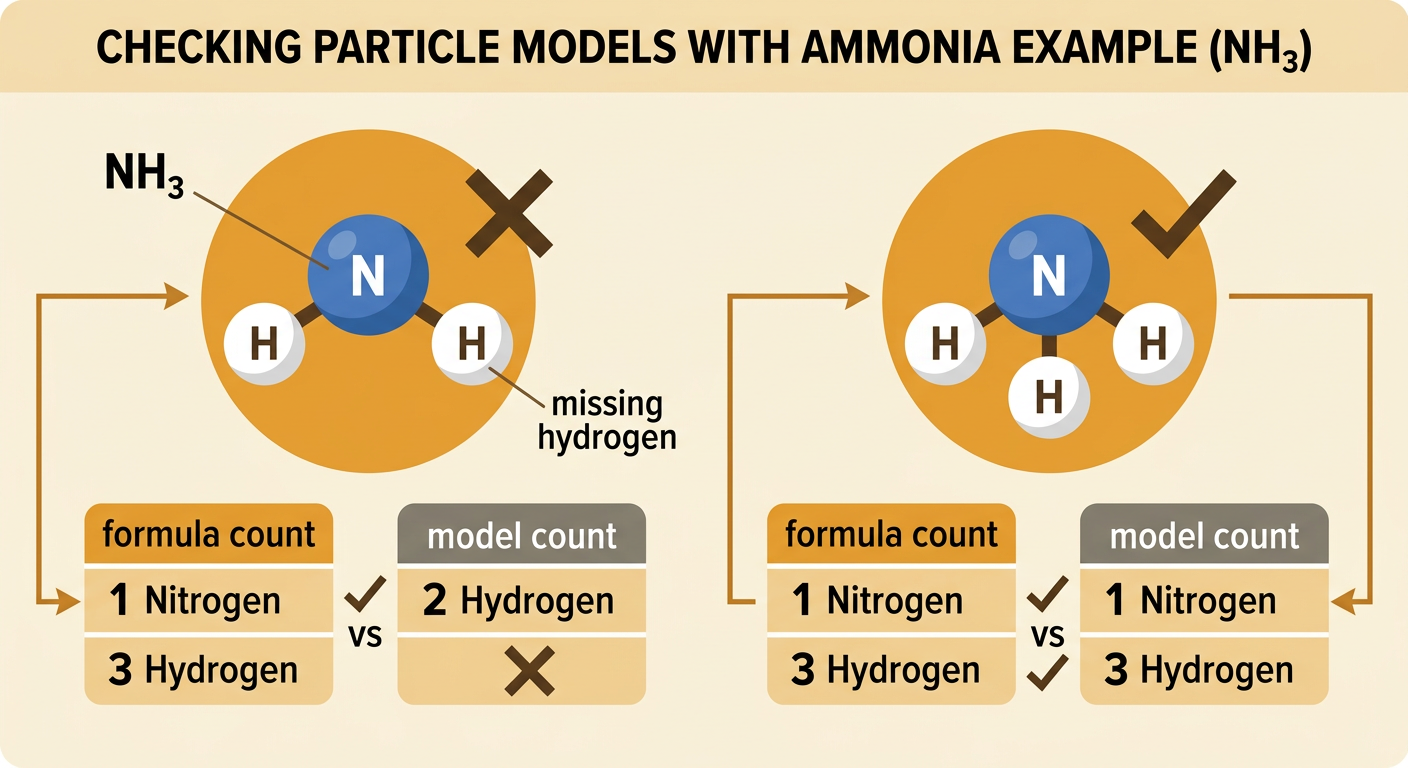
To check a particle model, use a clear sequence. First, list every element symbol in the formula. Second, read each subscript, remembering that no subscript means 1. Third, count the matching atom types in the model. Finally, compare the formula count with the model count and explain any difference. Consider ammonia, NH3. The formula requires one nitrogen atom and three hydrogen atoms. A model containing one nitrogen sphere connected to only two hydrogen spheres is not correct because one hydrogen atom is missing. A model with one nitrogen and three hydrogen atoms matches the formula. Also examine whether the picture shows one separate group or a repeating structure. Evidence from both the formula and the visual model supports a strong explanation: the symbols identify atom types, the subscripts give their numbers or simplest ratio, and the arrangement shows the kind of structure.