
What Do Living Things Need?
Students observe and sort evidence to learn that plants and animals need resources such as water and food to live and grow.

Illustrations are auto-generated and may be placeholders. They can be refreshed to match the narration.
Living or Nonliving?
Look closely at the things around you. A living thing is alive. Plants and animals are living things. They need resources, such as water and air, to survive. Living things also grow and change. Many animals move from place to place. Plants do not walk, but their roots, stems, and leaves grow. A nonliving thing does not need water or food, and it does not grow by itself. Compare a puppy with a toy dog. The puppy drinks water, eats food, breathes, and grows. The toy dog cannot do these things. Ask, “What do I observe?” Use what you see as evidence when you decide whether something is living or nonliving.

Needs of Plants
Plants need water, air, light, and enough space to live and grow. Roots take in water from the soil. Leaves take in air and use light to help the plant make its own food. A plant also needs space for its roots and leaves to grow. Imagine two bean plants. One plant receives water and light. Its stem becomes taller, and new green leaves open. The other plant receives light but no water. Its soil becomes dry, and the plant may wilt. This pattern is evidence that water helps plants survive. Different plants live in different environments, but all plants need resources from their surroundings. We can observe plant growth without pulling or harming the plant.

Needs of Animals
Animals need water, food, air, and a suitable place to live. Food gives animals energy to move and grow. Water helps their bodies work. Animals breathe air, although animals use air in different ways. Fish take oxygen from water with their gills. Many animals also use nests, burrows, trees, ponds, or other places for safety and rest. Think about a rabbit living in a meadow. It eats grass, drinks water, breathes air, and hides in a burrow. The meadow provides the rabbit’s resources. If the meadow has no water or plants, the rabbit may need to move. By observing where animals eat, drink, breathe, and rest, we can gather evidence about what they need to survive.

Sort the Needs
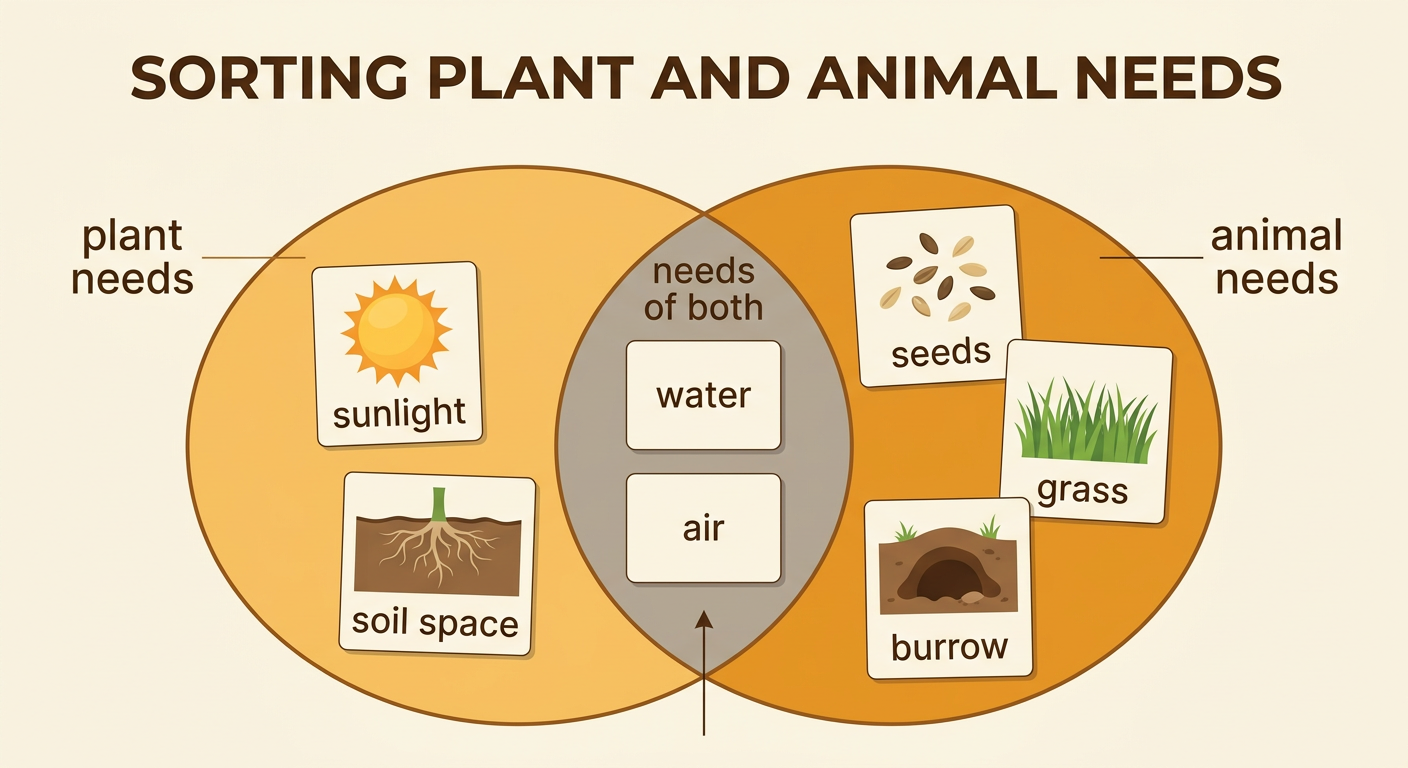
Sorting helps us find patterns. Look at picture cards showing water, sunlight, air, seeds, grass, soil space, and a burrow. Make three groups: plant needs, animal needs, and needs of both. Water and air belong in the “both” group because plants and animals need them. Sunlight belongs with plants because plants use light to make food. Seeds and grass can belong with animals because some animals eat them. Soil space can support a plant’s roots, while a burrow can give an animal a place to rest and hide. Some cards may lead to questions. For example, not every animal lives in a burrow. Explain each choice using an observation or fact, and move a card if new evidence changes your thinking.
Make a Class Picture Graph
A picture graph organizes information so patterns are easy to see. Give each class observation card one resource category: water, food, light, or air. Place the card above the matching category on a class chart. Let one picture stand for one observation. Suppose the graph shows five water pictures, four food pictures, three light pictures, and five air pictures. Count the pictures in each column. Water and air are tied for the most observations. Light has two fewer observations than water. Ask questions such as, “How many observations show food?” and “Which categories have equal totals?” The graph tells how often the class observed each resource. It does not show that one need is more important than another.

Explain the Evidence
Scientists use evidence to explain what living things need. Begin with a claim, or an idea you can support. You might say, “The bean plant needs water to stay healthy.” Then give evidence: “The watered plant grew new leaves, but the plant in dry soil wilted.” You can also use facts from an informational text. Ask, “What did the animal eat?” or “Where did the plant get water?” Answer with details from the words and pictures. Connect each living thing to its environment. A frog depends on pond water, insects for food, air, and places to hide. A cactus gets limited water from desert soil and light from the sun. End by explaining the pattern: plants and animals survive when their environments provide the resources they need.
