What Happens When Light Hits Matter?
Students test materials and use ray diagrams to explain how light can be reflected, absorbed, or transmitted when it encounters matter.
Illustrations are auto-generated and may be placeholders. They can be refreshed to match the narration.
Observe Light and Materials
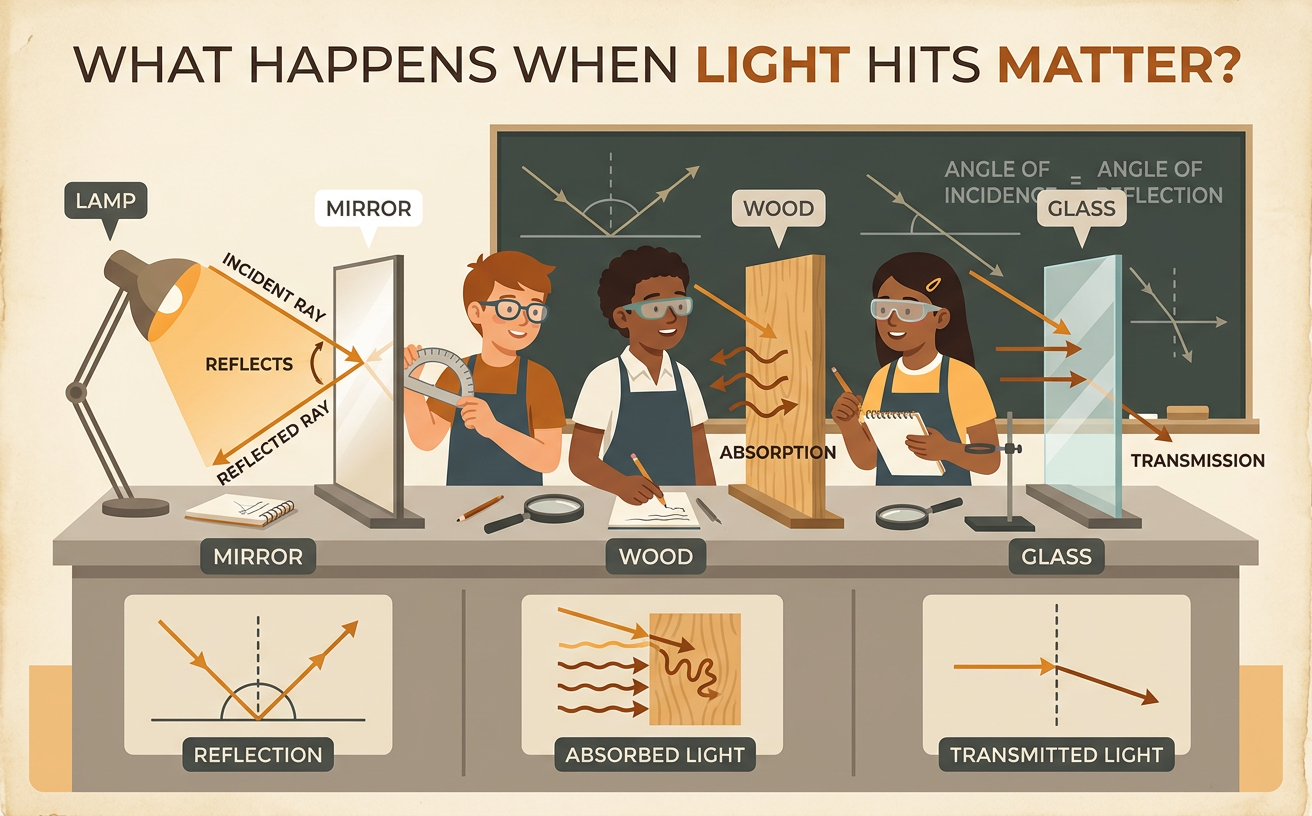
Light interacts with matter in three main ways. Reflection occurs when light bounces away from a surface. Absorption occurs when matter takes in light energy, often changing some of it into thermal energy. Transmission occurs when light passes through a material. Many objects produce more than one interaction at the same time. For example, a clear window transmits most visible light but also reflects a faint image of your face. A black sheet of paper absorbs much of the light that strikes it, although it still reflects enough light for you to see it. A mirror reflects most visible light and transmits almost none. Begin by shining a flashlight at several materials and observing the brightness of the reflected light, the light seen on the other side, and any temperature change.

Test Reflection, Absorption, and Transmission
Use the same flashlight, distance, angle, and testing time for every material so the comparison is fair. Work in a dim room, and never aim the flashlight into anyone’s eyes. First, place each sample in front of a white screen. Shine the flashlight at the sample and observe whether a bright spot appears on the screen behind it; this tests transmission. Next, aim the beam at an angle and look for reflected light on a second screen. Finally, measure each sample’s temperature before and after two minutes of illumination. A temperature increase can be evidence that some light was absorbed and changed into thermal energy. For example, black paper may show little transmission, a weak reflection, and a greater temperature increase than aluminum foil. Follow the same steps in the same order for glass, wax paper, foil, and black paper.

Record and Compare Results
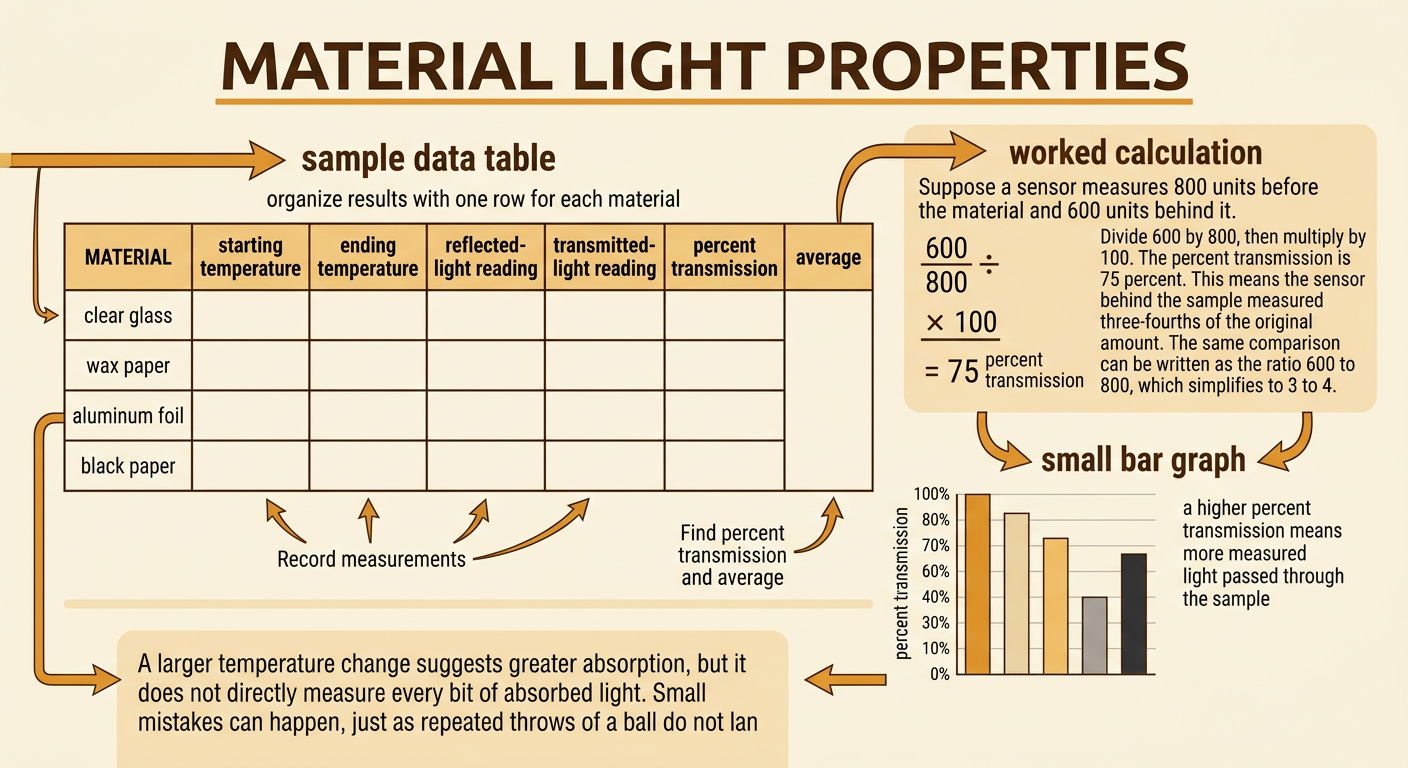
Create a data table with one row for each material. Record the starting temperature, ending temperature, reflected-light reading, and transmitted-light reading. If a light sensor measures 800 units before the material and 600 units behind it, calculate percent transmission by dividing 600 by 800 and multiplying by 100. The result is 75 percent transmission. You can also write the comparison as the ratio 600:800, which simplifies to 3:4. Use the same method for every sample. A higher transmitted-light percentage means more measured light passed through the material under the test conditions. A larger temperature change suggests greater absorption, but it is not a direct measurement of all absorbed light. Repeat each test three times and calculate an average to reduce the effect of small measurement errors.
Model Light with Ray Diagrams
A ray diagram is a model that uses straight arrows to represent the direction light travels. Draw an incoming ray from the flashlight to the material. For reflection, draw an outgoing ray bouncing away from the surface. On a smooth surface, the reflected ray leaves at the same angle at which the incoming ray arrived, measured from an imaginary line perpendicular to the surface called the normal. For transmission, draw a ray continuing through the material; its direction may bend when it enters or exits. For absorption, end the ray at the material and show that its energy is transferred to the matter. For example, a diagram of clear glass should include a strong transmitted ray and a weaker reflected ray. Ray thickness or several rays may be used to represent relative amounts, but the model should include a key.

Explain the Evidence
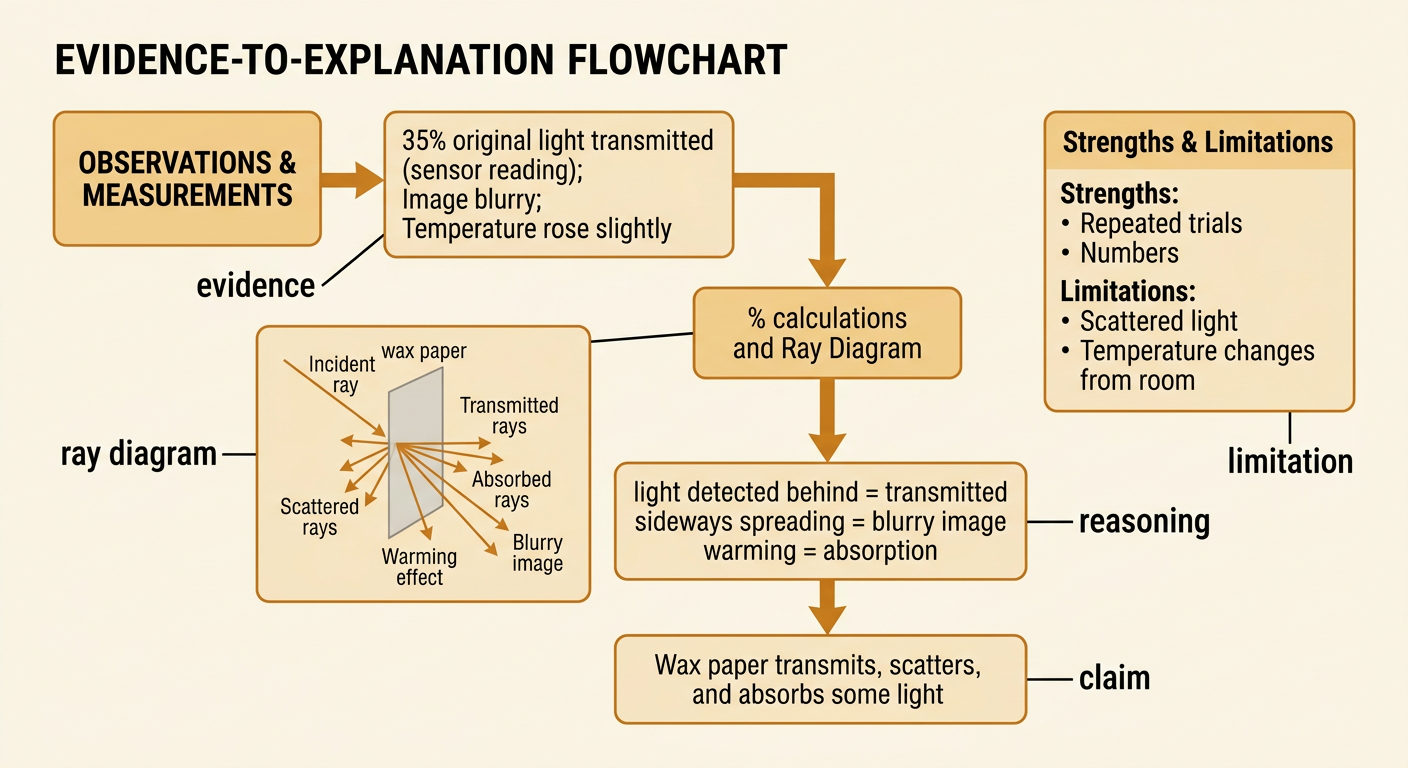
Use the observations, measurements, calculations, and ray diagrams to construct an explanation. Begin with a claim about how a material interacts with light. Then present relevant evidence in the order it was collected and explain why that evidence supports the claim. For example: “Wax paper transmitted some light because the sensor behind it measured 35 percent of the original light. It scattered the light, so the image behind it looked blurry. Its small temperature increase also suggests that some light was absorbed.” Include the ray diagram as a model of these interactions. A strong explanation also identifies limitations. A light sensor may not capture light scattered to the sides, and temperature can be affected by room air or uneven flashlight heating. Repeated trials strengthen the evidence, but they do not remove every source of uncertainty.