
What Happens When Light Meets a Material?
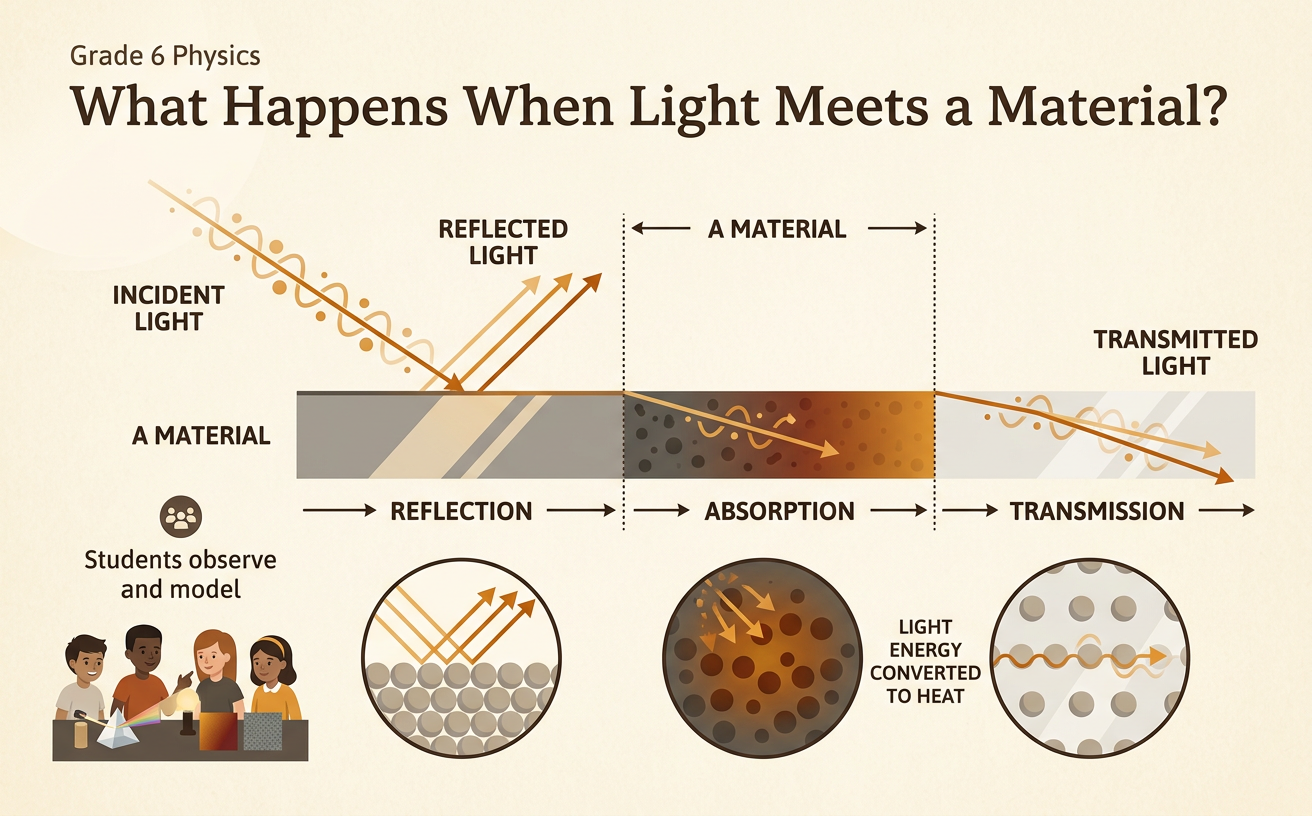
Students observe and model how light can be reflected, absorbed, or transmitted when it encounters different materials.
Illustrations are auto-generated and may be placeholders. They can be refreshed to match the narration.
Light and Materials
Light travels outward from a source and can move through empty space or some materials. When light reaches the boundary of a material, three main things may happen: it can be reflected, absorbed, or transmitted. Reflected light bounces away from the surface. Absorbed light transfers energy to the material, often warming it slightly. Transmitted light passes through the material. Usually, more than one of these processes happens at the same time. For example, when sunlight reaches a clear window, most visible light is transmitted, so you can see through it. A smaller amount is reflected, which can create a faint image on the glass. Some light is also absorbed by the glass. The material’s properties and the type of light help determine how much light follows each path.

Testing Different Materials
A fair test can show how different materials affect light. Place a flashlight the same distance from each sample and observe the light on the other side. Keep the flashlight, distance, room brightness, and sample size the same. Test clear plastic, wax paper, cardboard, and aluminum foil. Clear plastic transmits much of the light and produces a bright, clear spot. Wax paper transmits some light but scatters it, making the spot dim and blurry. Cardboard transmits almost no visible light and absorbs some of it. Shiny aluminum foil reflects much of the light. Record observations in a data table instead of relying on memory. For safety, use a regular flashlight rather than a laser, and never shine light directly into anyone’s eyes. Repeating each test makes the evidence more dependable.

Reflection, Absorption, and Transmission
Reflection, absorption, and transmission describe where light energy goes after light meets a material. During reflection, light changes direction at a surface. A smooth mirror produces an organized reflection that can form an image, while rough paper reflects light in many directions. During absorption, the material takes in light energy and changes much of it into thermal energy. This is why black pavement can become hot in sunlight. During transmission, light passes through a material. Transparent materials, such as clear glass, transmit light clearly. Translucent materials, such as frosted glass, transmit light but scatter it, so objects look blurry. Opaque materials, such as wood, transmit almost no visible light. These categories are useful, but no ordinary material behaves in only one way. A clear window can transmit most light while reflecting and absorbing smaller amounts.

Building a Light-Wave Model
A scientific model represents important parts of a process without showing every detail. In a light-wave model, draw parallel wave fronts or ray arrows traveling from a source toward a material. At the boundary, split the incoming light into possible reflected, absorbed, and transmitted parts. Arrow direction shows where light travels, while relative arrow thickness can represent the amount of light energy in each path. For a clear plastic sheet, draw a thick transmitted arrow, a thin reflected arrow, and a small absorbed portion. For aluminum foil, draw a thick reflected arrow and almost no transmitted arrow. The outgoing energy should not be shown as greater than the incoming energy. Add labels and a key so another student can understand the model. Models can be revised when observations provide new evidence, such as a dimmer transmitted spot than expected.

Explaining Results with Evidence
A strong scientific explanation includes a claim, evidence, and reasoning. The claim answers the investigation question. Evidence includes specific observations, measurements, or facts from a reliable text. Reasoning explains how the evidence supports the claim using scientific ideas. Suppose a flashlight produced a bright spot through clear plastic, a dim blurry glow through wax paper, and no visible spot through cardboard. A useful claim is that clear plastic transmitted more light than the other samples. The bright spot is evidence, especially if the result occurred in three trials. The reasoning is that a brighter spot indicates more light reached the screen, so more light was transmitted. Also discuss limits: without a light sensor, brightness judgments are approximate. Compare results with classmates’ data or a scientific source, then revise the explanation if needed. Do not simply say, “It worked”; cite the exact result that supports the claim.
