
What Happens When Objects Collide?
Students predict, observe, and explain how a moving object's energy can change or transfer when it collides with another object, then connect their findings to everyday safety.
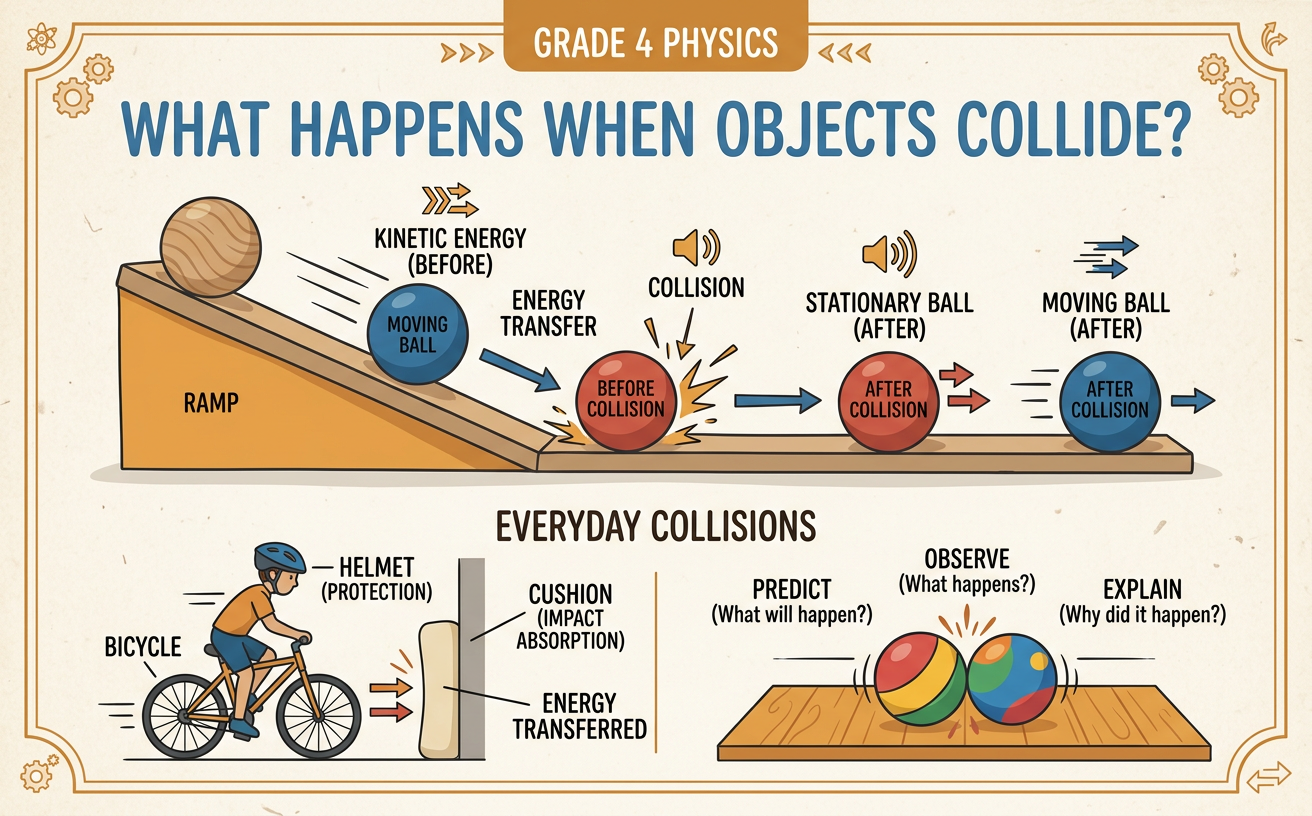
Illustrations are auto-generated and may be placeholders. They can be refreshed to match the narration.
Observe a Collision
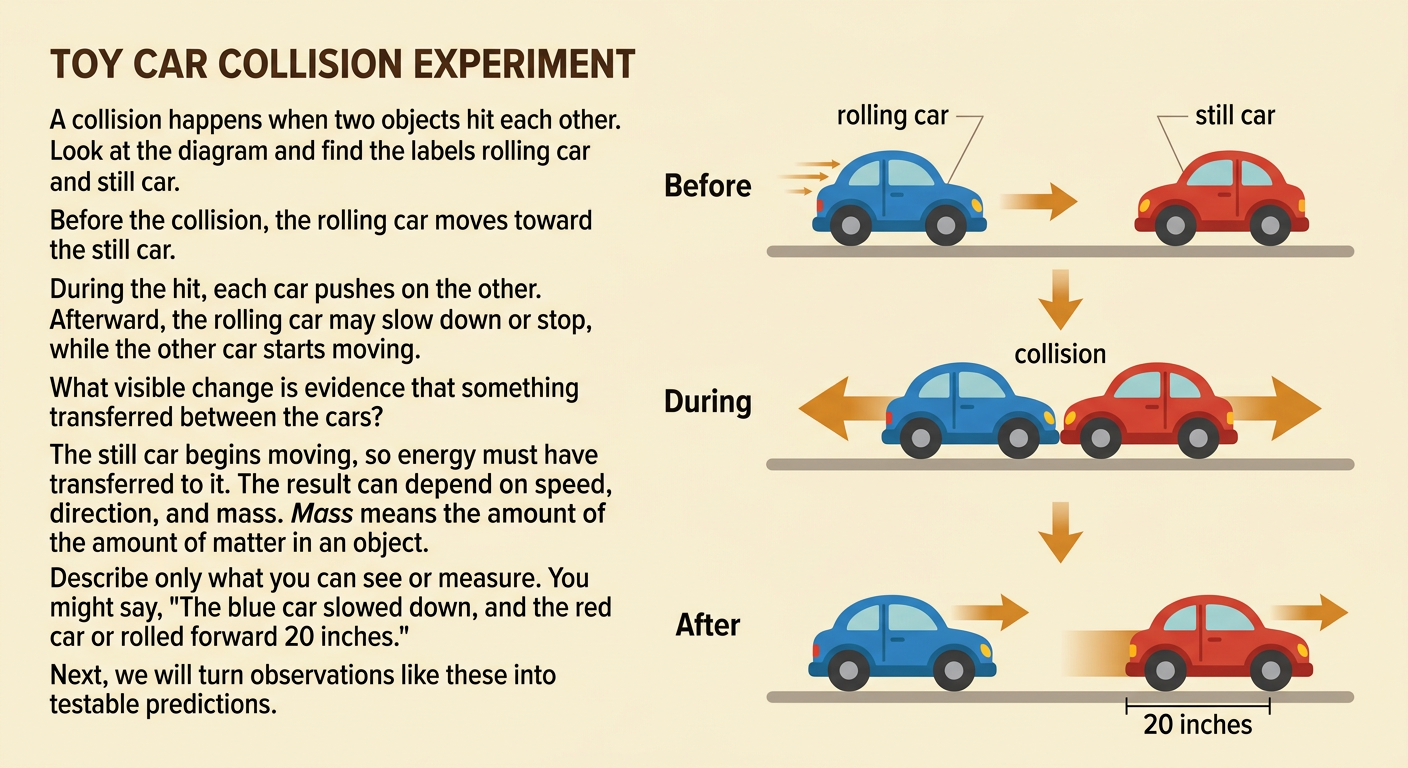
A collision happens when two objects hit each other. Watch what happens when a rolling toy car strikes a car that is standing still. Before the collision, the first car is moving and the second car is not. During the collision, each car pushes on the other. Afterward, the first car may slow down or stop, while the second car begins moving. These changes are evidence that energy was transferred between the cars. The result depends on features such as each car’s speed, mass, and direction of motion. Observe carefully and describe only what you can see or measure. For example, you might report, “The blue car slowed down, and the red car rolled forward about 20 inches.”
Ask Questions and Make Predictions
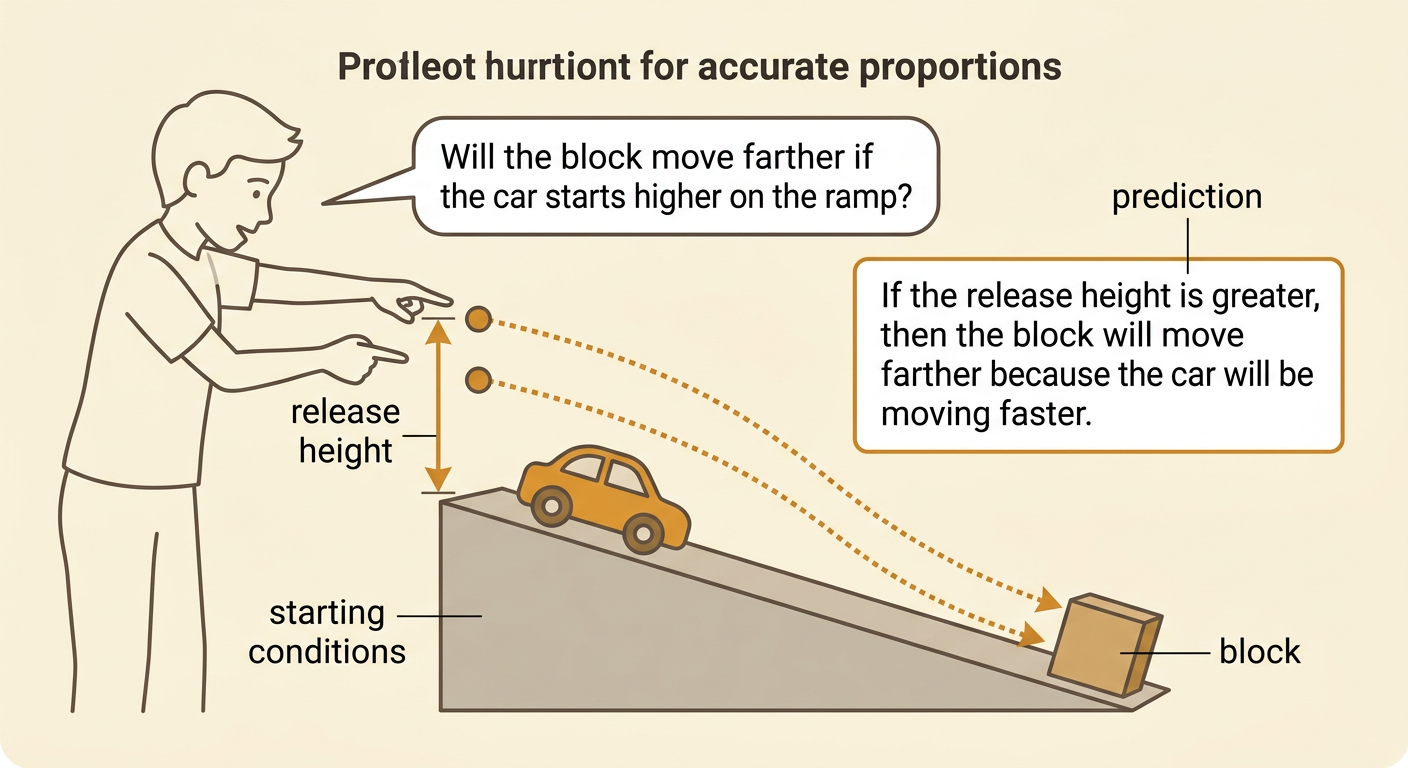
Scientists ask questions before testing an idea. Useful collision questions include: What will happen if one car rolls faster? Will a heavier object move as far as a lighter object after being hit? What changes if two objects move toward each other? Choose one question that can be tested safely. Then make a prediction based on a reason. You might say, “If the rolling car starts higher on the ramp, then it will push the block farther because it will be moving faster at the bottom.” Record the starting conditions and your expected result. Listen to your group members, compare ideas, and ask for evidence behind their predictions. Predictions do not have to be correct. They help the group plan what to observe and measure during the test.
Test Collisions with Rolling Objects
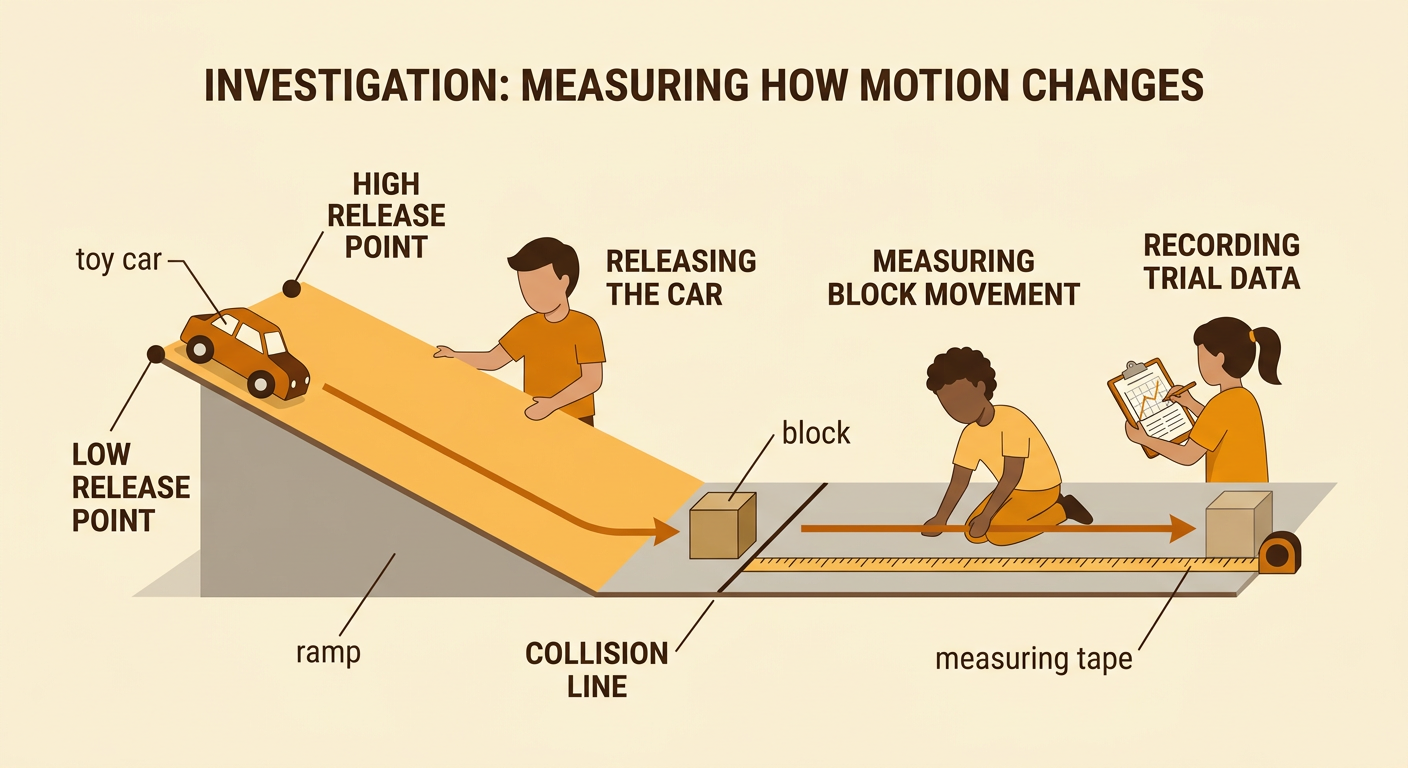
Set up a safe investigation using a toy car, a ramp, a small block, and a measuring tape. Place the block at a marked collision line. Release the car from a low point on the ramp without pushing it. Measure how far the block moves after the car hits it. Repeat the trial three times. Next, release the same car from a higher point and repeat three times. Change only the release height so the comparison is fair. Keep the car, block, ramp, and collision line the same. Group members can take roles such as releaser, measurer, recorder, and safety checker. Keep hands and faces away from the car’s path. This test provides numerical evidence about how the car’s motion before the collision affects the block’s motion afterward.
Track Changes in Motion
Motion can change in speed, direction, or both. Use observations and measurements to compare each object before and after a collision. A data table might list release height, distance the block moved, and whether the car stopped, slowed, or changed direction. Suppose a car released from 4 inches high moves the block 8 inches, while the same car released from 8 inches high moves it 19 inches. The numbers show that the higher release produced a larger change in the block’s motion. Look for patterns across all trials instead of relying on one result. If measurements vary, calculate or discuss a typical result and consider possible causes, such as an uneven floor or a slightly different release point. Quantitative measurements and careful descriptions together provide stronger evidence.

Explain Energy Transfer
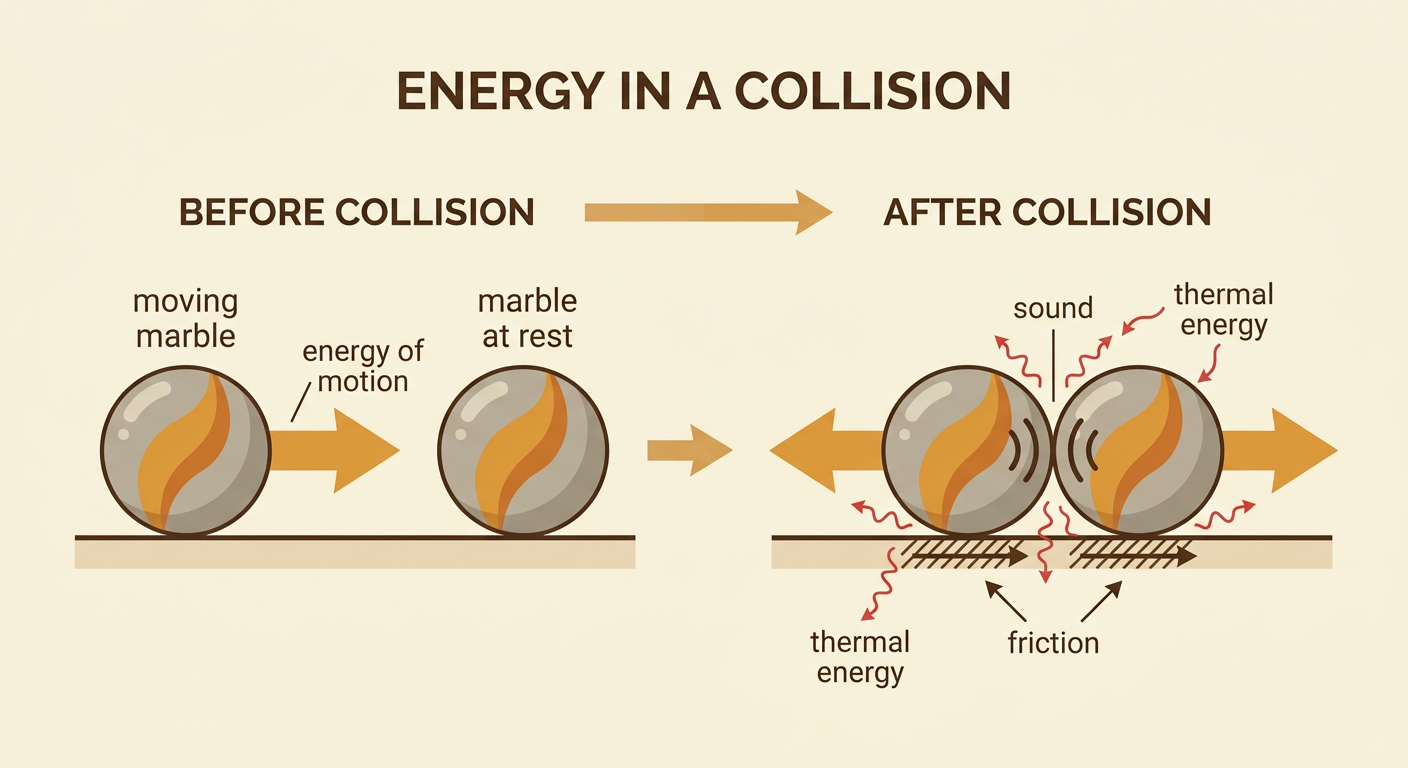
A moving object has energy of motion. When it collides with another object, some of that energy can transfer to the other object. Imagine a rolling marble striking a marble that is at rest. The first marble may slow down, and the second marble may roll away. The second marble’s new motion is evidence that it received energy during the collision. Not all the energy remains as visible motion. Some can become sound, such as a click, or thermal energy caused by tiny changes and friction. Energy is not a substance that can be seen, but its effects can be observed. Use evidence to explain the result: “The second marble began moving after contact, while the first slowed, so energy was transferred from the first marble to the second.”
Connect Collisions to Safety
Understanding collisions helps communities solve safety problems. During a bicycle crash, a rider’s motion can change very quickly when the bicycle strikes an object. A helmet contains a hard outer shell and crushable padding that help spread forces and reduce the effect of the collision on the head. Seat belts hold passengers in place when a car stops suddenly, and vehicle crumple zones bend during a crash to make the stopping change occur over more time. People also use speed limits, barriers, crosswalks, and playground surfaces to reduce collision risks. Discuss a safety problem with your group and identify a possible solution. For example, if bicycles and cars often cross the same busy entrance, a marked bike lane and warning sign could help separate their paths. Support your proposal with evidence about motion and collisions.
