What Happens When Objects Collide?
Students observe and predict how collisions transfer energy and change the motion of objects, then connect their findings to protective designs and safety rules.

Illustrations are auto-generated and may be placeholders. They can be refreshed to match the narration.
Observing a Collision
A collision happens when two objects bump into each other. During a collision, the motion of one or both objects may change. An object may speed up, slow down, stop, or move in a new direction. For example, roll a marble toward a second marble that is resting on a smooth surface. When the moving marble hits the resting marble, the first marble may slow down while the second begins to move. This is evidence that energy was transferred between the marbles. Observe the objects before, during, and after the collision. Notice their speeds and directions, and listen for sound. Share your observations with classmates. Different observers can compare details and use evidence to describe what changed.

Predicting Changes in Motion
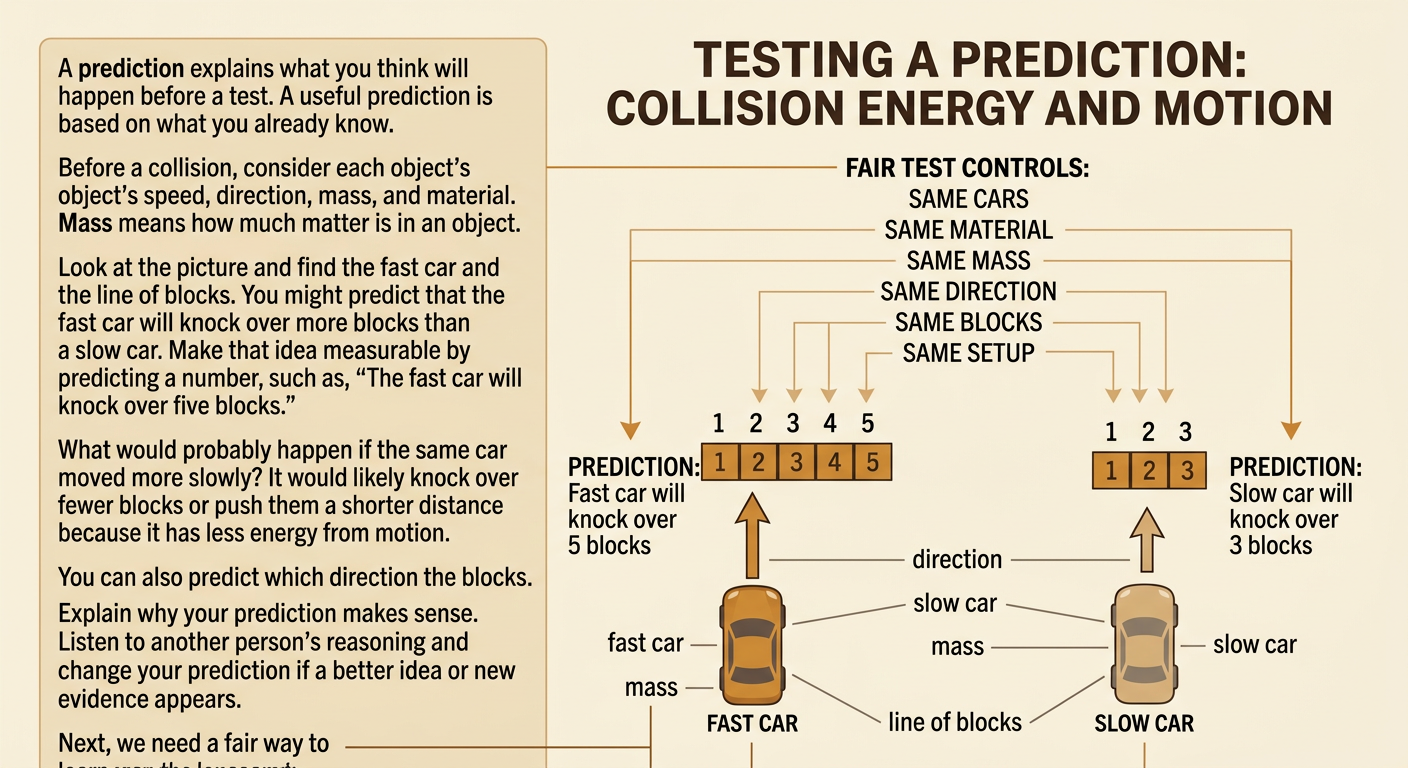
A prediction explains what you think will happen and should be based on what you already know. Before testing a collision, consider each object’s speed, direction, mass, and material. Imagine a toy car rolling toward a line of blocks. You might predict that a faster car will knock over more blocks than a slower car. You can make the prediction measurable by stating how many blocks you expect to fall. You can also predict the direction each object will move after contact. Use numbers or comparison words such as faster, slower, farther, or shorter. Then explain your reasoning to a partner. Listen to your partner’s idea, ask a helpful question, and revise your prediction if new reasoning or evidence changes your thinking.
Testing Collisions
A fair test changes one factor while keeping other factors the same. To test how speed affects a collision, release the same toy car from different marked heights on the same ramp. Let it collide with the same block each time. Measure how far the block moves after each collision using a ruler or measuring tape. Record the ramp height and the block’s travel distance in a table. Repeat each trial to check whether the results are similar. Keep the ramp, car, block, surface, and starting direction the same. Do not push the car because different pushes could make the test unfair. After testing, compare the numbers with your prediction. Discuss patterns with your group and use the recorded measurements, rather than guesses, to support your conclusion.

Tracing Energy Transfer
A moving object has energy because of its motion. When it collides with another object, some of that energy can transfer to the other object. Picture a rolling ball hitting a still ball. The rolling ball may slow down, and the still ball may begin moving. The new motion is evidence of energy transfer. Not all transferred energy remains as visible motion. A collision may also produce sound, slightly warm the objects, or bend and squash materials. Energy is not created by the collision; it changes form or moves between objects and their surroundings. Trace the transfer by following the event in order: a hand gives the first ball energy, the ball moves, the balls collide, and the second ball moves while sound is produced.

Designing for Safety
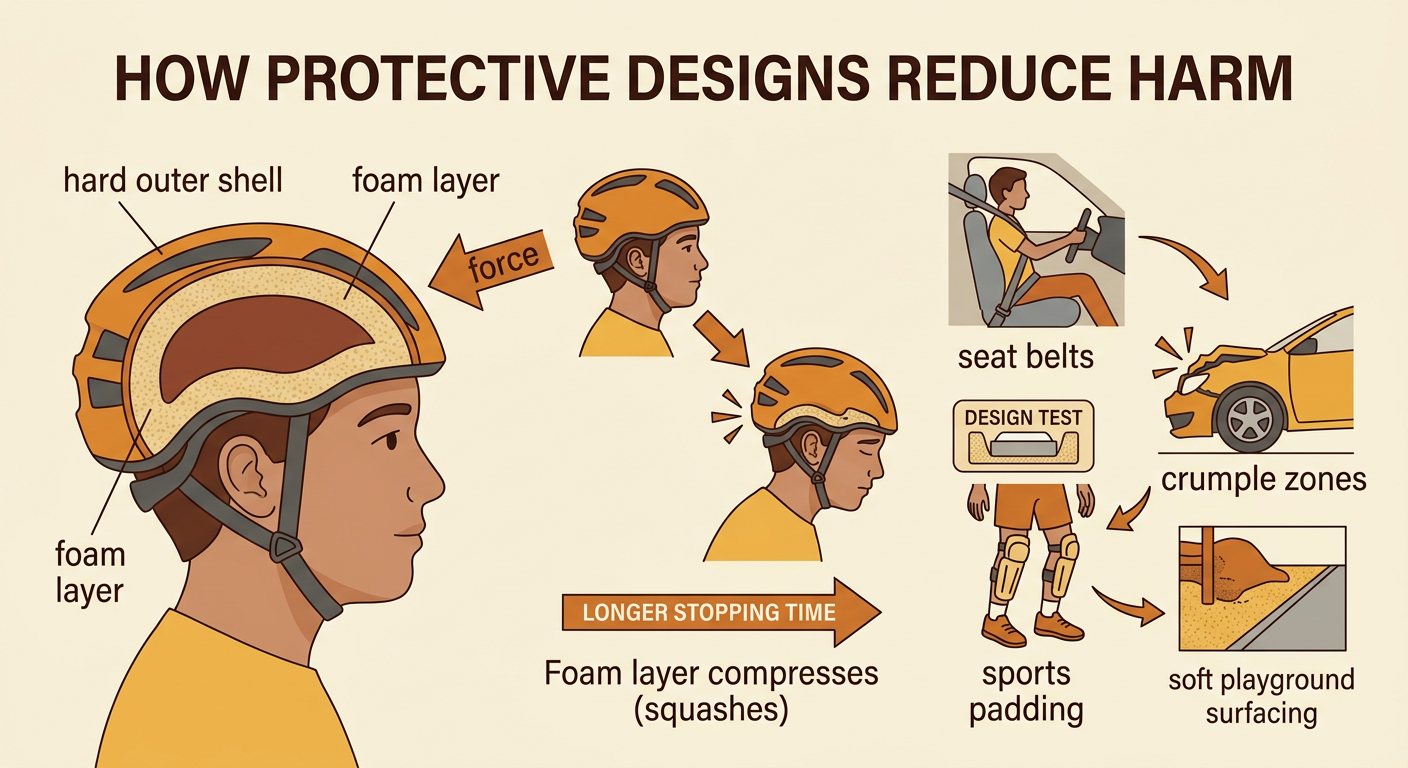
Protective designs reduce harm by changing what happens during a collision. A bicycle helmet contains a hard outer shell and a crushable foam layer. In a fall, the helmet spreads the force over a wider area and the foam compresses, making the head slow down over more time. Seat belts, car crumple zones, playground surfaces, and sports padding also help protect people. Engineers test these designs, collect measurements, and improve them using evidence. Communities use similar evidence to create safety rules and laws, such as requiring seat belts or helmets in certain situations. People can also ask leaders to update rules when new evidence becomes available. With your group, design a container that protects a small object in a drop test. Explain how each material helps manage the collision and support your safety rule with test results.