When Ecosystems Change: Predicting Population Effects
Students analyze evidence from a habitat-change scenario to explain how changes in an ecosystem can affect the populations that live there.
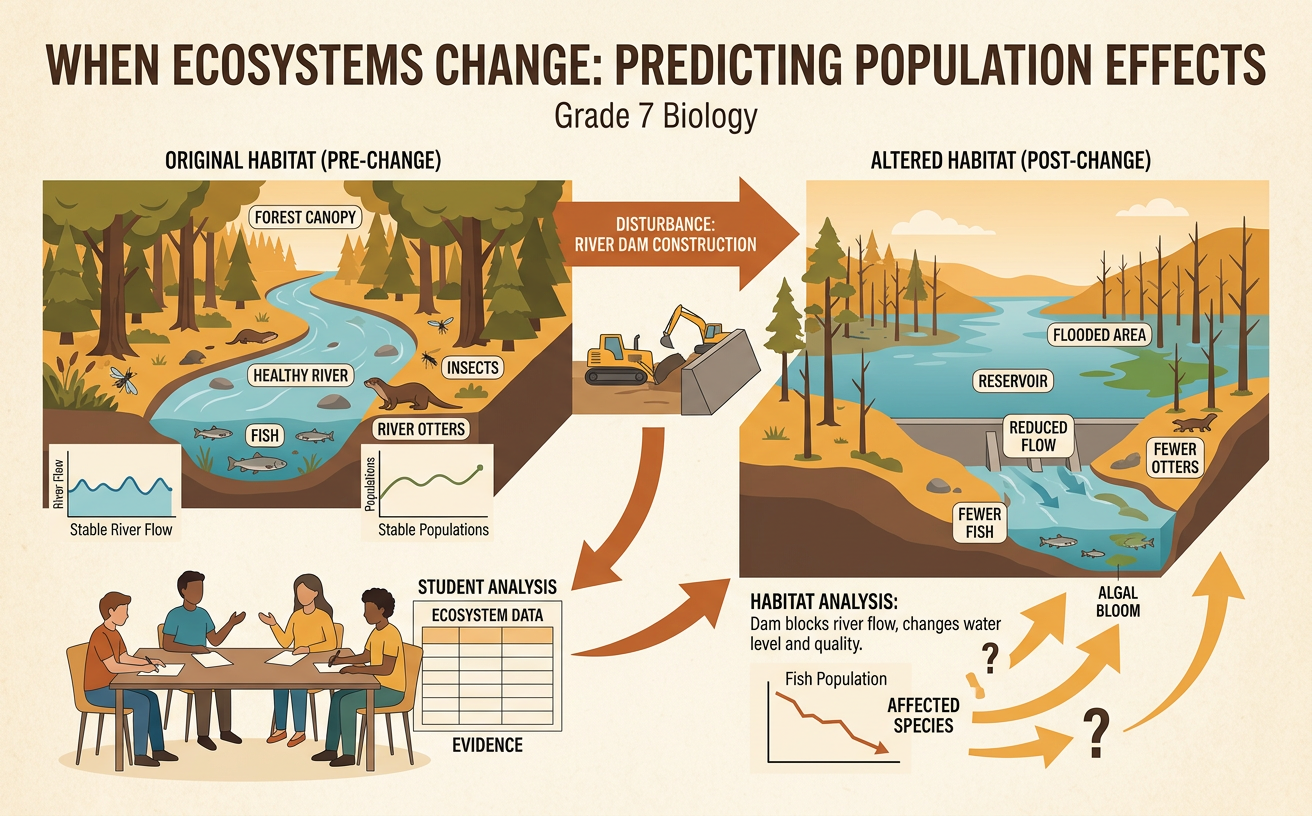
Illustrations are auto-generated and may be placeholders. They can be refreshed to match the narration.
Ecosystem Components
An ecosystem includes living, or biological, components and nonliving, or physical, components. Plants, animals, fungi, and bacteria are biological components. Water, sunlight, soil, temperature, and oxygen are physical components. These parts interact, so a change in one component can affect many populations. A population is all members of one species living in the same area. For example, cattails in a wetland provide food and shelter for insects. Frogs eat the insects, and herons eat the frogs. If the wetland receives less water, cattail growth may decrease. With fewer cattails, insect populations may lose food and shelter, followed by possible declines in frogs and herons. Scientists study these connected effects rather than assuming that each population changes independently.

A Habitat-Change Scenario
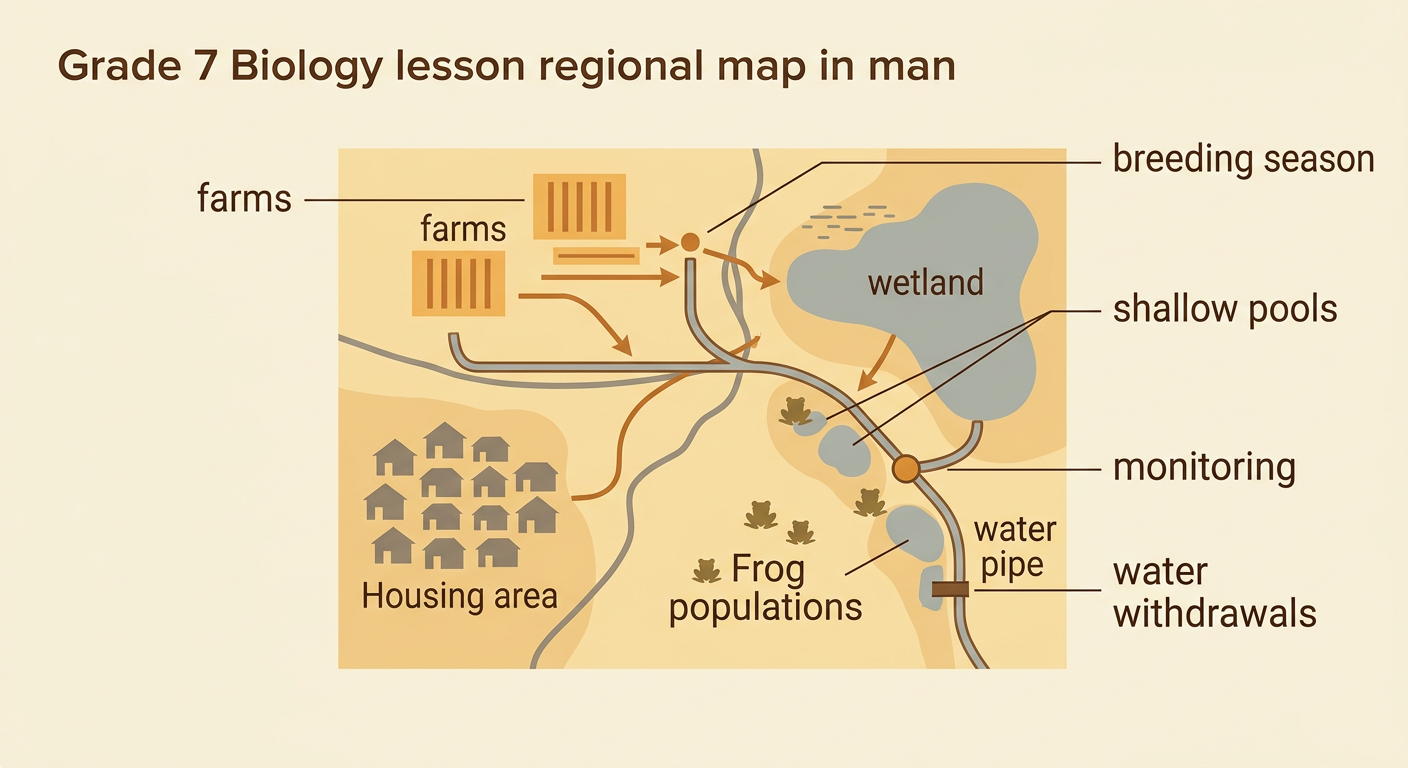
Imagine a town where a shallow wetland sits beside farms and new housing. Over several years, people redirect some water into irrigation pipes and storm drains. Measurements show that the wetland’s average summer water depth falls from 40 centimeters to 18 centimeters. The number of cattail-covered areas also decreases. This is a long-term human-induced habitat change because human actions have altered a physical component: water availability. The change can also affect biological components. Frogs need shallow pools for laying eggs, and aquatic insect larvae develop in water. Herons visit the wetland to feed on frogs and fish. Based on these relationships, students can predict that less water may reduce breeding habitat and food resources, causing some populations to decrease or move elsewhere.

Tracking Population Effects
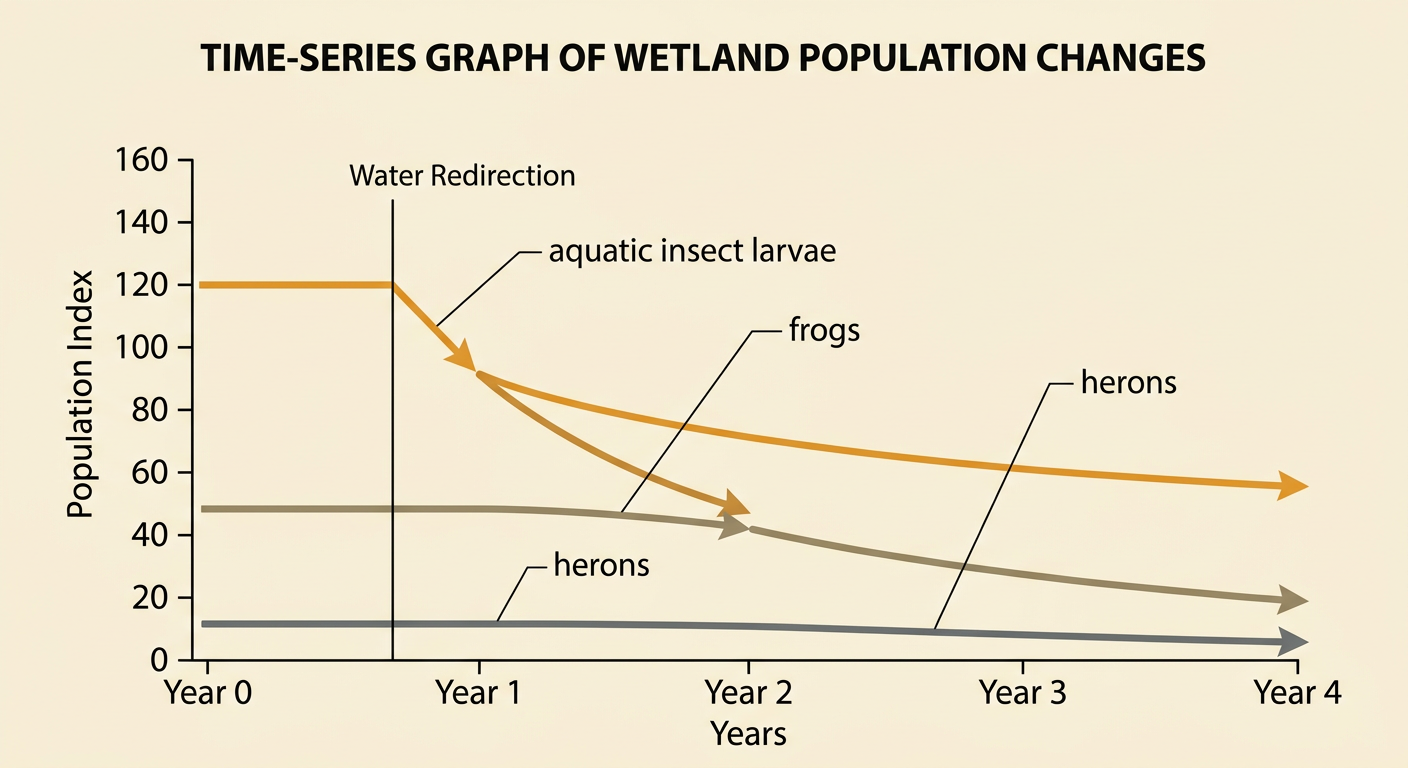
Scientists track populations by collecting the same kinds of data at regular times. In the wetland scenario, researchers survey equal-sized plots each June. Before water was redirected, they counted an average of 120 aquatic insect larvae, 48 frogs, and 12 herons. Four years later, comparable surveys found 55 larvae, 19 frogs, and 5 herons. These data show declines, but the populations may not respond at exactly the same time. Insect larvae may decline first when pools dry. Frog numbers may fall later because there is less food and fewer places for eggs. Herons may then visit less often because prey is harder to find. A time-series graph helps students identify these patterns and predict what might happen if low water levels continue.
Evidence and Cause-and-Effect
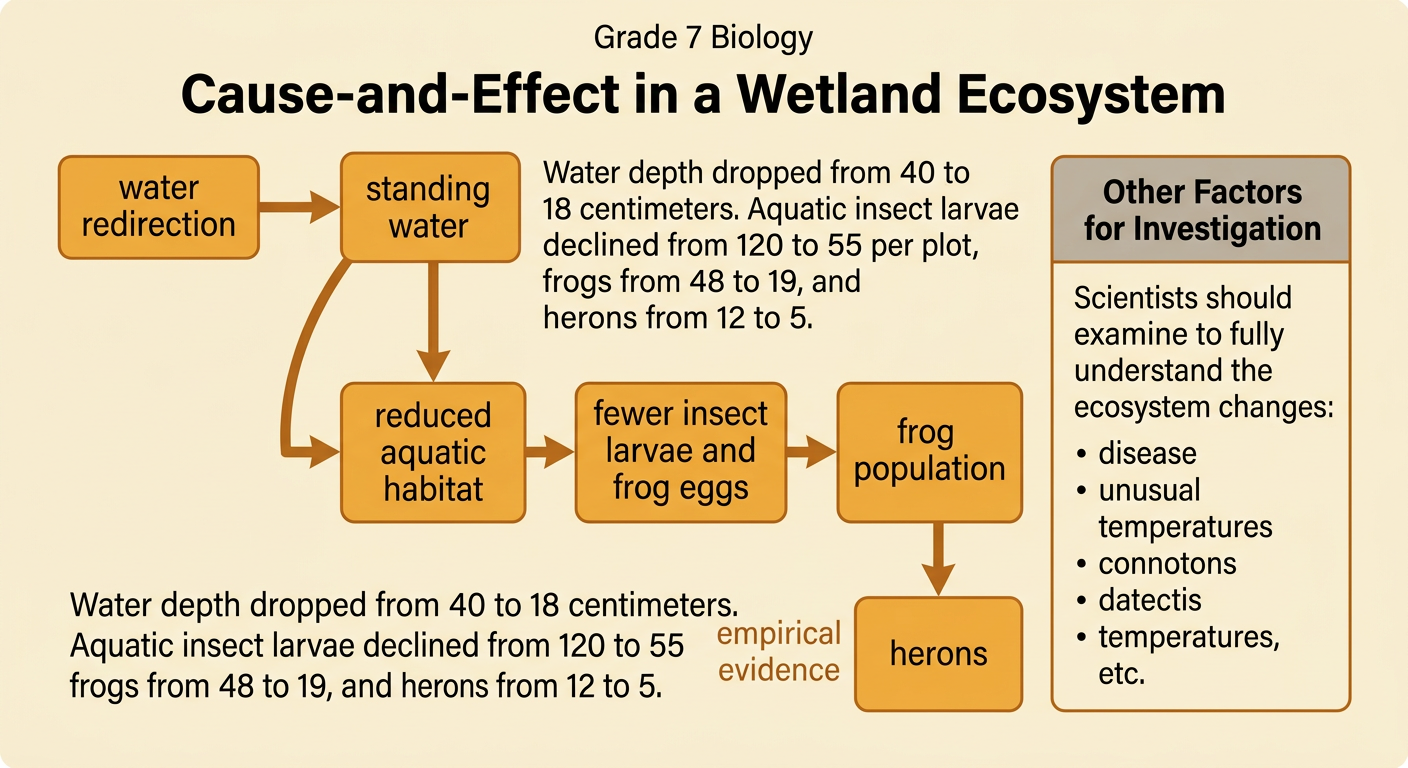
A strong cause-and-effect explanation connects specific evidence with known ecosystem relationships. The evidence states that summer water depth dropped from 40 to 18 centimeters, while aquatic insect larvae declined from 120 to 55 per survey plot. Frogs declined from 48 to 19, and herons declined from 12 to 5. These numbers are empirical evidence because they came from measurements and observations. The evidence supports a possible causal chain: water redirection reduced standing water; reduced water limited habitat for insect larvae and frog eggs; fewer insects and successful frog offspring reduced the frog population; and fewer frogs provided less prey for herons. Other factors, such as disease or unusual temperatures, could also affect the populations. Scientists strengthen the explanation by comparing multiple years, similar wetlands, and additional environmental measurements.
Constructing an Argument
A scientific argument includes a claim, evidence, and reasoning. A useful claim might be: Continued water redirection will cause frog and heron populations in the wetland to decrease. Evidence should be specific, such as the measured drop in water depth from 40 to 18 centimeters and the decline in frogs from 48 to 19 per survey plot. Reasoning explains why the evidence supports the claim. Frogs require water for reproduction and depend on aquatic insects for food, while herons depend on frogs and other wetland prey. Therefore, reduced water can limit frog survival and reproduction and indirectly reduce food for herons. Students should cite the exact data or sentences they use from a scientific text. They should also address a counterclaim, such as the idea that the populations will simply move, by noting that nearby suitable habitat may be limited.

Human Choices and Ecosystem Responses
People may disagree about how wetland water should be used. Farmers may need irrigation, residents may want flood control, and conservation groups may seek enough water to protect wildlife. As the wetland shrinks, frogs and herons may become concentrated in the remaining wet areas or disappear from parts of the landscape. These changing spatial patterns can create conflict over land and water. They can also encourage cooperation. For example, the town, farmers, and conservation groups could agree to limit water withdrawals during frog breeding season, restore shallow pools, and monitor water depth and populations together. Students can evaluate each choice by considering evidence, benefits, costs, and who is affected. Human decisions do not always eliminate ecosystem change, but cooperative planning can reduce harmful effects while meeting community needs.