
When Genes Change: Mutations, Proteins, and Traits
Students use a cause-and-effect model to explain how a mutation in a gene may change a protein and produce a beneficial, harmful, or neutral effect on an organism.
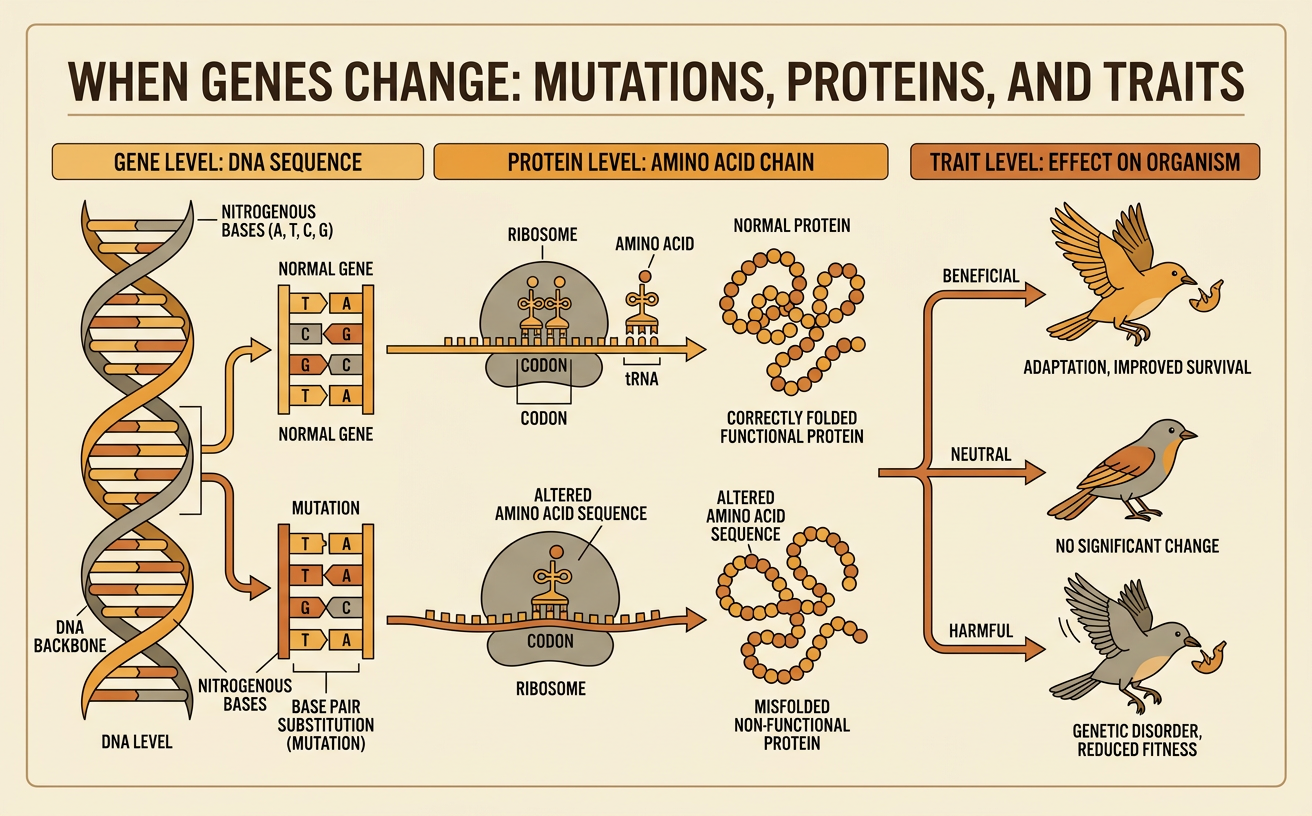
Illustrations are auto-generated and may be placeholders. They can be refreshed to match the narration.
Mutations as Changes in Genetic Instructions
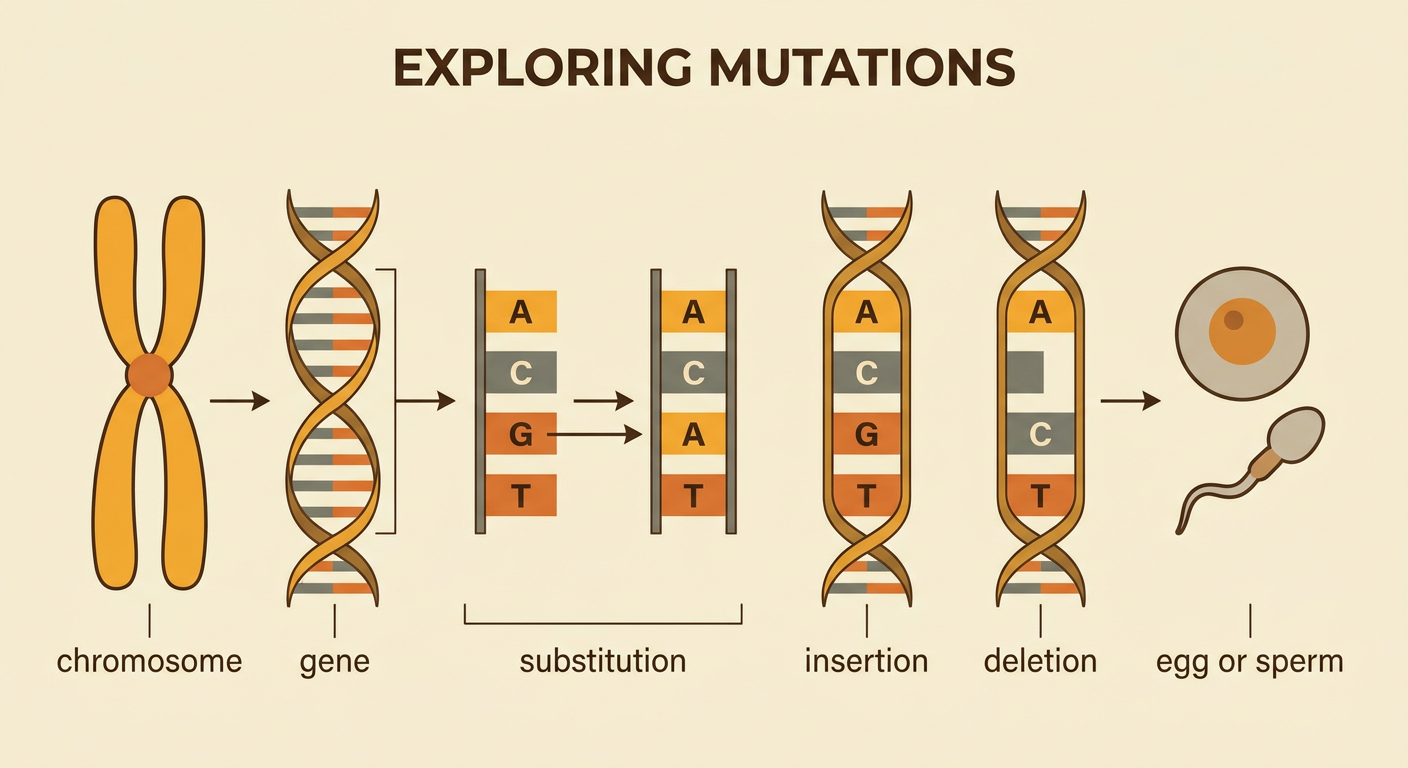
A mutation is a change in the DNA sequence of a cell. DNA is packaged into chromosomes, and a gene is a segment of DNA containing instructions for making a functional product, usually a protein. A substitution replaces one DNA base with another. An insertion adds one or more bases, while a deletion removes bases. For example, the original sequence A-C-G-T may change to A-C-A-T through substitution. Because proteins are built by reading DNA information in groups of three bases, an insertion or deletion can shift how later groups are read. Mutations can occur when DNA is copied or after exposure to factors such as ultraviolet radiation. Some are repaired by cells. A mutation can be inherited by offspring if it occurs in a cell that produces an egg or sperm, but mutations in most body cells are not passed to offspring.
From Gene to Protein to Trait
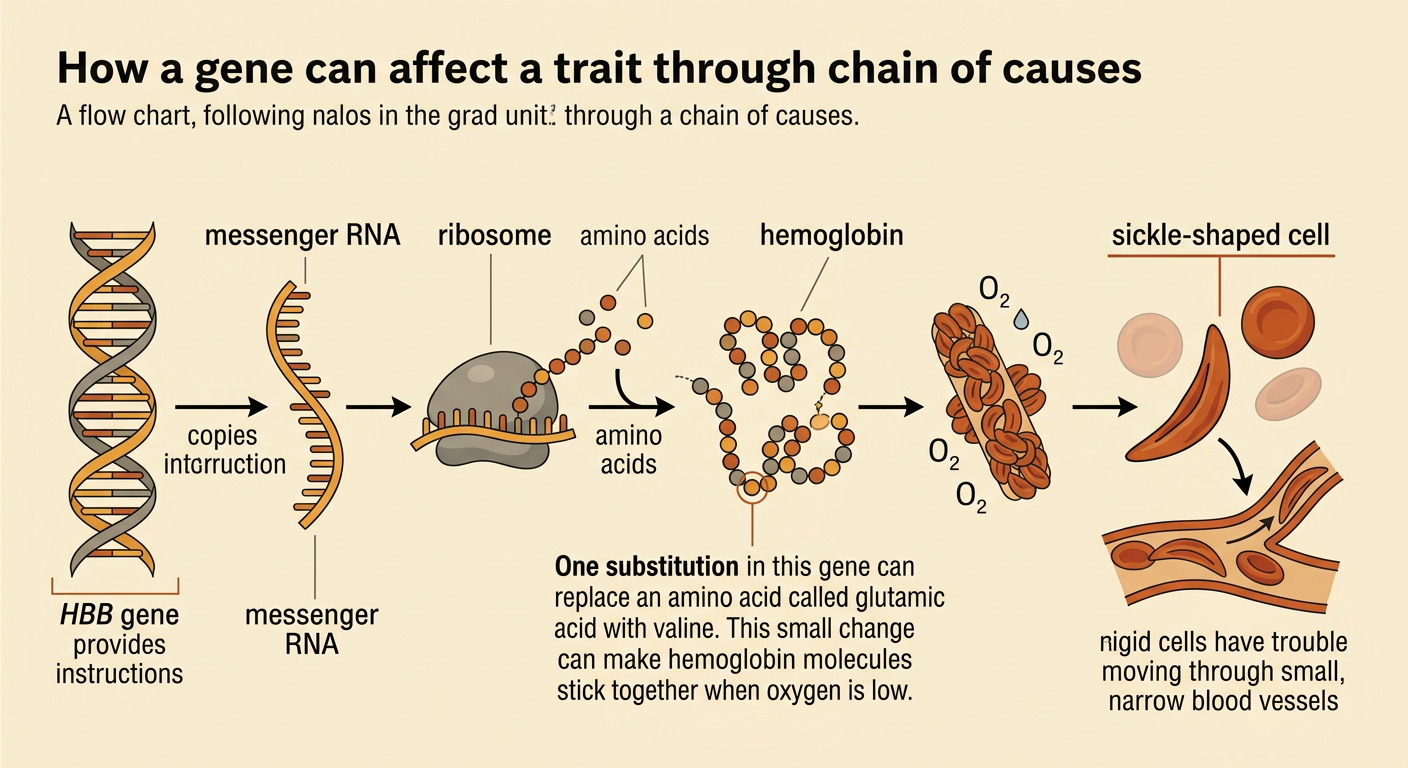
A gene can affect a trait through a chain of causes: DNA information is copied into messenger RNA, and a ribosome uses that RNA to assemble amino acids into a protein. The order of amino acids influences how the protein folds and functions. One example involves the HBB gene, which provides instructions for part of hemoglobin, the protein that carries oxygen in red blood cells. A particular substitution in HBB changes one amino acid from glutamic acid to valine. This change can make hemoglobin molecules stick together when oxygen is low, causing some red blood cells to become rigid and sickle-shaped. These cells do not move through small blood vessels as easily as normal cells. However, not every DNA mutation changes a protein. Some substitutions still specify the same amino acid, and some occur outside protein-coding regions.
Modeling a Change in a Gene
A model helps trace how one change can move through several biological levels. Consider a short piece of the HBB coding sequence. In one version, the DNA triplet is GAG, which produces the messenger RNA codon GAG and specifies glutamic acid. After a substitution, the DNA triplet is GTG, the RNA codon is GUG, and the amino acid is valine. The model can be written as DNA change → RNA codon change → amino acid change → protein behavior change → possible trait change. Students can also add a mathematical comparison. In a hypothetical microscope sample under low-oxygen conditions, suppose 6 of 20 cells with typical hemoglobin and 15 of 20 cells with altered hemoglobin become misshapen. The modeled proportions are 6/20 = 0.30 and 15/20 = 0.75. These values describe the sample; they do not mean every cell or organism will respond identically.
Harmful, Beneficial, or Neutral?
A mutation’s effect depends on what it changes and on the organism’s environment. A harmful mutation reduces survival, health, or reproductive success in a particular setting. Two copies of the sickle-cell allele can cause sickle cell disease, which may damage tissues and organs. A beneficial mutation increases success under certain conditions. People with one typical HBB allele and one sickle-cell allele have some protection against severe malaria, so the allele can provide an advantage where malaria is common. A neutral mutation has no noticeable effect on success. For example, changing a coding DNA triplet from GAA to GAG may still specify glutamic acid, leaving the protein’s amino acid sequence unchanged. The same mutation can therefore have different consequences in different genetic or environmental contexts. Scientists classify an effect by examining evidence rather than assuming that every mutation is harmful.
Evidence-Based Mutation Claims
A strong scientific explanation includes a claim, evidence, and reasoning. Imagine a controlled study of beetles exposed to the same pesticide. Of 100 beetles with a particular enzyme-gene mutation, 78 survive; of 100 beetles without it, 31 survive. The survival proportions are 78/100 = 0.78 and 31/100 = 0.31. A supported claim is that the mutation is beneficial in this pesticide environment. The evidence is the higher survival proportion among beetles with the mutation. The reasoning connects the evidence to a model: the changed gene may produce an altered enzyme that breaks down the pesticide more effectively, increasing survival. Scientists should also ask whether groups were treated equally, whether the sample was large enough, and whether repeated trials give similar results. The data support an environment-specific claim, not the claim that the mutation is always beneficial.