
When Mixing Substances Creates Something New
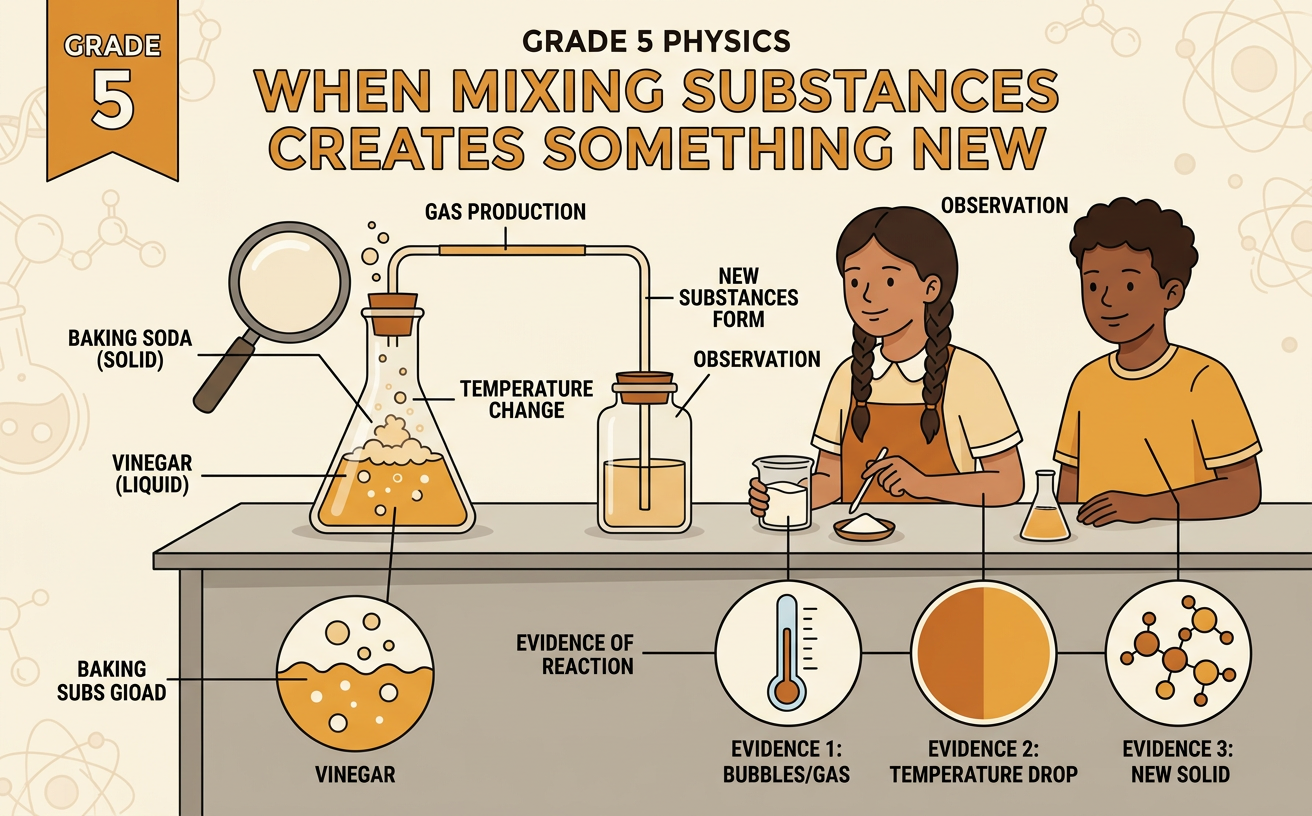
Students investigate a mixture such as baking soda and vinegar and use observations of gas production, temperature change, and other evidence to determine whether new substances formed.
Illustrations are auto-generated and may be placeholders. They can be refreshed to match the narration.
Physical Mixtures and New Substances
When substances are mixed, they do not always become new substances. In a physical mixture, each substance keeps its properties. For example, after mixing paper clips and sand, you can still recognize the paper clips and remove them with a magnet. Sometimes mixing causes a chemical reaction that forms new substances with different properties. When baking soda and vinegar mix, bubbles of carbon dioxide gas form. Water and a dissolved substance called sodium acetate also remain in the cup. Evidence of a reaction can include gas production, an unexpected temperature change, a new color, light, or a new solid. One observation alone may not prove that new substances formed, so scientists collect several kinds of evidence. They also compare what happened before, during, and after mixing.

Predict What Will Happen
Before an investigation, make a prediction that can be tested. Begin with a question: What will happen when baking soda and vinegar are mixed? You might predict, “If baking soda is added to vinegar, then bubbles will form and the temperature will decrease.” Explain why you expect those changes using what you already know or have observed. Next, identify what you will measure. You can record the starting and ending temperatures, the time that bubbling lasts, and the appearance of each substance. Keep the amounts the same in every trial, such as 30 milliliters of vinegar and 5 grams of baking soda. Using equal amounts makes trials easier to compare. A prediction is not a guess that must be correct; it is an idea that evidence will support or challenge.

Safely Mix and Observe
Wear safety goggles and work with adult supervision. Do not taste the materials, touch your eyes, or place your face directly over the cup. Set an open plastic cup on a tray to catch spills. Measure 30 milliliters of vinegar and pour it into the cup. Record its temperature and appearance. Measure 5 grams of baking soda and describe it before mixing. Add the baking soda to the vinegar, start a timer, and step back while observing closely. Never seal the reacting mixture in a container because the gas can build pressure. Look for bubbles, foam, sound, temperature change, and changes in the solid or liquid. Record observations rather than opinions. For example, write “foam rose to the halfway mark” instead of “it looked exciting.” Follow your teacher’s directions for cleanup and handwashing.

Record Evidence of Change
Organize measurements and descriptions in a data table. Include columns for the evidence type, observation before mixing, observation after mixing, and measured change. Suppose the vinegar begins at 22 degrees Celsius and the mixture drops to 18 degrees Celsius. Subtract to model the change: 18 − 22 = −4 degrees Celsius. The negative number means the temperature decreased by 4 degrees. You might also record that bubbling lasted 45 seconds and that some baking soda disappeared. Separate measured data from descriptive observations. Temperature and time are measured data; “many bubbles formed” is descriptive evidence. Results from repeated trials are stronger than results from one trial. Compare your table with another group’s table and look for patterns, such as gas production and cooling in most trials. Do not change numbers to make trials match.

Make an Evidence-Based Claim
Use your observations to answer the investigation question with a claim, evidence, and reasoning. A clear claim might be, “Mixing baking soda and vinegar produced new substances.” Support it with specific evidence: bubbles formed even though neither starting material was bubbling, gas left the open cup, and the temperature decreased from 22 degrees Celsius to 18 degrees Celsius. You can strengthen the argument by using evidence from your own table, repeated trials, and another group’s results. Then explain your reasoning. Gas production and an unexpected temperature change show that the materials interacted and their properties changed. Scientists identify the gas as carbon dioxide, which was not present as visible bubbles before mixing. Mention uncertainty honestly. For example, different temperature changes could result from different amounts or measuring methods. Finish by writing an informative paragraph that connects the claim, evidence, and scientific reasoning clearly.
