
Where Did the Mass Go? Conservation in Chemical Reactions
Students analyze measurements from closed-system reactions to model how atoms rearrange while total mass remains unchanged.
Illustrations are auto-generated and may be placeholders. They can be refreshed to match the narration.
Mass Before and After a Reaction
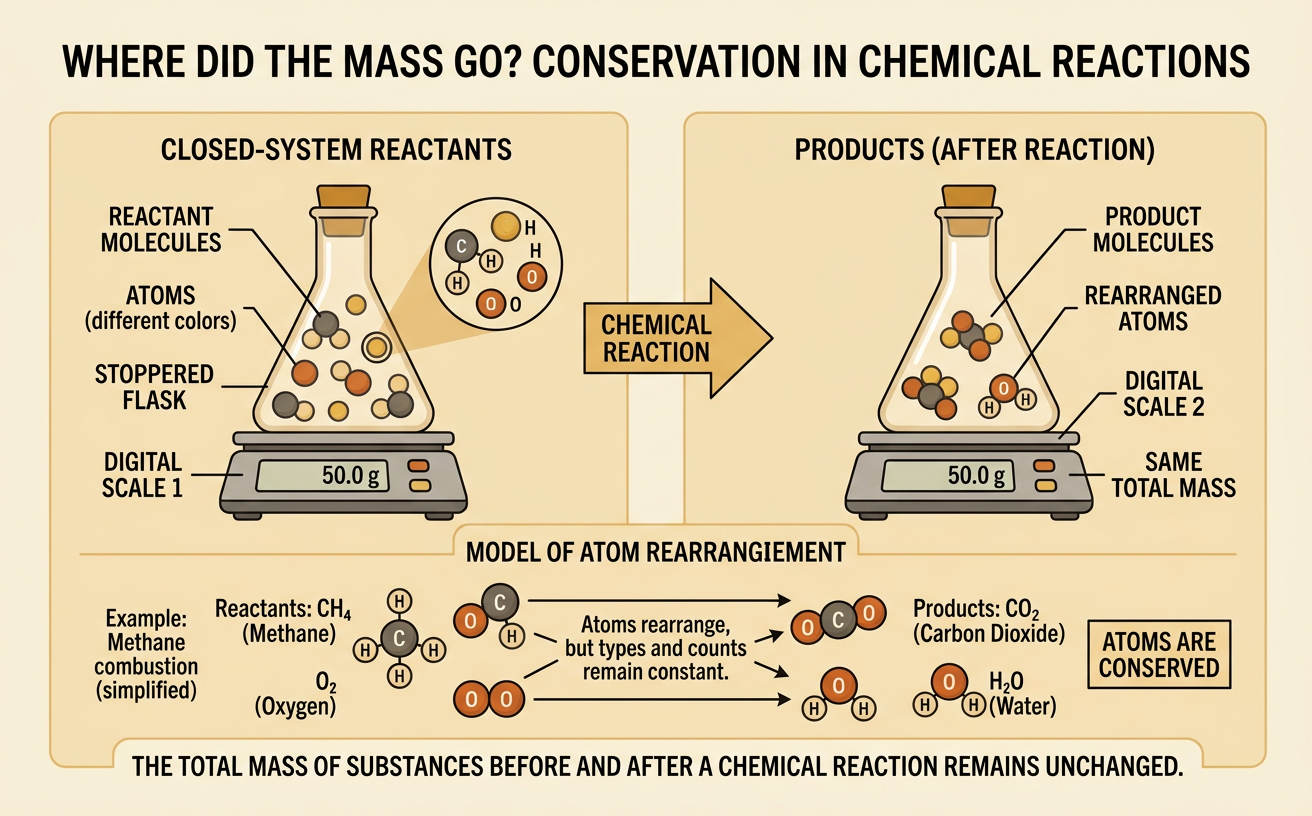
Mass is the amount of matter in an object or system. During a chemical reaction, substances change into new substances, but their atoms are not created or destroyed. Imagine baking soda and vinegar placed separately inside a sealed bag. The bag and all its contents have a mass of 128.4 grams before mixing. When the substances mix, bubbles form and the bag expands because carbon dioxide gas is produced. After the reaction, the sealed bag still has a mass of 128.4 grams. The products look different from the reactants, but the total mass remains unchanged. Measuring the entire sealed setup is important because every solid, liquid, and gas produced by the reaction must be included in the total.

Open Versus Closed Systems
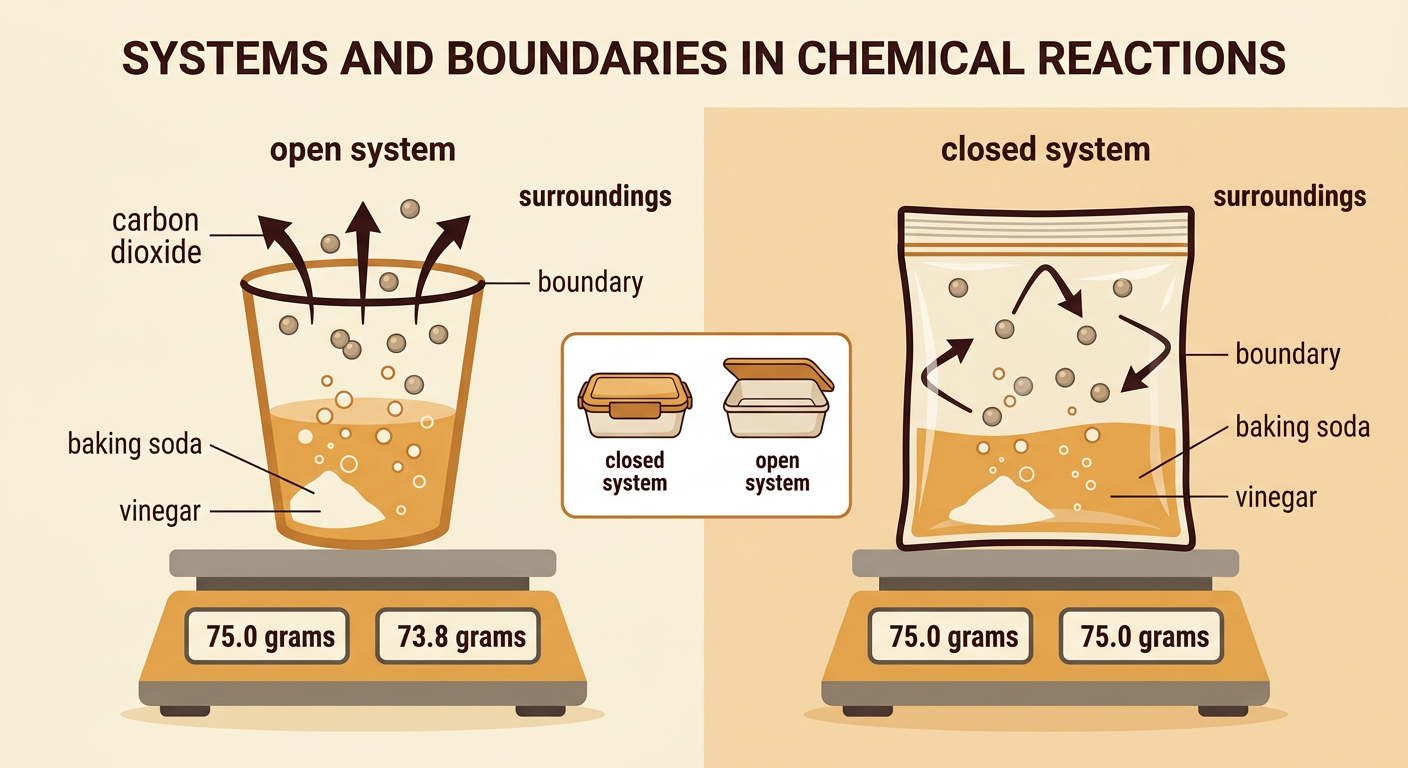
A system is the matter being studied, and its boundary separates it from the surroundings. In an open system, matter can cross the boundary. If baking soda and vinegar react in an open cup, carbon dioxide escapes into the air. A scale may show a lower mass afterward because the escaped gas is no longer on the scale. The mass was not destroyed; it moved into the surroundings. In a closed system, matter cannot enter or leave. If the same reaction occurs in a tightly sealed bag, the gas remains inside, so the measured mass stays constant. For example, an open setup might decrease from 75.0 grams to 73.8 grams, while a sealed setup remains at 75.0 grams. Identifying the system boundary helps explain the different measurements.
Tracking Atoms with Particle Models
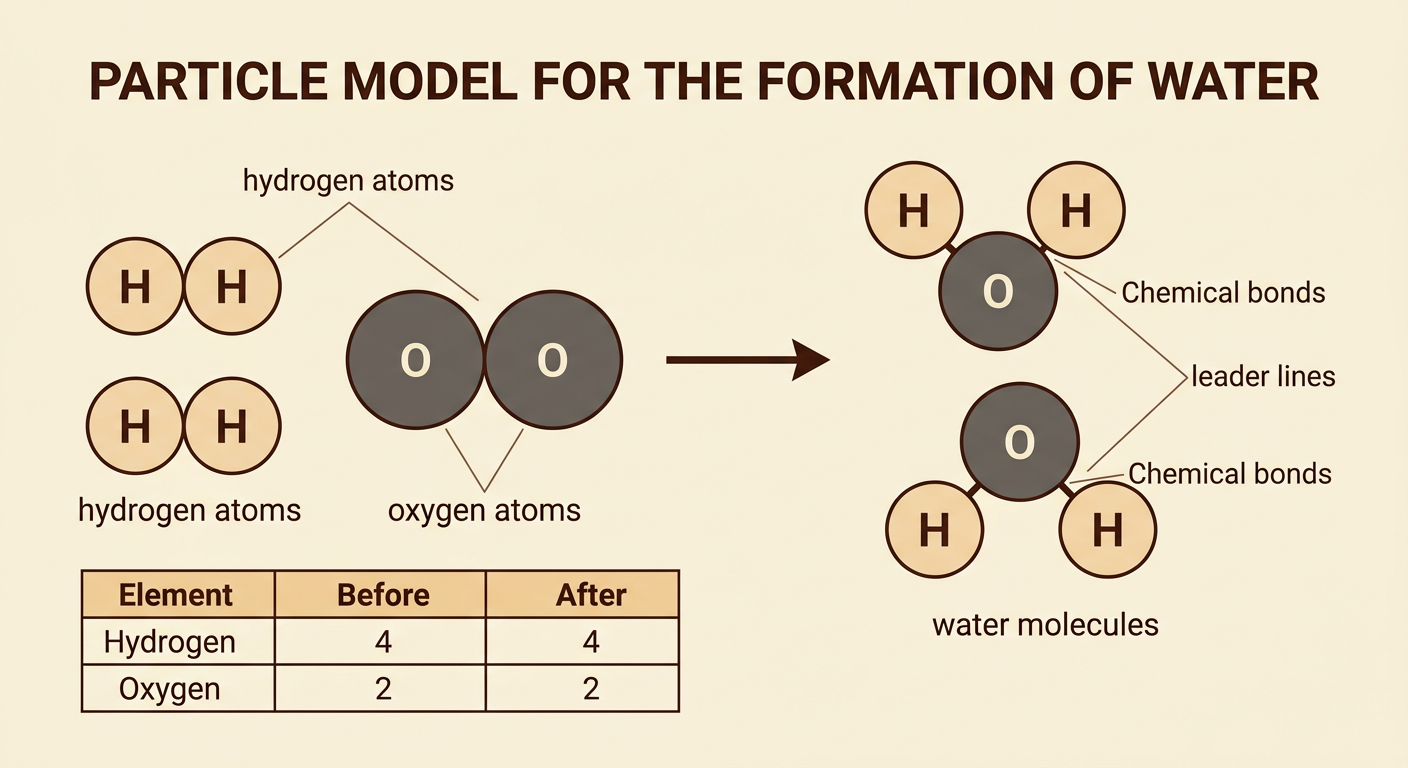
Particle models help show what happens to atoms during a chemical reaction. Consider the formation of water: two hydrogen molecules react with one oxygen molecule to form two water molecules. This can be written as 2H₂ + O₂ → 2H₂O. Before the reaction, the model contains four hydrogen atoms and two oxygen atoms. After the reaction, it still contains four hydrogen atoms and two oxygen atoms. The atoms are connected in new arrangements because old chemical bonds break and new bonds form. No atom disappears, and no new atom appears. Colored circles can represent different elements, although real atoms do not have these colors. Counting each type of atom on both sides provides visual evidence that atom number, and therefore total mass, is conserved.
Applying the Law of Conservation of Mass
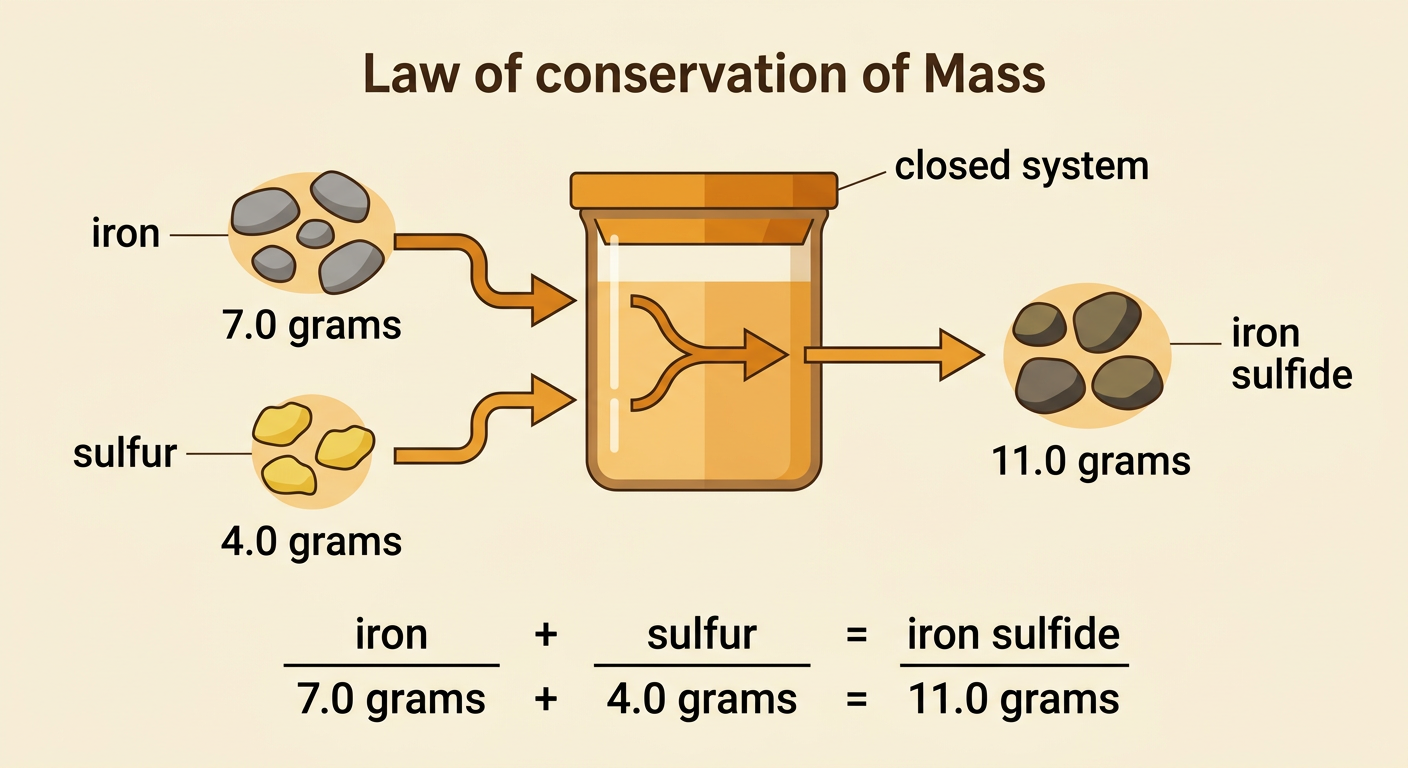
The law of conservation of mass states that the total mass of reactants equals the total mass of products in a closed system. This rule can be used to find an unknown mass. Suppose 7.0 grams of iron react completely with 4.0 grams of sulfur in a sealed container to form iron sulfide. The total reactant mass is 7.0 grams + 4.0 grams = 11.0 grams. Therefore, the iron sulfide produced must have a mass of 11.0 grams if no matter enters or leaves. The same reasoning works when several products form: add the masses of all products and compare the sum with the total reactant mass. Small differences in classroom data may result from spills, leaks, material left on tools, or limits in the precision of the scale.
Evidence-Based Explanation
A strong scientific explanation includes a claim, evidence, reasoning, and limitations. For example, a student may claim that mass was conserved when an effervescent tablet reacted with water in a sealed bottle. Scale measurements showed 214.6 grams before the reaction and 214.5 grams after it. A particle model also showed equal numbers of each type of atom before and after. Together, these sources support the claim because the 0.1-gram difference may be within the scale’s measurement precision, while the model explains why mass should remain constant. However, the model does not show actual particle sizes or motion, and one set of measurements could include error. Repeated trials, a more precise scale, and checks for leaks would strengthen the argument. Good conclusions acknowledge both the strengths and limitations of the evidence.
