Where Did the Matter Go? A Sealed Fizzing Reaction
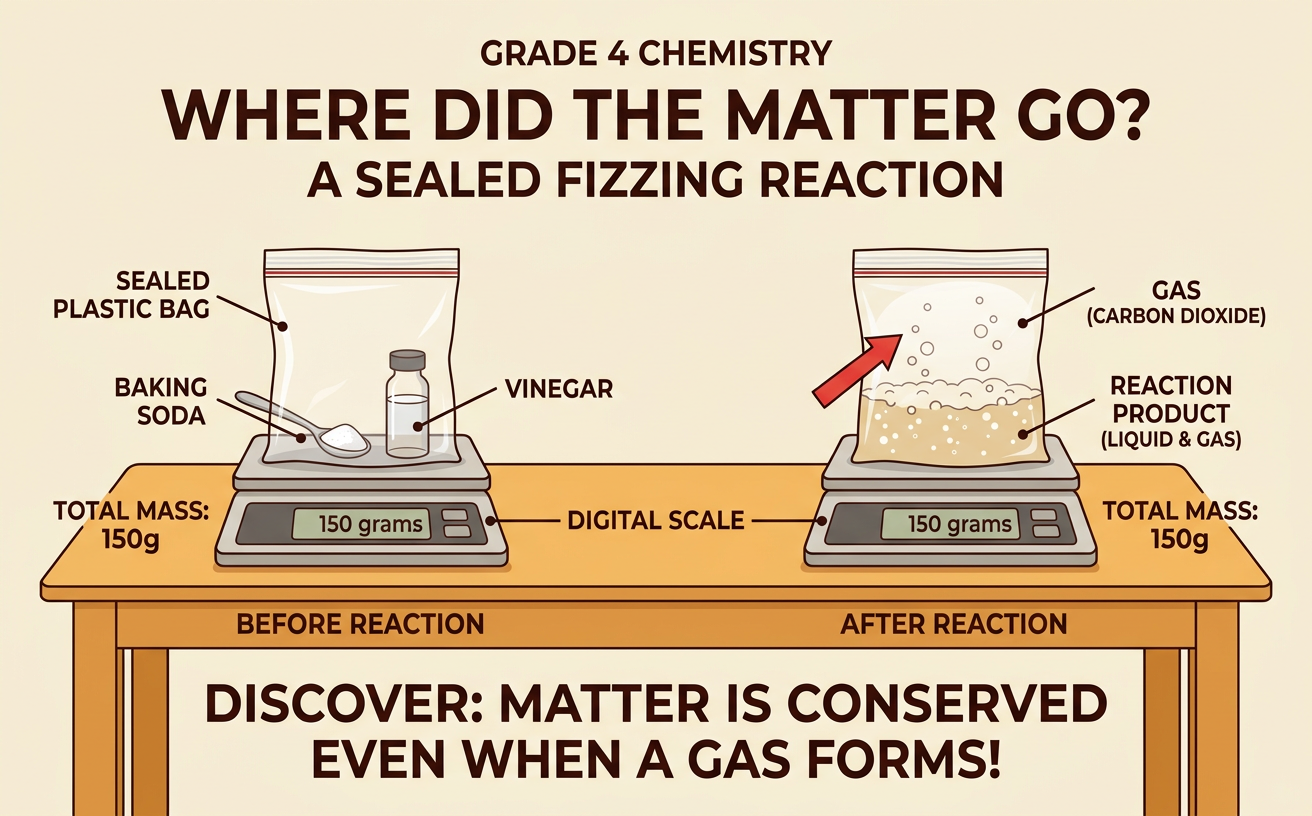
Students measure a sealed bag before and after combining baking soda and vinegar to discover that matter is conserved even when a gas forms.
Illustrations are auto-generated and may be placeholders. They can be refreshed to match the narration.
Predict What Will Happen
Baking soda is a white solid, and vinegar is a clear liquid. When they mix, they react and produce many bubbles of carbon dioxide gas. In this investigation, both materials will be placed in a strong plastic bag but kept apart at first. The bag will be sealed before they are mixed, so no solid, liquid, or gas can escape. Predict what you will observe and what will happen to the total mass. For example, you might predict, “The bag will puff up because a gas forms, but its total mass will stay the same.” Record your prediction before testing it. A prediction is not a guess to hide or change later. It is an idea that you compare with evidence after the investigation.

Measure the Sealed Materials
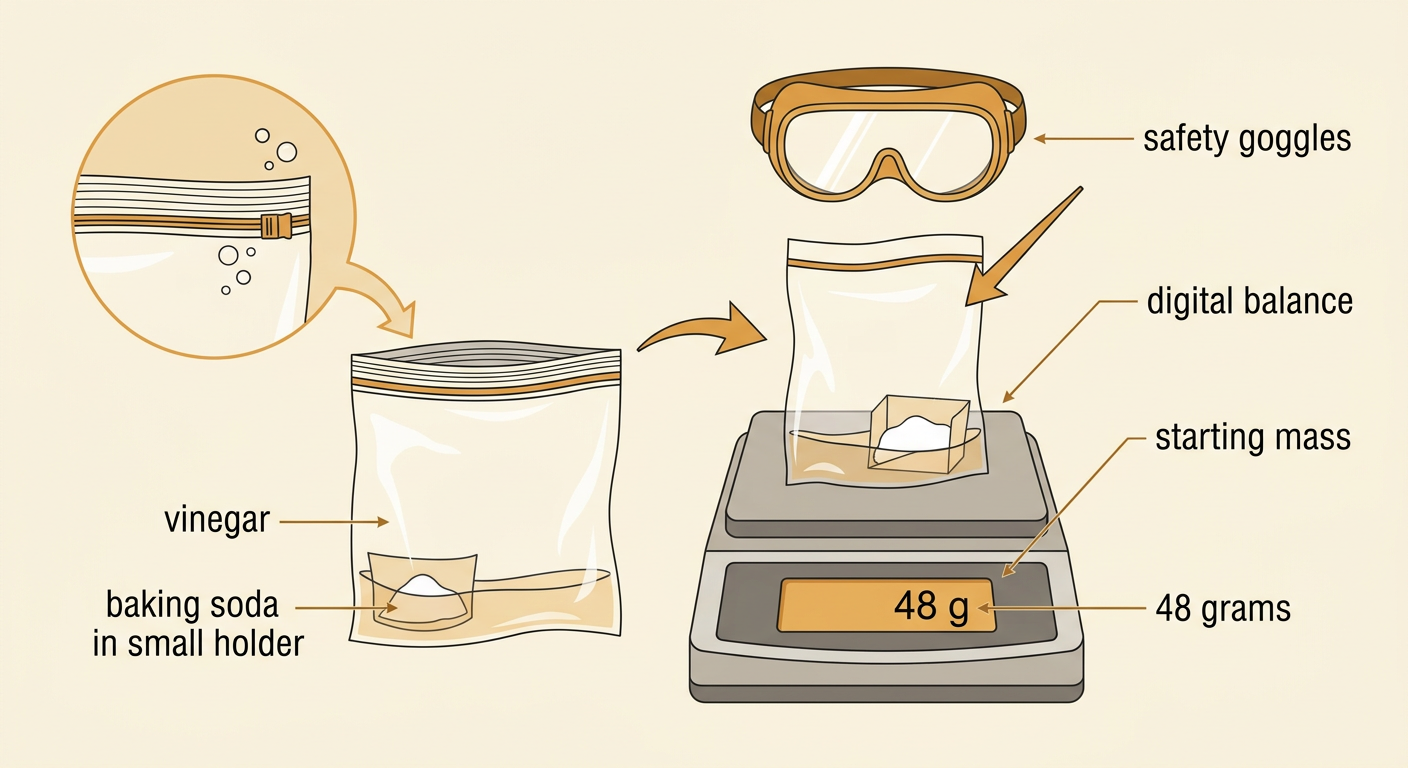
Put a measured amount of vinegar into a strong, leak-free plastic bag. Place the baking soda in a small cup or folded paper holder inside the bag so it does not touch the vinegar yet. Press out extra air without spilling anything, and seal the bag completely. Wear safety goggles and do not taste the materials. Place the entire sealed setup on a digital balance and record its mass in grams. Include the bag, vinegar, baking soda, holder, and trapped air in the measurement. For example, the balance might read 48 grams before mixing. This is the starting mass. Leave every part of the setup in the bag because removing even a small item would make the comparison unfair. Check that the balance displays zero before measuring.
Create the Fizzing Reaction
Keep the bag sealed while you tip it so the baking soda falls into the vinegar. Set the bag on a tray and watch closely without opening it. The mixture will fizz, and the bag may expand as carbon dioxide gas forms. You may also notice that the solid baking soda seems to disappear into the liquid. It has not vanished from existence. Its particles are taking part in a chemical reaction that creates new substances. For example, a flat bag may become rounded as gas spreads through the available space. Gently touch only the outside of the bag and keep it away from your face. If the bag leaks or opens, stop the trial because escaping gas would mean the system is no longer sealed and the mass comparison would not be valid.

Measure and Compare Again
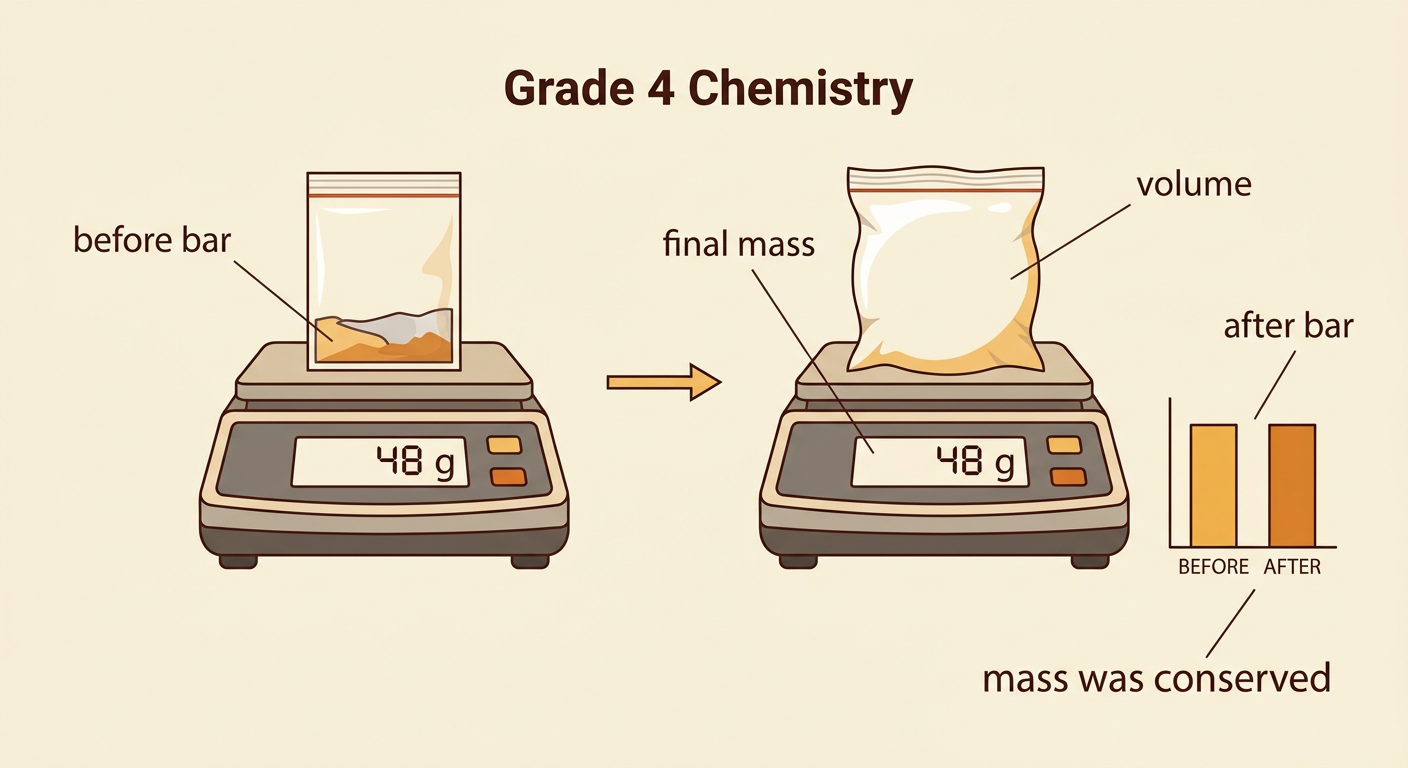
Wait until the strongest fizzing slows, then place the still-sealed bag back on the same digital balance. Make sure no part of the bag touches the table or hangs off the balance. Record the final mass in grams and compare it with the starting mass. If the bag measured 48 grams before the reaction, it should measure about 48 grams afterward. A difference of a small fraction of a gram may come from the balance rounding, movement, or a tiny leak. Subtract the smaller measurement from the larger one to find the difference. You can also make a bar graph with one bar for “before” and one for “after.” Equal or nearly equal bars show that the total mass was conserved. The bag changed shape, but shape and volume are not the same as mass.
Explain Where the Gas Came From
The carbon dioxide gas did not come from nowhere. Baking soda and vinegar are made of tiny particles called atoms. During the reaction, atoms from the baking soda and vinegar rearranged to form new substances, including carbon dioxide gas, water, and a dissolved substance called sodium acetate. The same atoms were present before and after the change; they were simply grouped in new ways. For example, some carbon and oxygen atoms that began in the materials became part of carbon dioxide molecules. Because the bag stayed sealed, those gas molecules remained inside and were included in the final measurement. The gas takes up space and pushes outward on the bag, making it puff up. Matter may change from solid or liquid materials into a gas, but it does not disappear during this reaction.

Make a Conservation-of-Matter Claim
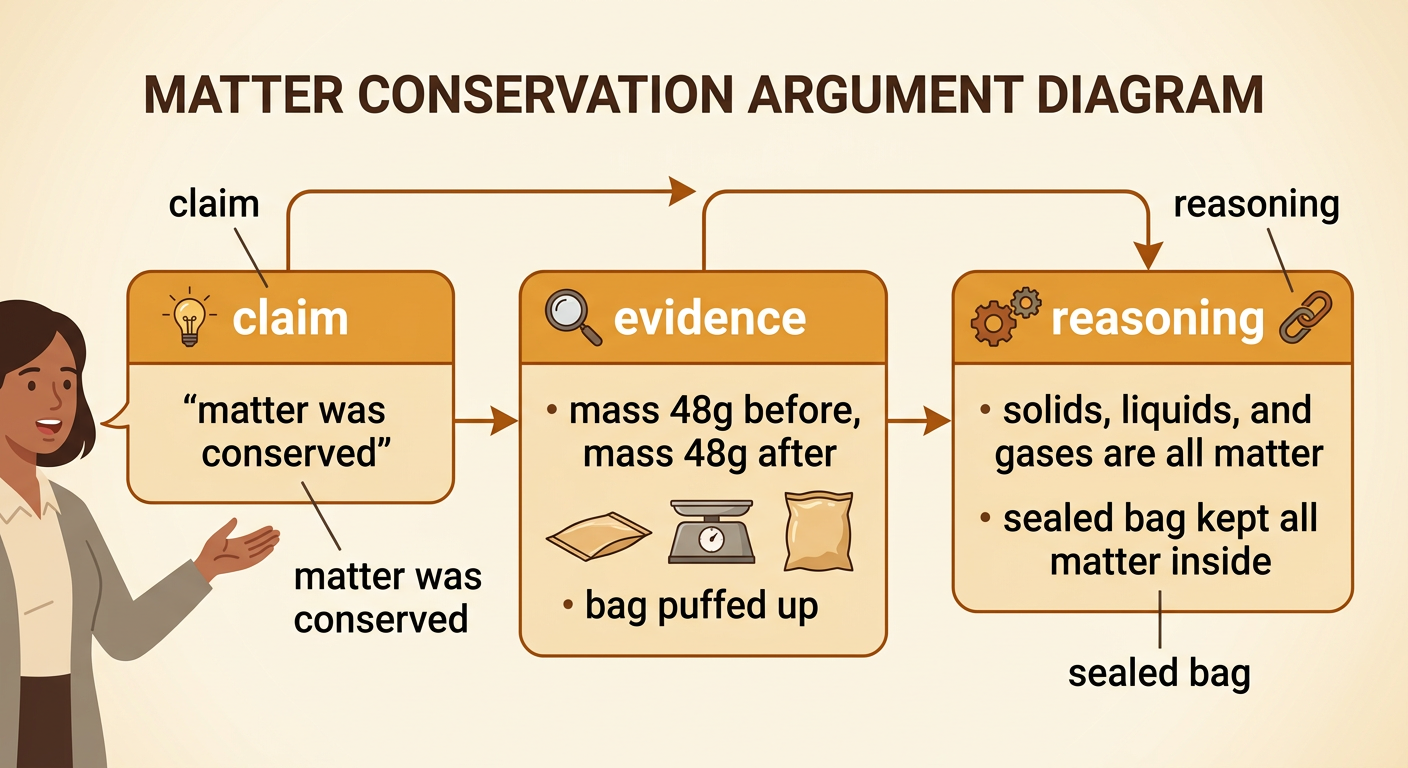
Use your observations and measurements to make a scientific argument. Begin with a claim that answers the question: Was matter conserved during the sealed reaction? Then support the claim with numerical evidence and observations. For example, write, “Matter was conserved because the sealed bag had a mass of 48 grams both before and after the reaction. The bag puffed up, showing that gas formed, but the gas stayed inside.” Add reasoning that connects the evidence to the claim: all solids, liquids, and gases are matter, and none could leave the sealed bag. You may also compare your results with another group’s measurements or a class graph. If measurements differ slightly, explain possible causes such as balance precision or a leak. Use facts, precise words, and complete sentences to communicate your conclusion clearly.