Where Did the Puddle Go? Evaporation and Condensation
Students observe and model how warming changes liquid water into water vapor and how cooling changes water vapor back into liquid droplets.

Illustrations are auto-generated and may be placeholders. They can be refreshed to match the narration.
The Disappearing Puddle
After rain, a puddle may slowly become smaller even when no one touches it. The liquid water does not vanish. Energy from warm air and sunlight helps water at the surface change into water vapor, a gas that mixes with the air. This change is called evaporation. Water vapor is invisible, so we cannot see it moving away. For example, a shallow puddle on a sunny sidewalk often dries faster than a similar puddle in the shade. To investigate why, useful sources include careful observations, measurements, weather information, and science books about water. These sources help us ask a supporting question: Does warmer water evaporate faster than cooler water?

Observe Evaporation
You can observe evaporation with two identical cups. Add the same amount of water to each cup. Place one cup in a warm, sunny spot and the other in a cooler, shaded spot. Mark the starting water level on both cups. Check the cups at the same times without moving or spilling them. After several hours or a day, compare the levels. The warmer cup will often have less liquid water because more water has changed into water vapor. Keep the test fair by using the same kind of cup, the same starting volume, and the same amount of time. Remember that the mist above boiling water is made of tiny droplets; water vapor itself cannot be seen.

Find Condensation Droplets
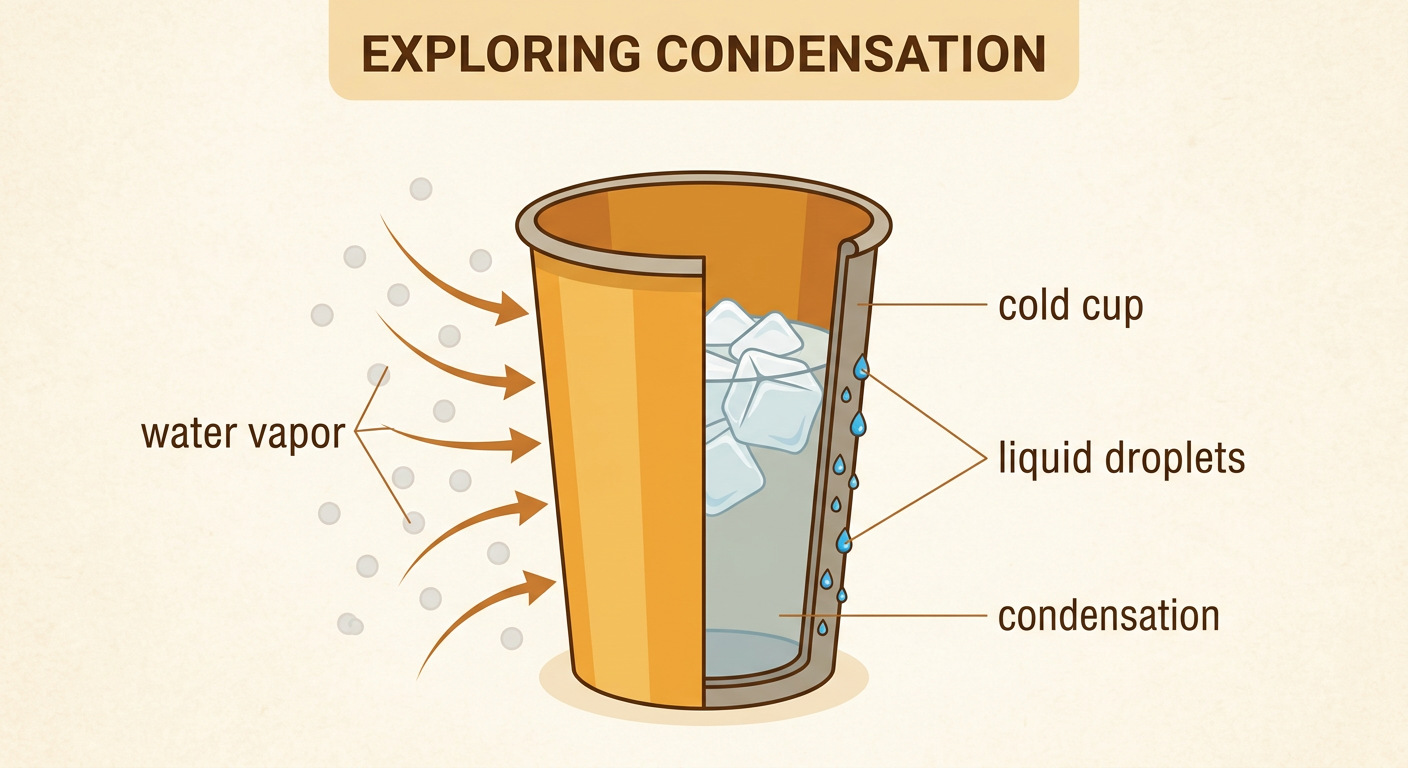
Water vapor can change back into liquid water when it cools. This change is called condensation. Fill a metal cup with ice water and wait for a few minutes. Tiny drops will form on the outside of the cup. The water did not leak through the metal. Water vapor in the nearby air touched the cold cup, cooled, and changed into liquid droplets. You can check this idea by drying the cup and watching new drops appear. A bathroom mirror gives another example. After a warm shower, water vapor cools against the mirror and forms droplets. Condensation shows that cooling can reverse evaporation: gas changes back into liquid water.
Measure and Record Water
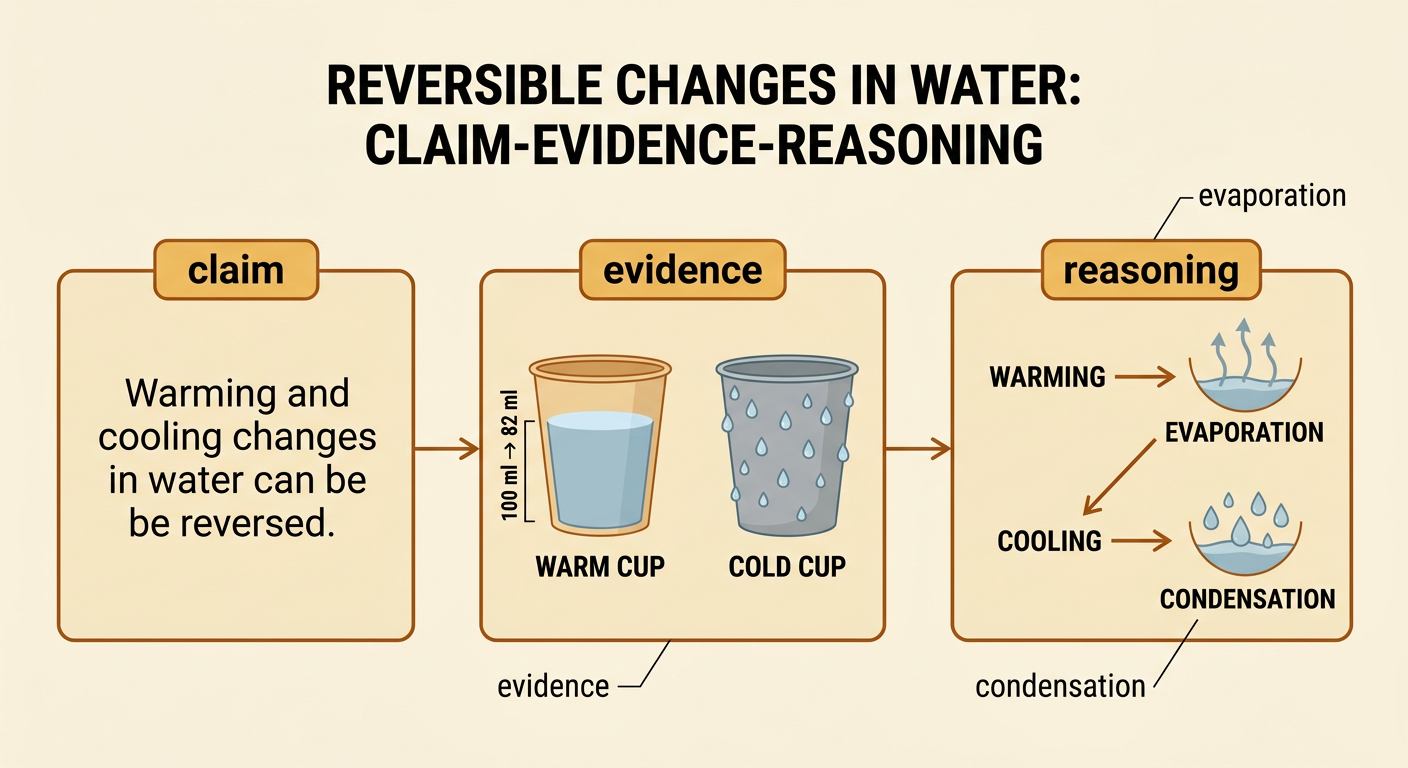
Measurements provide stronger evidence than a quick look. Use a measuring cup or graduated cylinder marked in milliliters. Begin with 100 milliliters of water in each container and record the amount in a table. After the same amount of time, measure again. Read the scale at eye level and use the line closest to the water surface. Suppose the warm container has 82 milliliters left and the cool container has 94 milliliters left. The warm container lost 18 milliliters, while the cool one lost 6 milliliters. No water was destroyed. Some liquid became water vapor and entered the air. Repeat the measurements to check whether the pattern happens again.

Model the Reversible Change
A model can show water changing state even though individual water particles are too small to see. In liquid water, particles stay close together and move around one another. When water gains thermal energy, some particles move fast enough to leave the liquid surface and spread through the air as water vapor. When water vapor loses thermal energy near a cold surface, its particles slow down and gather into liquid droplets. Use beads or dots to model the particles. Move closely grouped dots upward and farther apart to show evaporation. Then move the spread-out dots toward a cold surface and group them together to show condensation. The same water can change from liquid to gas and back to liquid.

Explain the Evidence
An evidence-based argument includes a claim, evidence, and reasoning. A claim could be: Some changes to water caused by heating or cooling can be reversed. Evidence may include the lower water level in a warm cup and the droplets that formed on a cold cup. Measurements give exact support, such as the warm cup decreasing from 100 milliliters to 82 milliliters. Reasoning connects the evidence to the claim: warming helped liquid water become water vapor, and cooling helped water vapor become liquid again. A science text can confirm the meanings of evaporation and condensation, while your data show what happened in the investigation. Together, observations, measurements, and reliable science information explain where the puddle went and how its water can return as droplets.