
Where Do Fizzing Bubbles Come From?
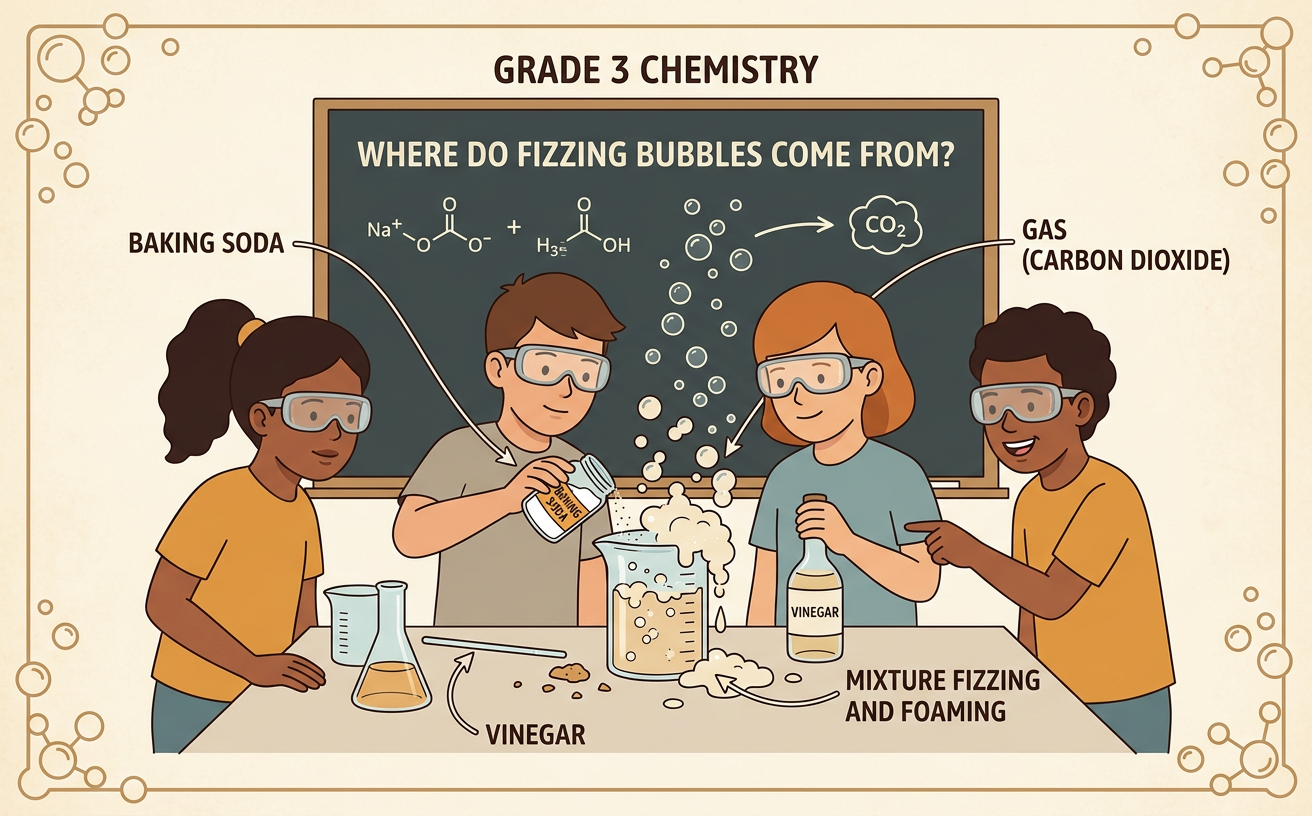
Students mix baking soda and vinegar, observe the bubbles and foam, and use evidence to explain that a gas forms when the substances react.
Illustrations are auto-generated and may be placeholders. They can be refreshed to match the narration.
Notice the Starting Substances
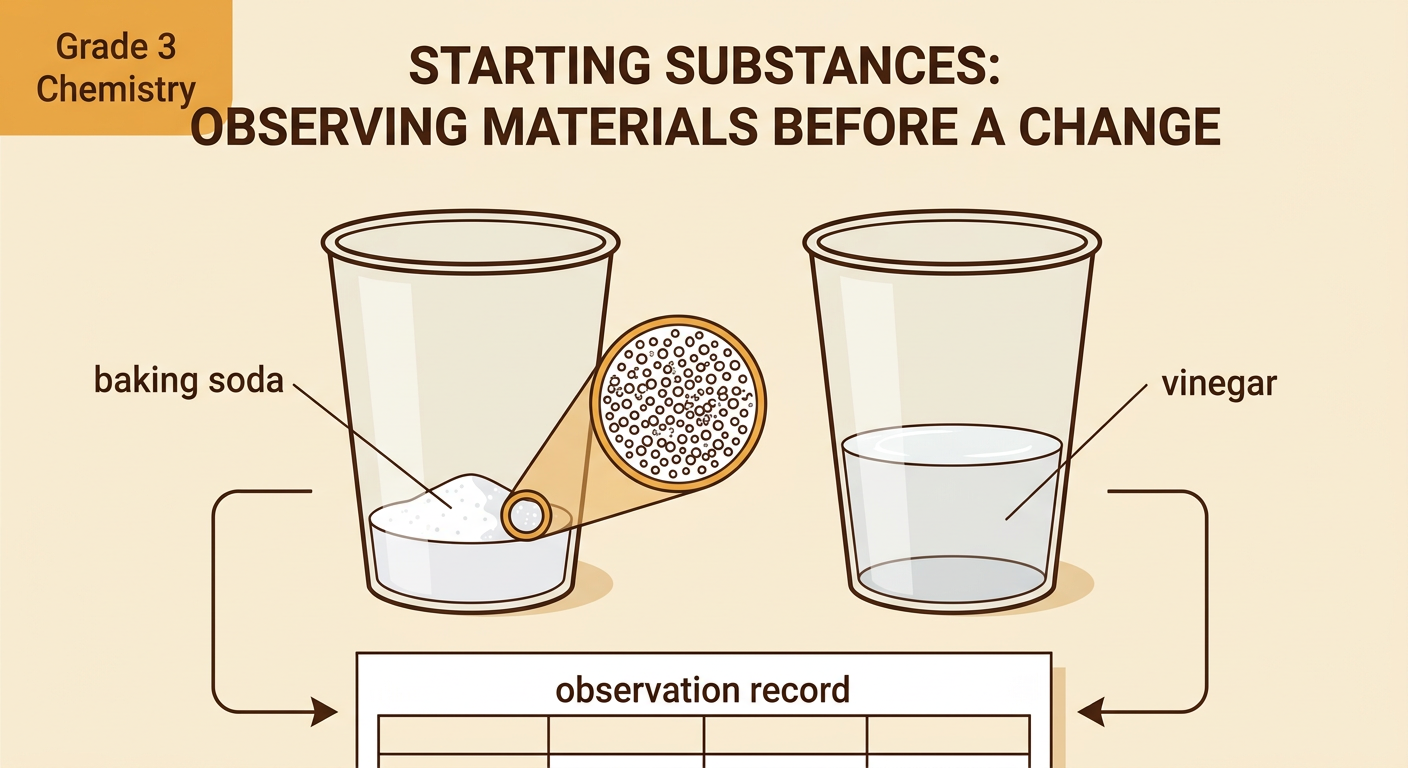
Before mixing anything, examine each starting substance. Baking soda is a dry, white powder made of tiny solid particles. Vinegar is a clear liquid with a strong, sour smell. Place one teaspoon of baking soda in a clear cup and two tablespoons of vinegar in a second cup. Record what you see, smell, and feel without tasting either substance. For example, you might write, “The baking soda is powdery, and the vinegar flows when the cup tilts.” Neither substance is bubbling strongly by itself. These observations are evidence about how the materials look before they are mixed. Keeping a record helps you compare the starting substances with what appears after the reaction.
Mix and Observe Safely
Wear safety goggles and place the cups on a tray. Slowly pour the vinegar into the cup of baking soda. Keep your face away from the cup, and never taste the materials. As soon as the substances touch, many bubbles appear and foam rises. You may also hear fizzing. Watch the reaction in an open cup; never close the mixture inside a hard container because gas can build up pressure. Describe events in order: first, the vinegar is poured; next, bubbles form; then, foam rises; finally, the foam begins to fall. Use cause-and-effect language too. For example, “Because the baking soda and vinegar mixed, fizzing and foam appeared.” Careful observations provide evidence that the mixture changed.

Measure and Graph the Foam
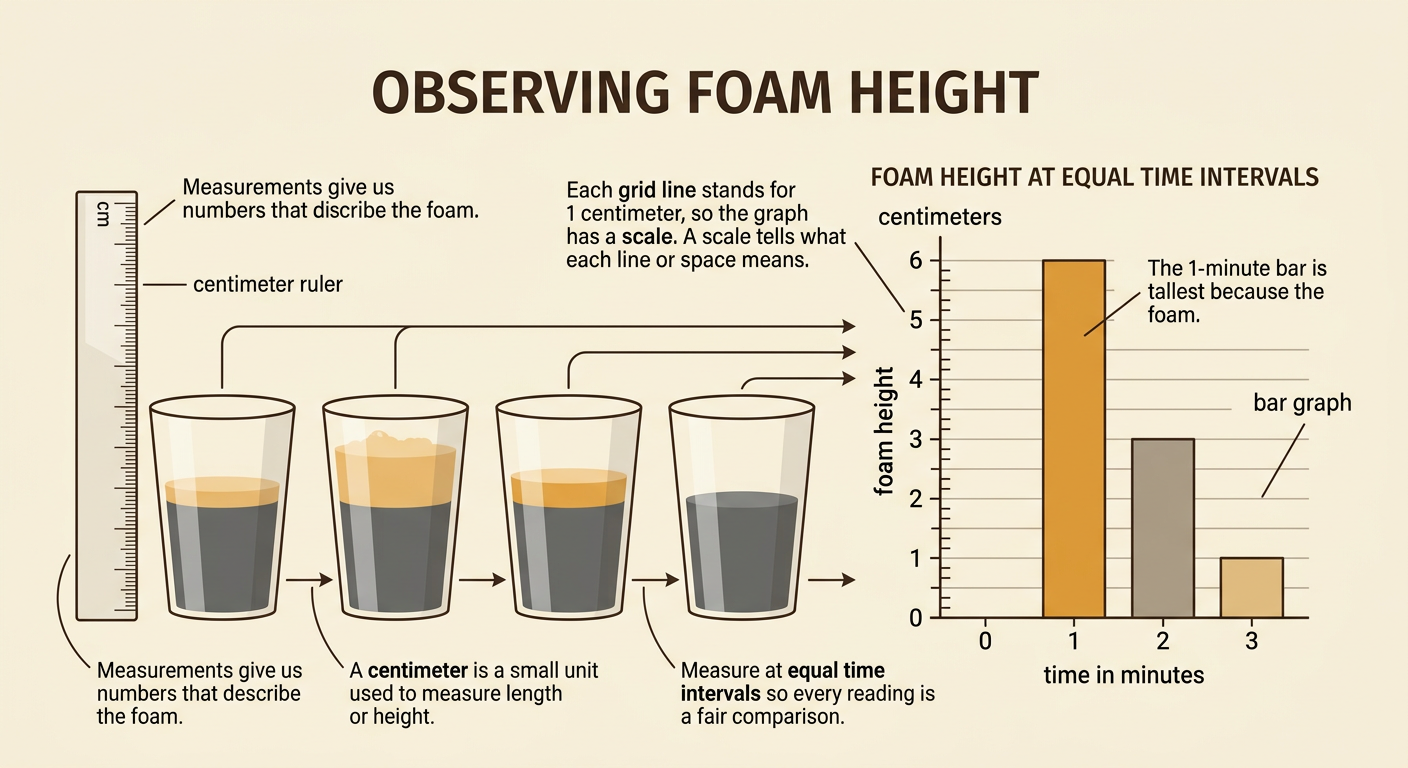
Measurements help describe how the foam changes over time. Hold a centimeter ruler beside the cup without putting it into the mixture. Measure the foam height at the same time intervals. In one example, the foam measured 0 centimeters before mixing, 6 centimeters after 1 minute, 3 centimeters after 2 minutes, and 1 centimeter after 3 minutes. Your results may be different. Make a scaled bar graph with time in minutes along the bottom and foam height along the side. Use a scale in which each grid line equals 1 centimeter. Draw one bar for every measurement. The tallest bar shows when the foam was highest. The graph makes the pattern easy to see: the foam rises quickly and then becomes lower.
Explain the New Gas
The bubbles are filled with a gas called carbon dioxide. Carbon dioxide forms when baking soda and vinegar react. It was not stored as visible bubbles inside either starting substance. Instead, their particles rearranged during the reaction and produced new substances, including the gas. The appearance of many bubbles is evidence that a new gas formed. Foam develops because some carbon dioxide bubbles become trapped in the liquid. If the reaction happens in a bottle with a balloon stretched over its opening, the balloon can inflate as the gas enters it. This test should be set up by an adult and should never use a rigid sealed container. A clear explanation is: “Mixing caused a reaction, so carbon dioxide gas formed and made the bubbles.”

Compare Leavening Then and Now
Leavening makes dough or batter rise by adding gas bubbles. Long ago, many bakers saved a sourdough starter containing yeast and used it to raise bread. Yeast slowly feeds on sugars and releases carbon dioxide gas, so the dough expands. Some people also used substances made from wood ashes as chemical leaveners. Today, bakers can buy packaged yeast, baking soda, or baking powder. Baking soda needs an acid, such as buttermilk or vinegar, to produce carbon dioxide. Baking powder already contains baking soda and acidic ingredients, so it reacts when it becomes wet and often again when heated. For example, bubbles trapped in pancake batter make a cooked pancake light and fluffy. Past and present methods differ, but both use gas to help foods rise.
