
Where Does a Plant’s Growth Come From?
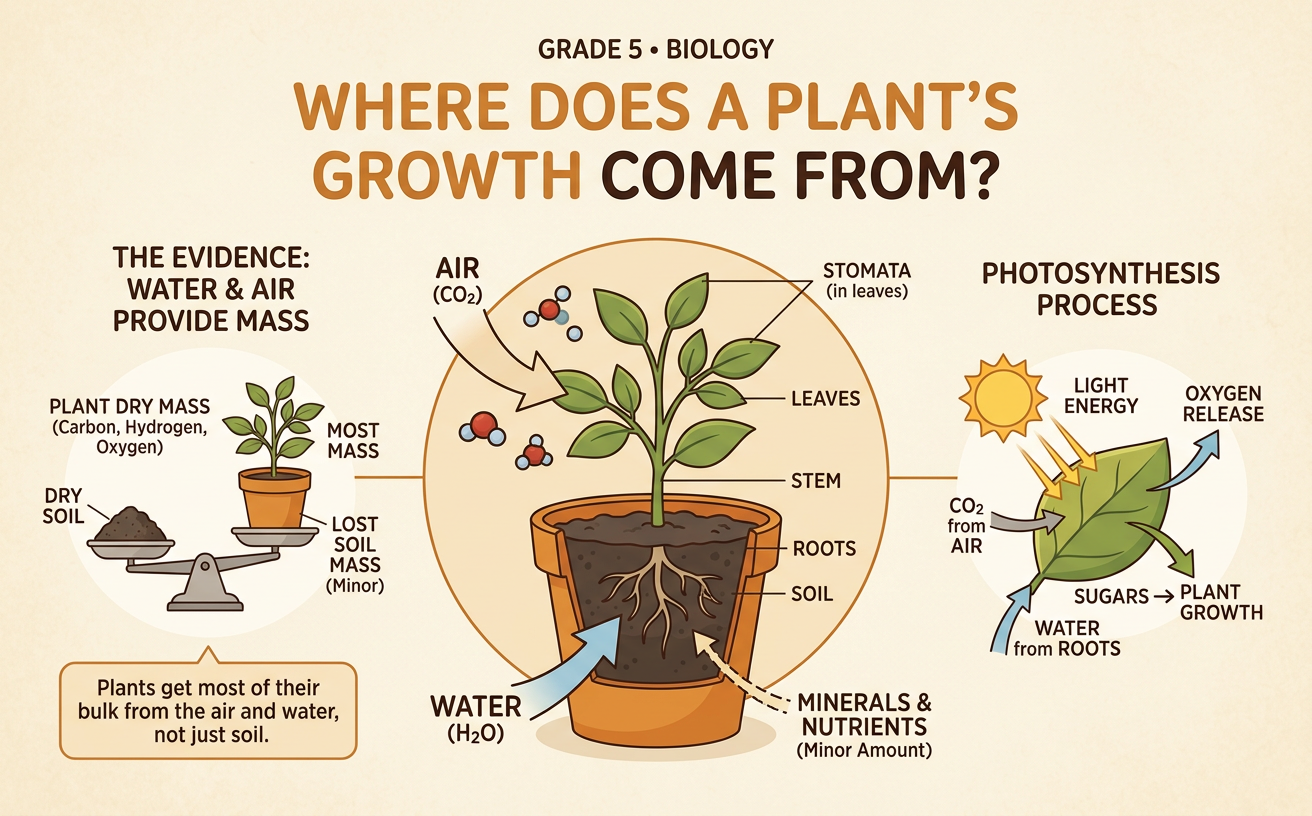
Students analyze plant-growth evidence to explain that plants gain most of the materials needed for growth from air and water rather than soil.
Illustrations are auto-generated and may be placeholders. They can be refreshed to match the narration.
What Makes a Plant Grow?
Plants grow by adding new roots, stems, leaves, flowers, and fruits. These new structures are made of matter, so the materials must come from somewhere. Roots take in water and small amounts of minerals. Leaves take in carbon dioxide from the air. Using energy from sunlight, plants combine carbon dioxide and water to make sugars. Plants use these sugars to build much of their new tissue. For example, a small bean seedling may become many times heavier even though the soil in its pot loses very little mass. This shows that soil cannot be the source of most of the added plant material. Soil supports the plant and supplies important minerals, but most plant growth comes from materials in air and water.

Tracking Changes in Plant Mass and Height
Measurements help scientists describe plant growth. Students can measure plant height from the soil surface to the highest point at the same time each day. They can also compare the dry mass of matched groups of plants at the beginning and end of an investigation. Dry mass is useful because changing amounts of stored water can affect fresh mass. Suppose five bean plants are 12, 13, 13, 14, and 15 centimeters tall after two weeks. On a line plot, place an X above each height for each plant. Two X marks go above 13 because two plants have that height. If a starting group has an average dry mass of 2 grams and a final group averages 8 grams, the data show that plant matter increased by 6 grams.

Evidence from Air, Water, and Soil
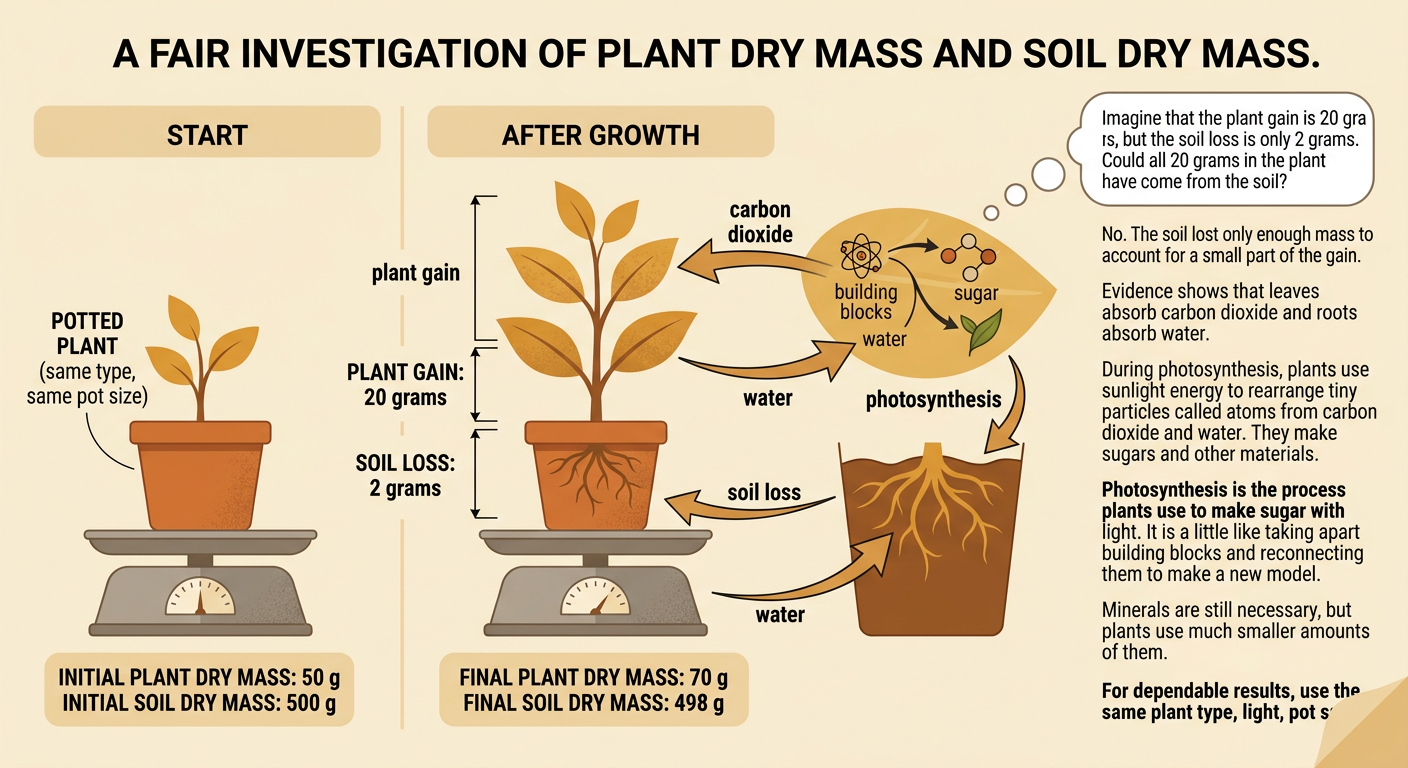
A fair investigation can compare changes in plant mass with changes in soil mass. Imagine that a plant gains 20 grams of dry mass while its dry soil loses only 2 grams. The plant could not have obtained all 20 grams from the soil. Modern scientific evidence shows that leaves absorb carbon dioxide from the air and roots absorb water. During photosynthesis, the plant rearranges atoms from carbon dioxide and water to make sugars and other materials. Minerals from soil are still necessary, but plants need them in much smaller amounts. To make the evidence dependable, students should use the same plant type, light, pot size, and growing time. They should also measure water, soil, and plants carefully and repeat the investigation with several plants.
Building an Evidence-Based Explanation
A strong scientific explanation includes a claim, evidence, and reasoning. A useful claim is: Plants obtain most of the materials needed for growth from air and water, not soil. Evidence may include plant and soil mass measurements, height data, and accurate information from a reliable text. For example, a source may state, “Most of a plant’s dry mass comes from carbon dioxide in the air.” Quote those exact words and identify the source. Then connect the evidence to the claim through reasoning. If a plant gains far more dry mass than the soil loses, the soil cannot be the main source of that matter. Carbon dioxide enters leaves, and water enters roots. With sunlight energy, the plant uses those materials to make sugars and build new cells. Minerals from soil remain important, but they make up a smaller share of growth.

Connecting Plant Needs to Agriculture
Farmers modify environments so crops receive the air, water, light, and minerals they need. Irrigation channels and drip lines move water to roots when rainfall is limited. Greenhouses provide sunlight while allowing farmers to adjust temperature, humidity, and airflow. In hydroponic systems, roots grow in water containing dissolved minerals instead of soil, showing that soil itself is not required when plants receive necessary materials and support. For example, a greenhouse farmer may use drip irrigation to deliver measured amounts of water directly to tomato roots. These changes can increase crop growth, but they must be managed carefully. Taking too much water can lower rivers or groundwater, and excess fertilizer can enter lakes. Farmers can conserve resources by measuring soil moisture, recycling water, protecting soil, and choosing crops suited to the local climate.
