
Who Is Telling the Story?
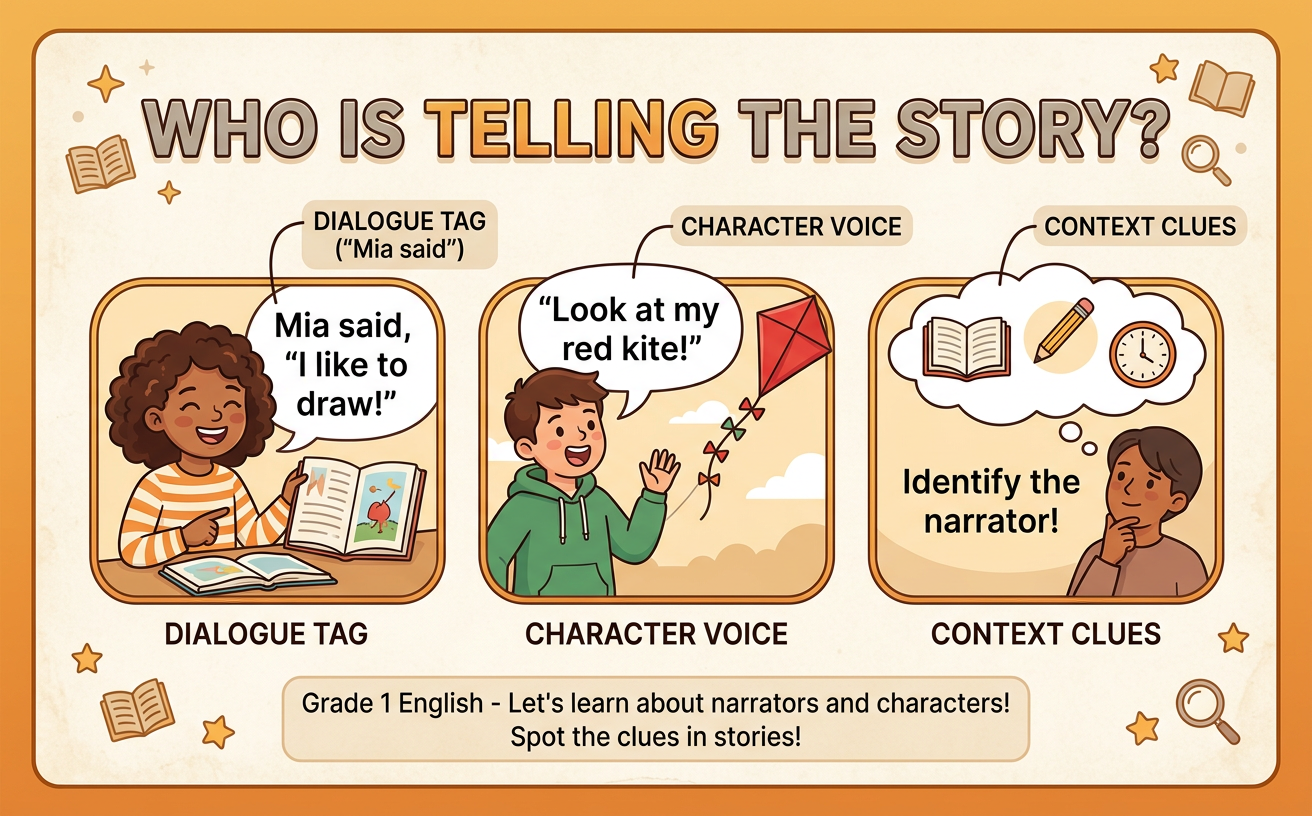
Students identify the narrator or character speaking at different points in a story by using dialogue, illustrations, and context clues.
Illustrations are auto-generated and may be placeholders. They can be refreshed to match the narration.
Meet the Storyteller
Every story has someone who tells what happens. This voice is called the narrator, or storyteller. Sometimes the narrator is a character in the story. A character may say, “I packed my red bag and ran to the bus.” The word “I” tells us that the character is telling this part. Other times, the narrator is outside the story. An outside narrator may say, “Mia packed her red bag and ran to the bus.” The narrator calls the character “Mia” instead of “I.” Ask yourself, “Who is telling me what happens?” The answer can stay the same through a story, or it can change at different points. Careful readers look for words and pictures that show who is telling each part.

Listen for Who Is Speaking
A narrator tells the story, but characters can also speak inside the story. Listen for a change in voice. Imagine a story says, “Ben saw a tiny frog near the pond. ‘Look at this frog!’ Ben called. ‘It is bright green,’ Ava answered.” The first sentence is told by an outside narrator. Then Ben speaks. After that, Ava speaks. The words “Ben called” and “Ava answered” are speaker tags. They name the person who says each line. When a story is read aloud, a reader may use a different voice for each character. Stop after each line and ask, “Who said that?” Do not choose the character who is only listening. Use the speaker tag and the meaning of the words to identify the speaker.

Notice Dialogue and Picture Clues
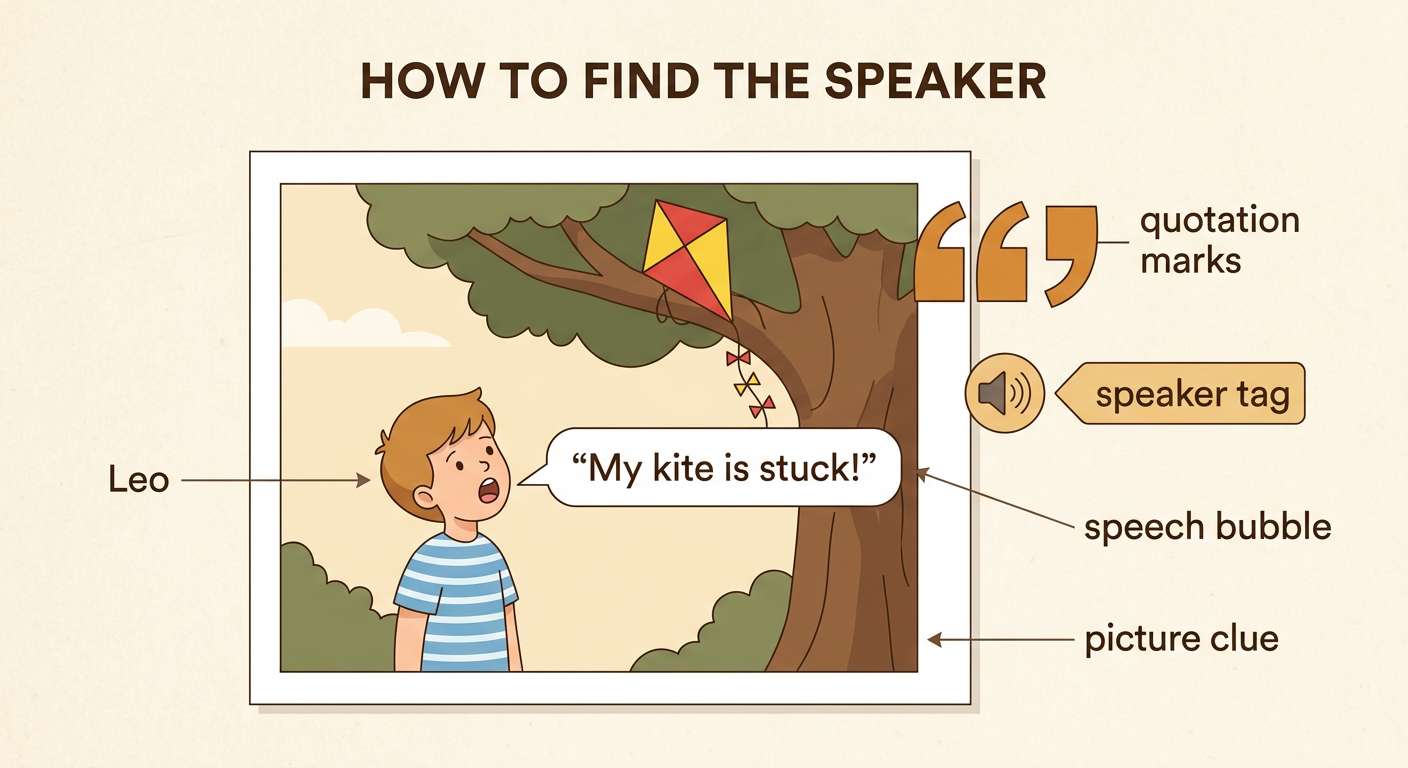
Dialogue is the exact speech of characters. In printed stories, quotation marks often go around the words a character says. For example, “My kite is stuck!” cried Leo. The quotation marks show the spoken words, and “cried Leo” names the speaker. Pictures can give clues too. An illustration might show Leo looking up at a kite in a tree with his mouth open. A speech bubble may point toward him. These details support the words in the text. However, use both the text and the picture. A picture may show several characters, but only one is speaking. Look for quotation marks, speaker tags, open mouths, pointing speech bubbles, and actions that match the words. Together, these clues help you identify the speaker.
Identify the Speaker Together
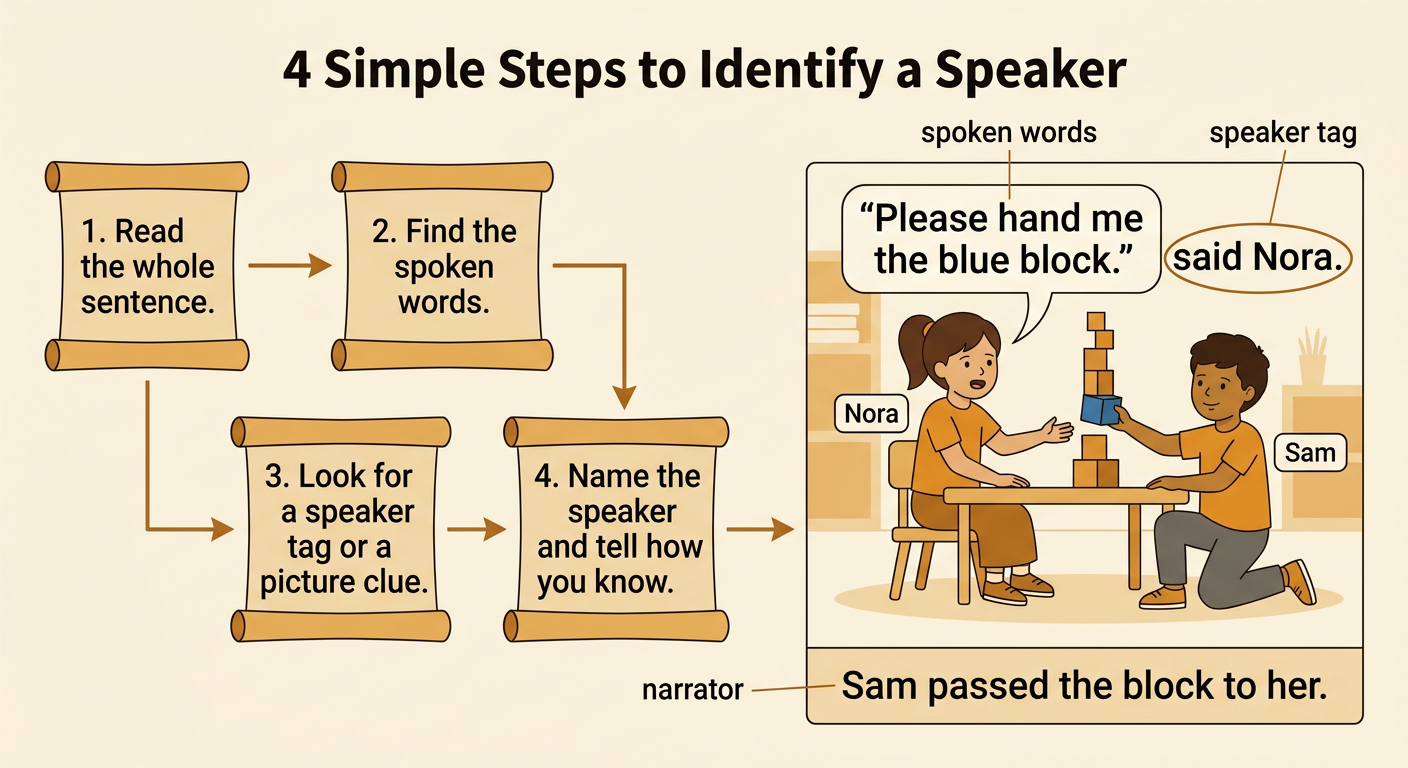
Use a simple routine to find the speaker. First, read the whole sentence. Next, find the spoken words. Then, look for a speaker tag or a picture clue. Finally, name the speaker and explain your clue. Try it with this example: Nora and Sam are building a tower. “Please hand me the blue block,” said Nora. Sam passed it to her. Who speaks? Nora speaks because the text says “said Nora.” Who hands over the block? Sam does, but Sam does not speak in this part. Now read the last sentence. It is told by the narrator because it describes Sam’s action. Following the steps helps you separate the person speaking, the person acting, and the narrator telling what happens.
Practice with Story Excerpts
Practice by stopping at different points in a short story. Read: “Owen opened the garden gate. ‘I found a ladybug!’ he shouted. Lily hurried over. ‘Where is it?’ she asked. The ladybug rested on a leaf.” In the first sentence, an outside narrator tells about Owen. In the second sentence, Owen speaks. The word “I” refers to Owen because the tag says “he shouted.” In the fourth sentence, Lily speaks because the tag says “she asked.” In the last sentence, the outside narrator speaks again. Make a speaker list in order: narrator, Owen, narrator, Lily, narrator. Remember that the speaker can change from one sentence to the next. Check every new piece of dialogue instead of guessing that the same person is still speaking.

Share the Evidence
Good readers do more than name the speaker. They share evidence, or clues, from the story. Use this sentence frame: “I know _____ is speaking because _____.” For example, you might say, “I know Lily is speaking because the text says ‘she asked’ after her words.” You could also say, “I know Owen is speaking because he says ‘I found a ladybug,’ and the picture shows him pointing to it.” If the narrator is telling a part, explain that the sentence describes a character from outside the action. Listen to a partner’s answer and check the same clues. Partners may notice different evidence, such as a speaker tag, a speech bubble, or an illustration. Strong evidence must match the words and the picture at that exact point in the story.