
Why Communities Have Rules and Laws
Students examine everyday community situations to learn how rules and laws promote safety, fairness, and shared responsibility.

Illustrations are auto-generated and may be placeholders. They can be refreshed to match the narration.
Rules and Laws Around Us
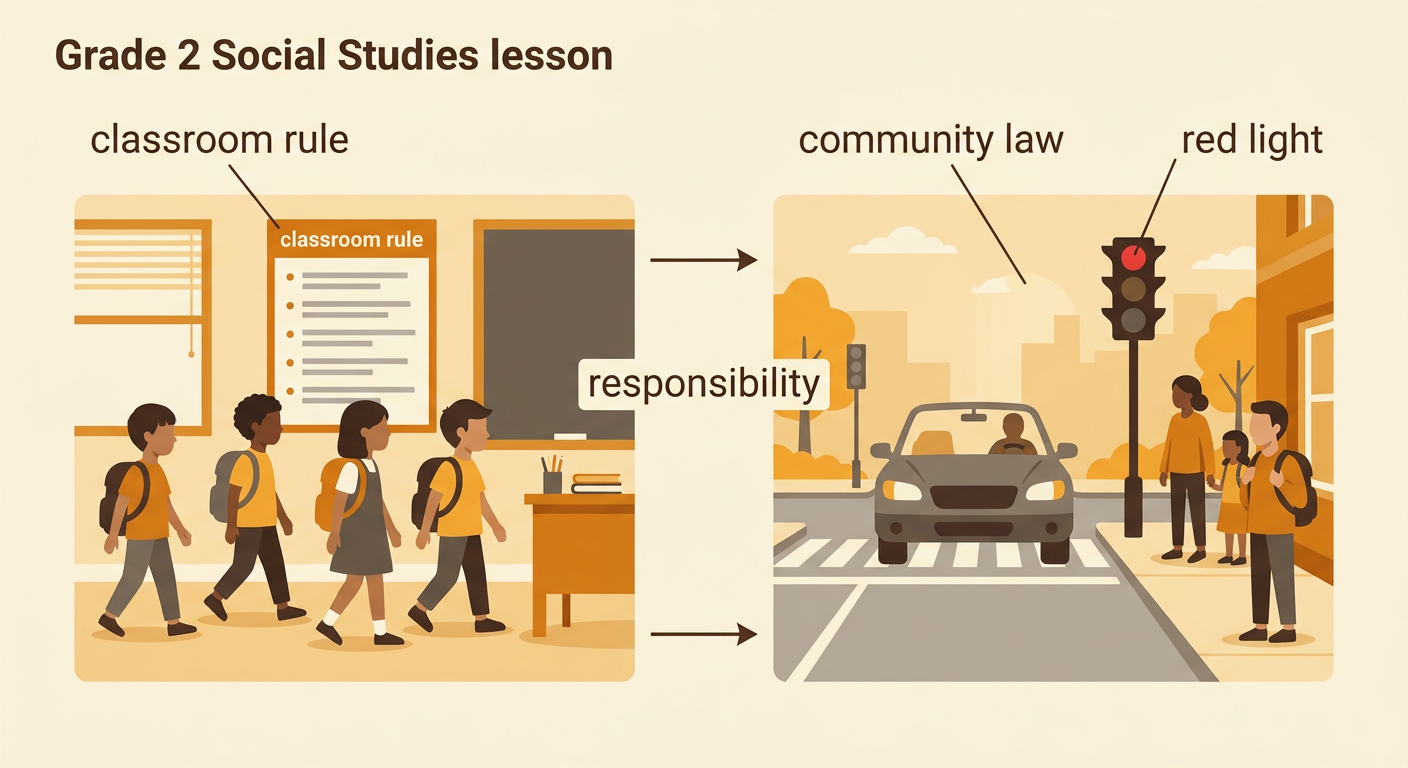
Rules and laws tell people what they should or should not do. A rule may be made for a home, school, park, or other place. For example, a classroom rule might say, “Walk inside.” A law is made by a government and applies to everyone in the community. One law requires drivers to stop at a red light. Rules and laws help people know what to expect. They also protect people and their rights. When reading about a rule or law, ask questions such as: Who must follow it? What problem does it address? Why is it important? Then look for details that answer those questions. People may not agree with every rule, but they still have a responsibility to follow rules and laws that apply to them.
Safety, Fairness, and Responsibility
Rules and laws often support safety, fairness, and responsibility. Safety means helping protect people from harm. A rule against running near a swimming pool helps prevent falls. Fairness means treating people justly and giving everyone a chance. A playground rule that limits each turn on the swing lets more children play. Responsibility means doing your part. Children are responsible for waiting behind the swing until it is their turn. They also have the right to use shared playground equipment safely. These ideas work together. If everyone follows the turn-taking rule, children are less likely to bump into one another, and no one controls the swing all day. Ask, “Whom does this rule protect?” and “What must each person do?” The answers explain how the rule supports the whole group.

Examine a Community Problem
Communities sometimes find problems that a new rule or tool could help solve. Imagine that bicycles move quickly past the entrance to a busy park. People walking out of the gate may not see the bicycles, and riders may not notice the people. First, gather information. Ask: Where do people and bicycles cross paths? When is the area busiest? Who could be hurt? Watch from a safe place, talk with an adult, and count how many people use the entrance. These details define the problem: riders and walkers need a safer way to share the path. The community might add a rule requiring riders to slow down near the gate. It could also create a safety sign. Before choosing, people should consider the needs and rights of both walkers and bicycle riders.

How Signs Support Rules
A sign is a tool that shares a message quickly. Signs can remind people about rules and warn them about danger. Near the busy park entrance, a sign could show a bicycle and the words “Slow Down: People Crossing.” The picture helps young children and people who are reading from far away. Large letters, simple words, clear colors, and a useful location make the sign easier to notice and understand. The sign should stand before the crossing so riders have time to slow down. A sign does not solve the problem by itself. People must notice it, understand it, and choose to follow the rule. Community members can observe the entrance after the sign is added. If riders still move too quickly, the sign may need to be larger, clearer, or placed in a better spot.

Choose a Fair Solution
A fair solution protects people while respecting their rights and needs. For the park problem, the community could compare three ideas: close the bicycle path, post a slow-down sign, or create separate spaces for walkers and riders. Closing the path may protect walkers, but riders would lose access. Separate spaces could work well, but they may cost more and require extra room. A clear sign and a painted slow zone may be a fair first step because riders can keep using the path while walkers gain protection. Everyone has responsibilities too. Riders must slow down and watch for people. Walkers must look before crossing and stay in the walking area. Community leaders can ask people whether the solution works and observe the crossing. If the problem continues, they can improve the sign or try another solution.
