
Why Communities Have Rules
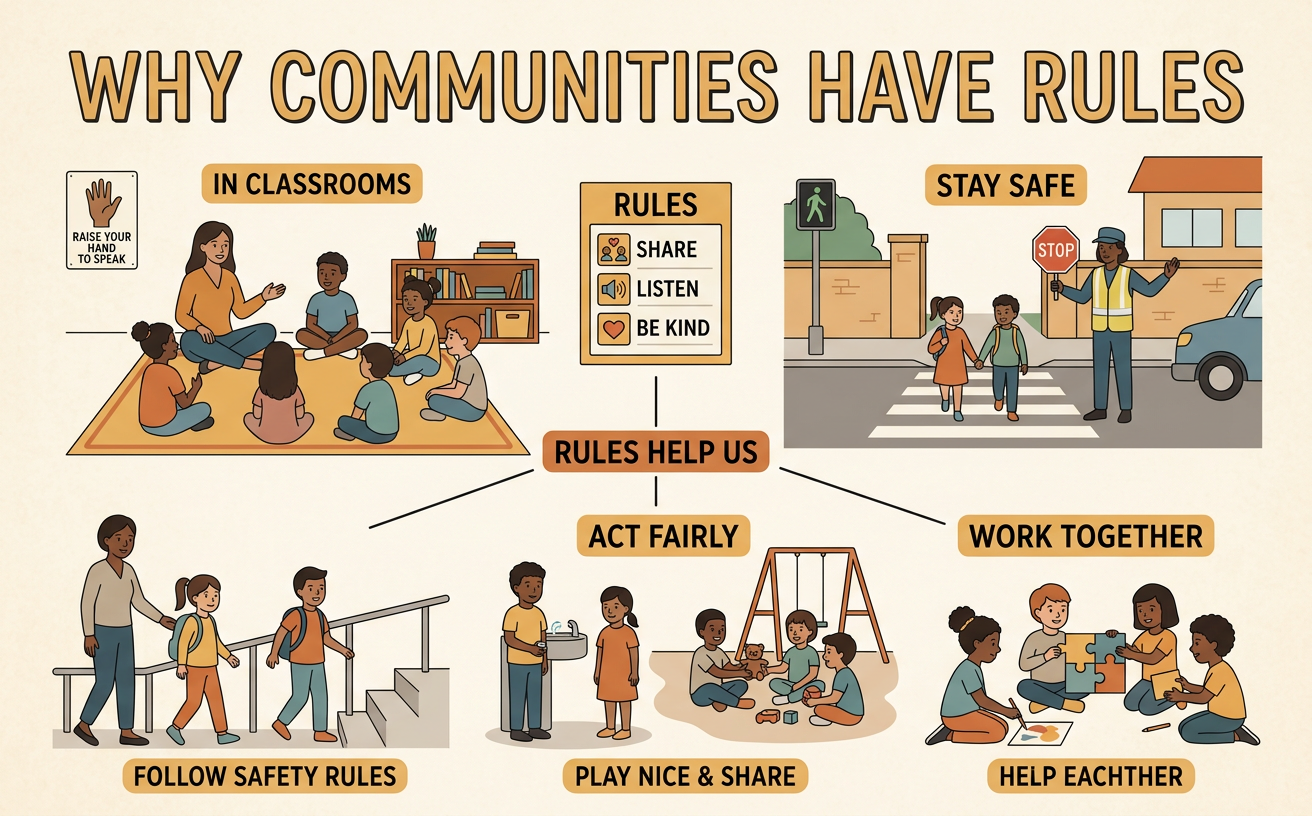
Students explore how rules help people stay safe, act fairly, and work together in classrooms and communities.
Illustrations are auto-generated and may be placeholders. They can be refreshed to match the narration.
What Is a Rule?
A rule is an agreed way to act in a place or group. A rule tells people what they should or should not do. Rules can be spoken, shown with pictures, or written with words. For example, a classroom may have a rule that says, “Listen when someone else is speaking.” During circle time, Maya waits while Leo shares an idea. Then Maya takes her turn. This rule helps both children hear and learn from each other. Teachers help explain rules, but children have an important part too. They can follow rules, remind one another kindly, and ask questions when a rule is unclear. Rules work best when everyone understands how they help the group.

Rules at School and in the Community
We follow rules in many places. At school, rules help students learn and care for shared spaces. A school rule might be, “Walk in the hallway.” In the community, rules help people use streets, parks, libraries, and other places together. A crosswalk rule tells people to cross when the walk signal is on and drivers have stopped. A library rule may ask visitors to use quiet voices. Different places need different rules because people do different things there. Children, families, teachers, librarians, crossing guards, and neighbors all help the community. They follow rules, share information, and kindly remind others what to do. Official leaders make some rules, but every person can help the community work well.

How Rules Keep Us Safe and Fair
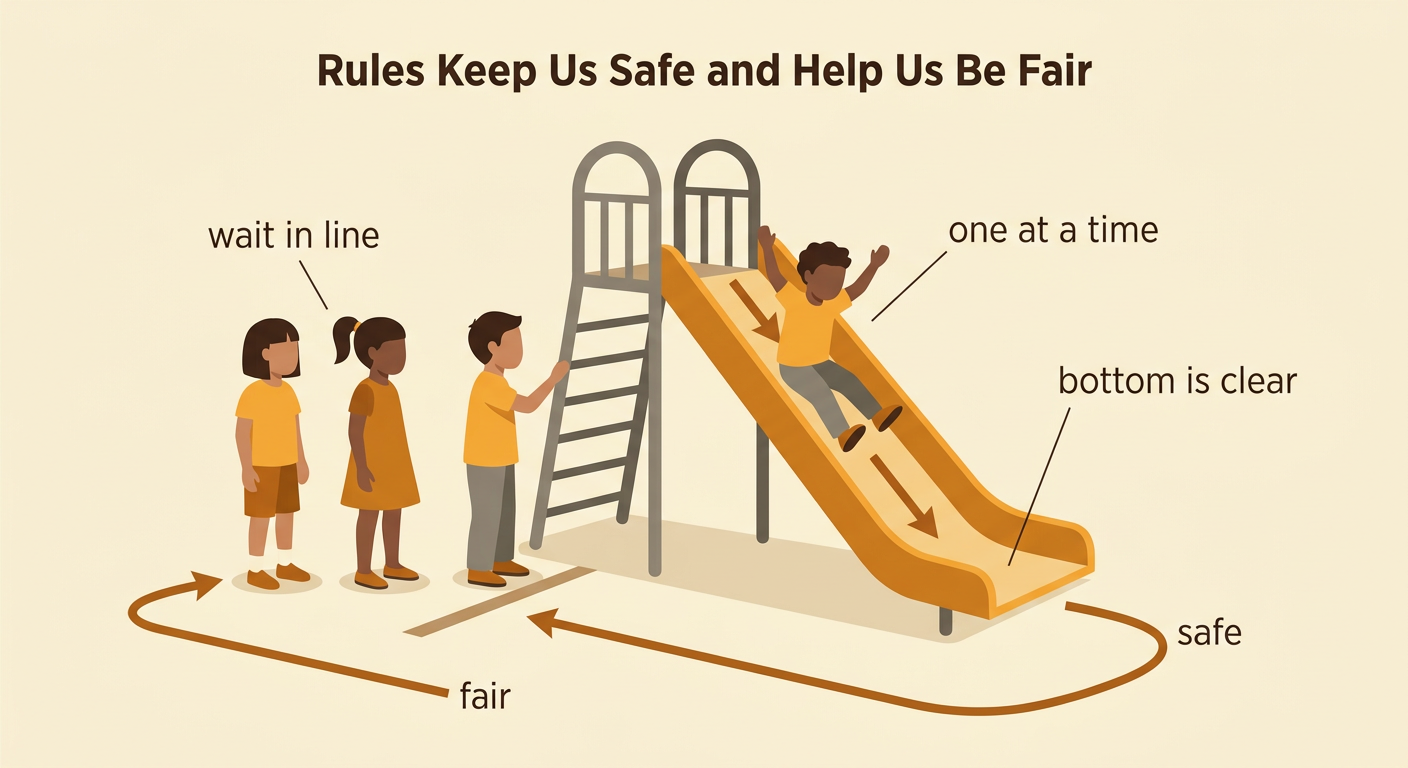
Some rules keep people safe. Other rules help people act fairly, and many rules do both. Imagine children waiting to use a playground slide. The rule is, “Wait in line and go one at a time.” Going one at a time helps prevent children from bumping into each other. Waiting in line gives each child a turn. That is fair because no one pushes ahead or takes every turn. The children also work together by leaving space and checking that the bottom of the slide is clear. If a friend needs help understanding the rule, another child can point to the line and explain it kindly. By following the rule, everyone helps make play safer and fairer.
What Happens Without Rules?
Without clear rules, people may not know what to do. This can cause confusion, unfairness, or danger. Imagine a classroom art table with no plan for sharing crayons. Several children reach for the same box, one child takes many crayons, and another child gets none. The class can observe what happened and name the problem: the crayons are not being shared fairly. Students can ask, “How can everyone get the colors they need?” They might gather information by counting the crayon boxes and listening to each child. Then they can suggest a helpful rule, such as, “Take the crayons you need and return them when you are done.” Everyone can help improve the situation by discussing, testing, and following the new rule.

Create a Helpful Classroom Rule
You can help create a classroom rule. First, notice a situation the class wants to change. For example, coats may fall on the floor near the door, where someone could trip. Observe the area and ask questions: “Why are the coats falling?” and “Where can we put them?” Gather information by checking whether each child has a hook. Next, share ideas with classmates and listen as they speak. The class might choose the rule, “Hang your coat on your hook.” Draw or write the rule so everyone can remember it. Try the rule for several days. Then talk about whether the floor stays clear. If the rule does not solve the problem, the class can improve it. Every student has a role in making the classroom work well.
