Why Did the Roman Republic Fall?
Students analyze evidence about political conflict, military expansion, economic inequality, and powerful leaders to explain the multiple causes of the Roman Republic’s collapse.

Illustrations are auto-generated and may be placeholders. They can be refreshed to match the narration.
The Roman Republic in Crisis
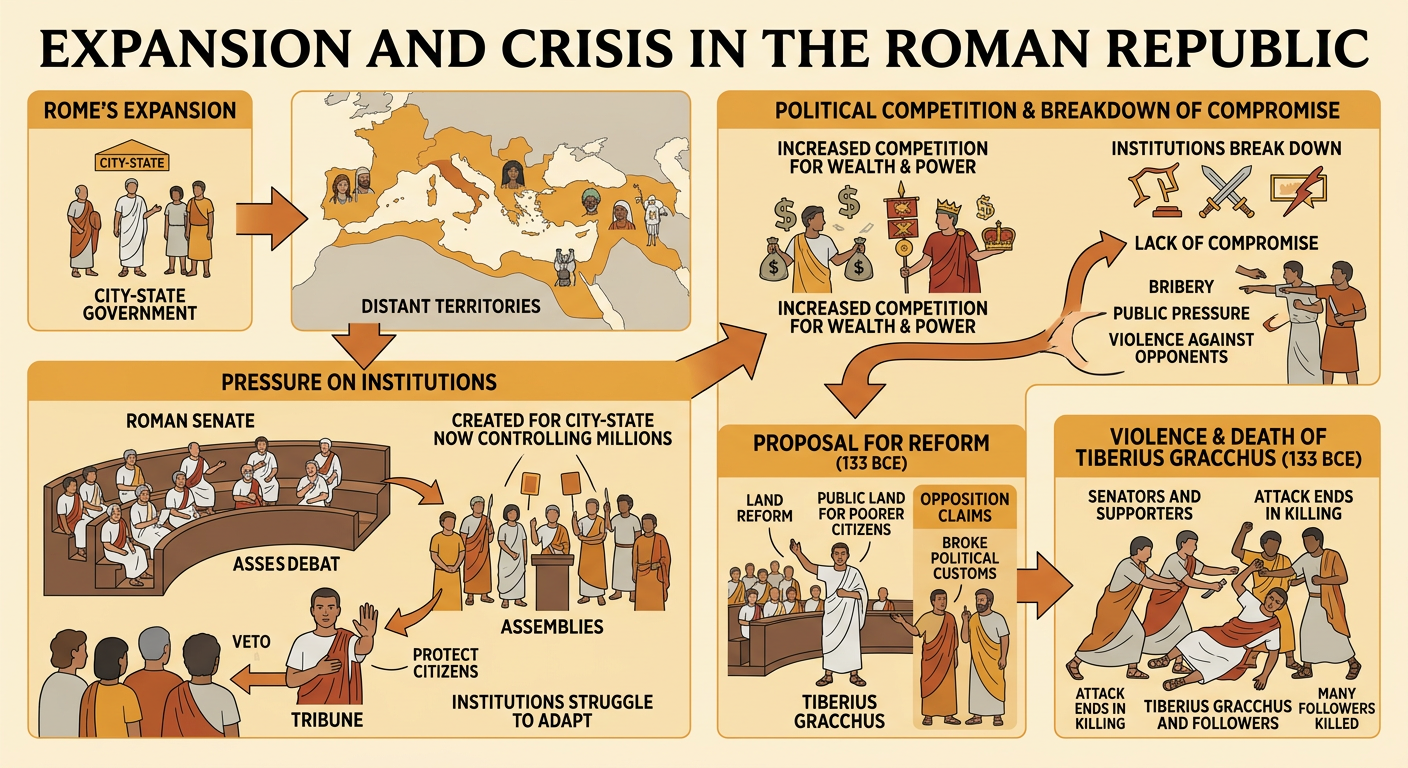
Rome’s republican government was designed for a city-state, but conquest placed millions of people and distant territories under Roman control. Senators competed for wealth, military commands, and political influence. Assemblies elected officials, while tribunes could defend ordinary citizens and veto government actions. These institutions often worked through compromise, but intense competition weakened cooperation. Leaders increasingly used public pressure, bribery, and violence to defeat opponents. In 133 BCE, the tribune Tiberius Gracchus proposed redistributing public land to poorer citizens. His opponents argued that he had violated political customs, and a group led by senators killed him and many supporters. This attack did not immediately end the Republic, but it established a dangerous example: political disagreements could be settled through force instead of debate and law.
Economic and Social Inequality
Roman conquests brought land, enslaved laborers, taxes, and treasure into Italy, but the benefits were distributed unequally. Wealthy Romans purchased or controlled large estates, while some small farmers struggled with debt, military service, and competition from enslaved labor. Farmers who lost land often moved to Rome, where many depended on irregular work and public grain distributions. Reformers argued that land should be distributed more widely so that citizens could support their families and serve in the army. For example, Tiberius and Gaius Gracchus promoted land and grain reforms during the late second century BCE. Their programs attracted strong support from poorer Romans and fierce resistance from powerful landholders. Economic inequality did not cause the Republic to collapse by itself, but it increased social tension and gave ambitious leaders opportunities to build loyal groups of supporters.

Military Loyalty and Civil War
As Rome fought more wars, generals gained unusual political power. Beginning with reforms associated with Gaius Marius in 107 BCE, more citizens without property entered the army. Soldiers increasingly hoped their commanders would provide pay, rewards, and land after service. This could make personal loyalty to a successful general stronger than loyalty to the Senate. Rival commanders then used armies in political conflicts. In 88 BCE, Lucius Cornelius Sulla marched his troops on Rome, an action that broke a major republican custom. He later became dictator and used deadly lists called proscriptions to eliminate enemies. Decades later, Julius Caesar crossed the Rubicon River with his army in 49 BCE, beginning another civil war. These examples showed that military force could decide political disputes, weakening elections, laws, and civilian government.
Caesar’s Rise and Assassination
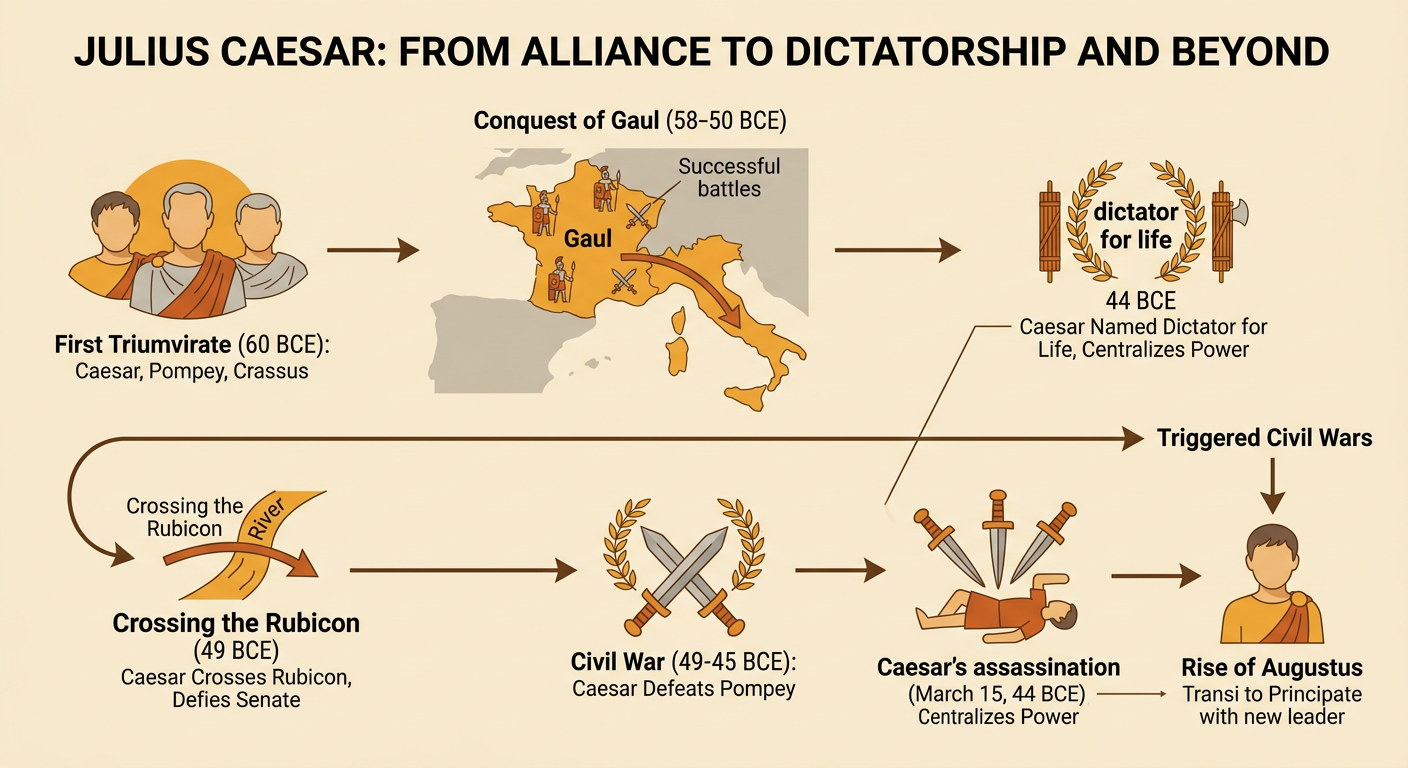
Julius Caesar used military success, political alliances, and popular support to become Rome’s most powerful leader. In 60 BCE, he formed an informal alliance with Pompey and Crassus. After conquering Gaul, Caesar commanded experienced troops and gained enormous wealth and fame. When the Senate ordered him to give up his command, he crossed the Rubicon in 49 BCE and fought a civil war against Pompey’s forces. Caesar won and was eventually named dictator for life. He introduced reforms, including changes to the calendar and the settlement of veterans, but many senators feared that he intended to become a king. On March 15, 44 BCE, a group of senators assassinated him. The killing did not restore the Republic. Instead, it produced more civil wars, which Octavian ultimately won before becoming Augustus in 27 BCE.
Weighing Multiple Causes
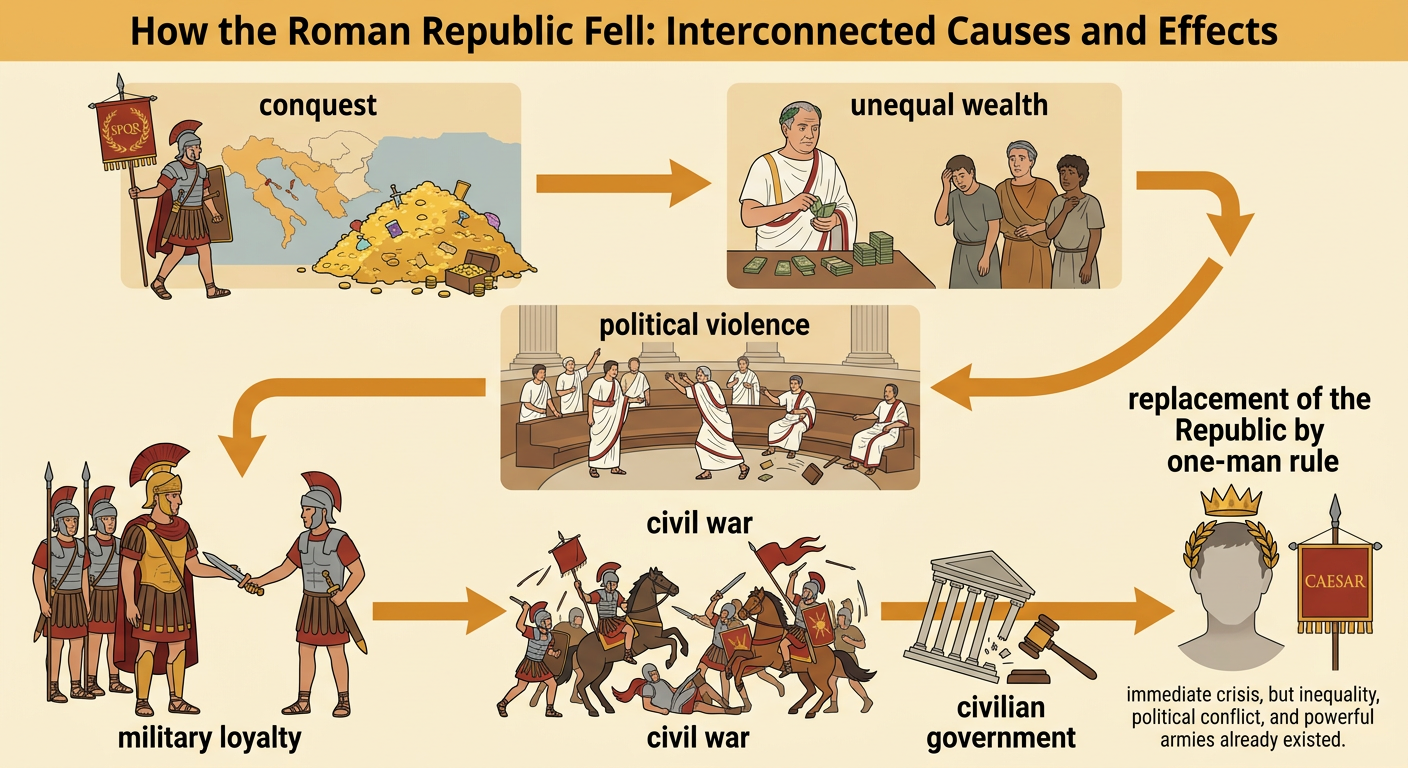
The Roman Republic fell because several causes reinforced one another over many decades. Expansion brought wealth and territory, but it also increased inequality and made governing more difficult. Social tensions encouraged reform movements, while political leaders resisted compromise and sometimes used violence. At the same time, soldiers became closely connected to commanders who promised them rewards. Generals could then use military power to defeat political rivals. Caesar’s actions were an important immediate cause of the final crisis, but deeper problems existed before his rise. One possible cause-and-effect chain begins with conquest, moves through unequal wealth and political conflict, and ends with armies fighting civil wars. Students should also consider importance: military loyalty made violence possible, while political competition helped leaders choose violence. No single cause fully explains the collapse. The strongest explanation connects long-term pressures, individual decisions, and short-term events.