
Why Is Earth Warming? Evaluating Climate Evidence
Students analyze evidence linking greenhouse gas concentrations and human activities to the recent rise in global temperatures.

Illustrations are auto-generated and may be placeholders. They can be refreshed to match the narration.
Global Temperature Trends
Earth’s average surface temperature is measured with thousands of land stations, ocean buoys, ships, and satellites. Scientists compare yearly temperatures with a long-term average, creating a temperature anomaly. Multiple independent records from NASA, NOAA, and other research groups show the same pattern: global temperature has risen by about 1.1 degrees Celsius since the late 1800s, and recent decades have been the warmest in the modern record. A single cold day does not disprove this trend because weather describes short-term conditions, while climate describes patterns over decades. For example, a city may experience an unusually cold winter week even during one of Earth’s warmest years. When evaluating a graph, cite its source, time span, units, and overall trend rather than focusing on one data point.

The Greenhouse Effect
The greenhouse effect is a natural process that keeps Earth warm enough for life. Sunlight passes through the atmosphere, and Earth’s surface absorbs some of this energy. The warmed surface then releases energy as infrared radiation. Greenhouse gases, including carbon dioxide, methane, nitrous oxide, and water vapor, absorb and re-emit some infrared radiation. Some of that energy returns toward the surface, warming the lower atmosphere and surface. Human activities strengthen this effect by adding long-lasting greenhouse gases. For example, burning gasoline releases carbon dioxide that can remain in the climate system for a long time, increasing the amount of infrared energy absorbed. Greenhouse gases do not block all heat from escaping; energy still leaves for space, but the surface warms until incoming and outgoing energy are balanced again.

Carbon Dioxide Evidence
Scientists compare carbon dioxide records with temperature records to investigate possible causes of warming. Air bubbles in ice cores reveal that atmospheric carbon dioxide stayed near 280 parts per million before large-scale industrialization. Direct measurements at Mauna Loa, Hawaii, show a steady rise since 1958, with seasonal ups and downs, and global concentrations exceeded 420 parts per million in the 2020s. Records of fossil fuel use show that people have released large amounts of carbon from coal, oil, and natural gas. The changing ratios of carbon isotopes and the decline of atmospheric oxygen expected during combustion provide additional evidence that much of the added carbon dioxide comes from fossil fuels. For example, a student can cite both the Mauna Loa data and fossil fuel emission records to support the conclusion that human activity is increasing atmospheric carbon dioxide.

Natural and Human Causes
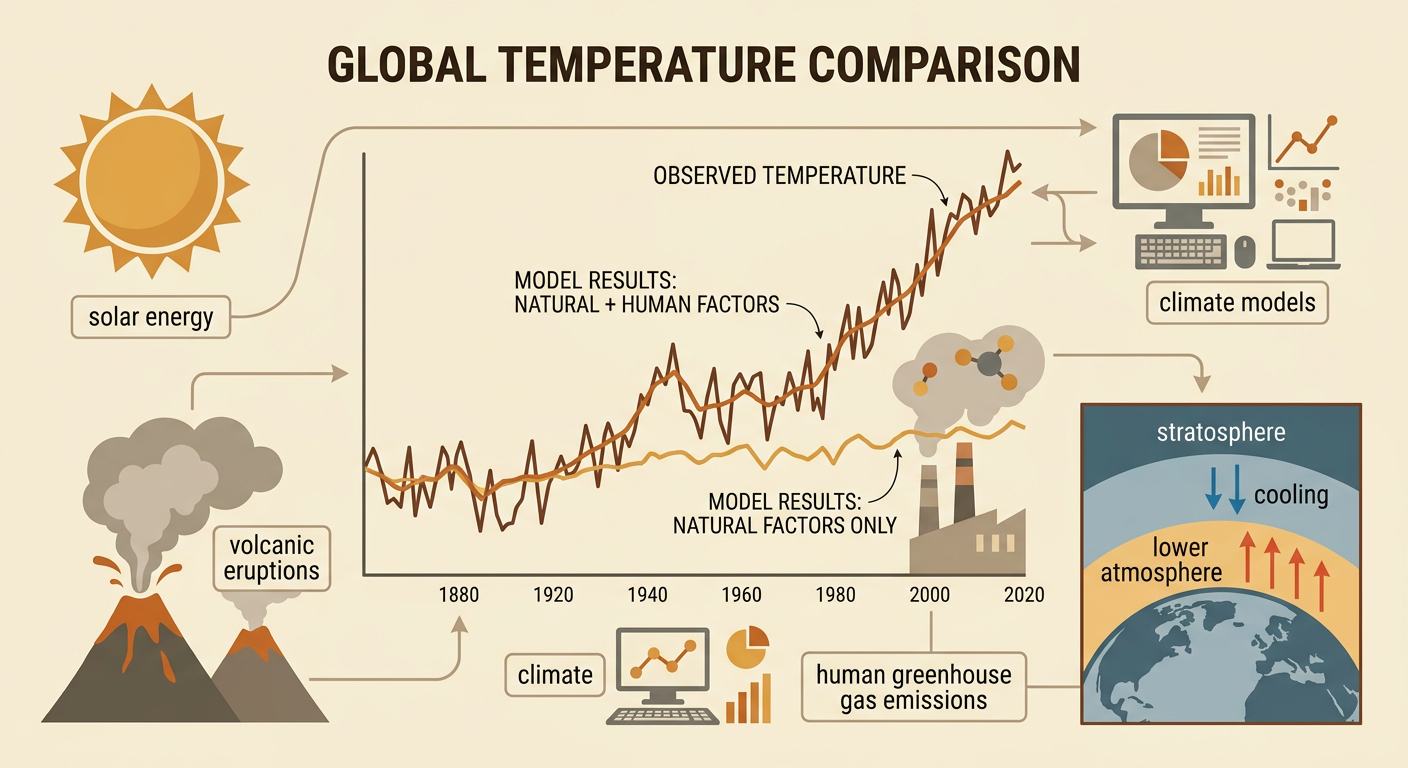
Climate can change because of both natural and human factors. Changes in solar energy, volcanic eruptions, and slow variations in Earth’s orbit affect climate, but scientists test whether these factors match the timing and pattern of recent warming. Satellite measurements show no sustained increase in solar energy large enough to explain the trend. Major volcanic eruptions usually cause short-term cooling because particles reflect sunlight. Climate models reproduce the strong warming observed since the mid-1900s only when human greenhouse gas emissions are included. Another fingerprint is that the lower atmosphere is warming while the stratosphere cools, a pattern expected from increased greenhouse gases rather than a brighter Sun. For example, warming, drought, sea-level rise, or repeated flooding may reduce water supplies or damage homes, influencing where people settle or whether families migrate. Such decisions also depend on jobs, costs, policies, and community ties.
Claim-Evidence-Reasoning Conclusion
A claim-evidence-reasoning explanation connects a conclusion to reliable data. A strong claim is that human activities, especially fossil fuel burning, are the main cause of recent global warming. Evidence includes the measured rise in carbon dioxide from about 280 parts per million before industrialization to more than 420 parts per million in the 2020s, the increase in global temperature, fossil fuel emission records, and climate model comparisons. Reasoning explains that added carbon dioxide absorbs and re-emits infrared radiation, strengthening the greenhouse effect and changing Earth’s energy balance. For example, instead of writing, “The graph goes up,” cite the graph’s source, dates, values, and trend. Students should also ask clarifying questions: Were instruments calibrated? Do independent datasets agree? Could solar or volcanic changes explain the pattern? These questions help distinguish strong evidence from unsupported opinion.
