
Why Is the Sky Blue? A Light-Scattering Investigation
Students use a flashlight, water, and a small amount of milk to model how tiny particles scatter blue light through the atmosphere, making the daytime sky appear blue.
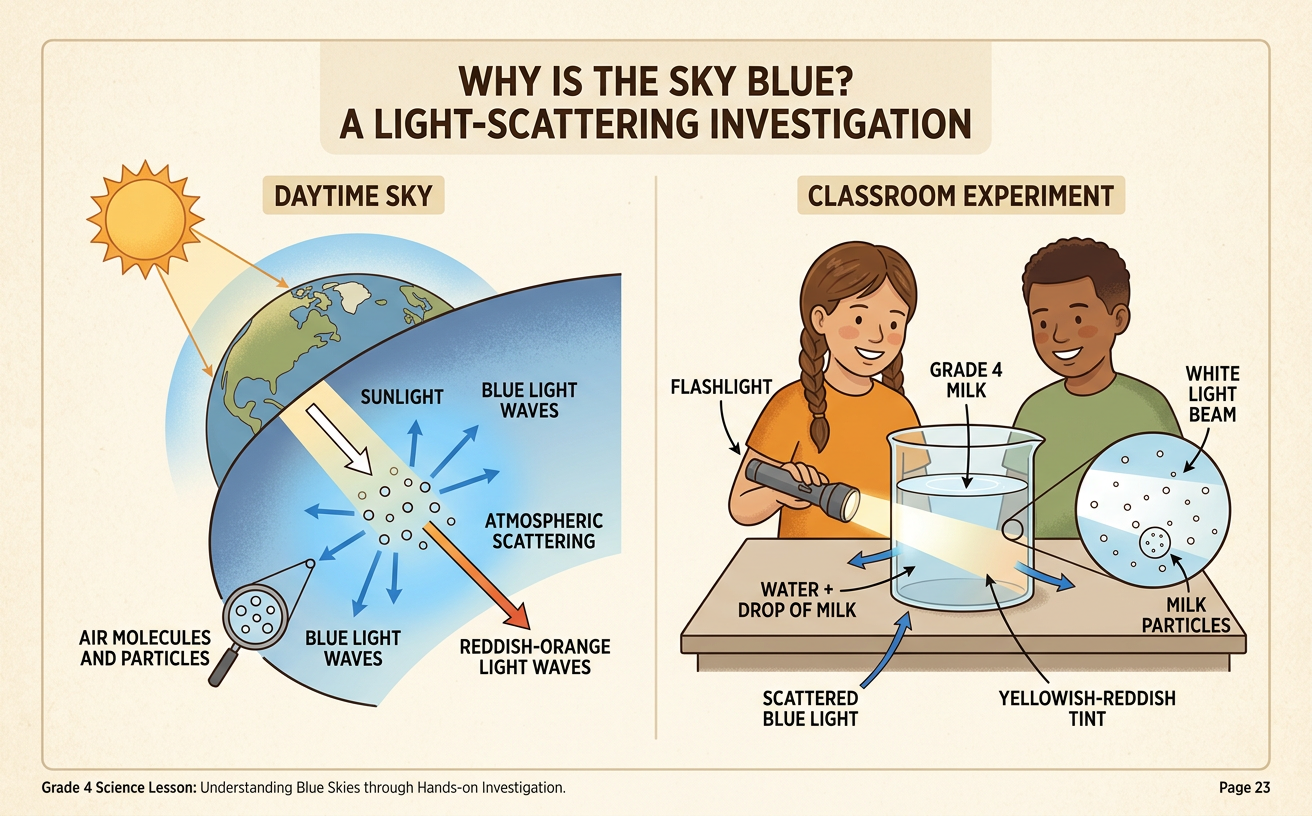
Illustrations are auto-generated and may be placeholders. They can be refreshed to match the narration.
Observe the Color of the Sky
Look at the daytime sky from a safe place, away from the Sun. Never stare at the Sun because its bright light can damage your eyes. On a clear day, much of the sky appears blue. Near sunrise or sunset, the sky may look orange, red, or pink. Clouds may appear white or gray. Record the time, weather, and colors you observe. For example, you might write, “At noon, the clear sky overhead looked bright blue, while the sky near the horizon looked pale blue.” We see these colors when light from the sky enters our eyes. Begin the investigation with this question: Why does sunlight, which looks white, make the sky look blue? Your observations will provide evidence for an explanation.
Explore White Light and the Atmosphere
Sunlight looks white, but white light contains many colors, including red, orange, yellow, green, blue, and violet. A rainbow is a familiar example of these colors becoming separated. Before sunlight reaches your eyes, it travels through the atmosphere, the layer of gases surrounding Earth. The atmosphere is mostly nitrogen and oxygen, with tiny amounts of other materials. Light can travel in a straight line, but when it meets extremely small molecules and particles, some of it changes direction. This change in direction is called scattering. Different colors of light do not scatter equally. Blue light scatters more strongly through the atmosphere than colors such as red. The next model uses water and a small amount of milk to make this scattering easier to observe.
Set Up the Water-and-Milk Model
Fill a clear, straight-sided container with water. Place it on a stable table in a dim room. Add only a few drops of milk and stir gently until the water looks slightly cloudy. The water represents the atmosphere, and tiny milk particles represent materials that scatter light. Place a white card at one end of the container. Aim a flashlight through the opposite end so its beam travels lengthwise through the mixture. Use an ordinary flashlight, not a laser. Keep water away from electrical outlets, do not drink the mixture, and wipe up spills immediately. For example, begin with two or three drops of milk in about one liter of water. Too much milk may block the light instead of showing how light travels and scatters.
Shine and Observe the Light
Darken the room and turn on the flashlight. First, observe the beam from the side of the container. Then look at the light reaching the white card at the far end. Do not look directly into the flashlight. From the side, the mixture may have a faint bluish appearance because more blue light is scattered sideways toward your eyes. After traveling through enough of the mixture, the light on the card may look yellowish, orange, or reddish because much of the blue light has been scattered out of the forward beam. Record both observations in a table. For example, write, “Side view: pale blue; end view: yellow-orange.” Repeat the test after gently stirring. Your exact colors may vary with the flashlight, container, amount of milk, and room lighting.
Explain How Blue Light Scatters
The model helps explain the blue sky, although milk particles are much larger than the gas molecules in the real atmosphere. When sunlight enters Earth's atmosphere, tiny gas molecules scatter shorter wavelengths of visible light, especially blue and violet, more strongly than longer red wavelengths. Scattered blue light travels in many directions. When some of it enters your eyes, the sky appears blue even when you are not looking toward the Sun. Human eyes are more sensitive to blue than violet, and sunlight contains less violet light that reaches us, so the sky usually looks blue rather than violet. At sunset, sunlight passes through more atmosphere. Much of the blue light scatters away before the direct light reaches you, leaving more orange and red light visible near the Sun.
Write an Evidence-Based Explanation
Write an informative explanation using a claim, evidence, and reasoning. Your claim should answer the question: Why is the sky blue? Use evidence from more than one source, such as your sky observation, the water-and-milk investigation, a class diagram, or a science text. Then explain how each piece of evidence supports your claim. For example: “The sky appears blue because gases in the atmosphere scatter blue light in many directions. In our model, the mixture looked bluish from the side, showing that some light changed direction and entered our eyes. A science diagram also showed blue light scattering more strongly than red light.” Include definitions for white light, atmosphere, and scattering. End by noting that the model is useful but not exact because milk particles are different from atmospheric gas molecules.