
Why the Sun Looks Brighter Than Other Stars
Students analyze a simple distance-and-light model and use evidence to explain why the Sun appears brighter than other stars.

Illustrations are auto-generated and may be placeholders. They can be refreshed to match the narration.
Observing the Sun and Stars
The Sun is a star, but it looks much brighter and larger than the stars we see at night. During the day, sunlight scatters through Earth’s atmosphere and makes the sky bright. This scattered light makes most other stars difficult to see. At night, when our location faces away from the Sun, the sky becomes dark enough for distant stars to be visible. The stars are still in space during the day; their light is simply overwhelmed by sunlight. For example, Sirius is one of the brightest stars in the night sky, yet it appears only as a small point of light. The Sun looks far brighter because it is much closer to Earth. Never look directly at the Sun because its intense light can permanently damage your eyes.

Apparent Brightness
Apparent brightness means how bright an object looks to an observer. It is not always the same as the amount of light the object actually produces. A star’s apparent brightness depends mainly on its actual light output and its distance from Earth. A very powerful star can look faint if it is extremely far away. The Sun is an ordinary star in many ways, but it is about 150 million kilometers from Earth, far closer than any other star. Proxima Centauri, the next closest star, is more than 250,000 times farther from Earth than the Sun. Imagine two identical porch lights: the light across the street looks brighter than the same kind of light several blocks away. In a similar way, distance strongly affects how bright a star appears.

Modeling Light at Different Distances
A model can show how distance changes apparent brightness. Place one flashlight so it shines on a wall, and measure the size and brightness of its lighted area. At a short distance, the light is concentrated in a small, bright area. Move the same flashlight farther from the wall without changing its power. Its light spreads over a larger area, so each part of the wall receives less light. In an idealized model, doubling the distance spreads the same amount of light over about four times the area. For example, if the flashlight is one meter from the wall and then moves to two meters away, the center of the light pattern becomes dimmer. A flashlight is not a star, but the model provides useful evidence that light appears dimmer as distance increases.

Analyzing Evidence
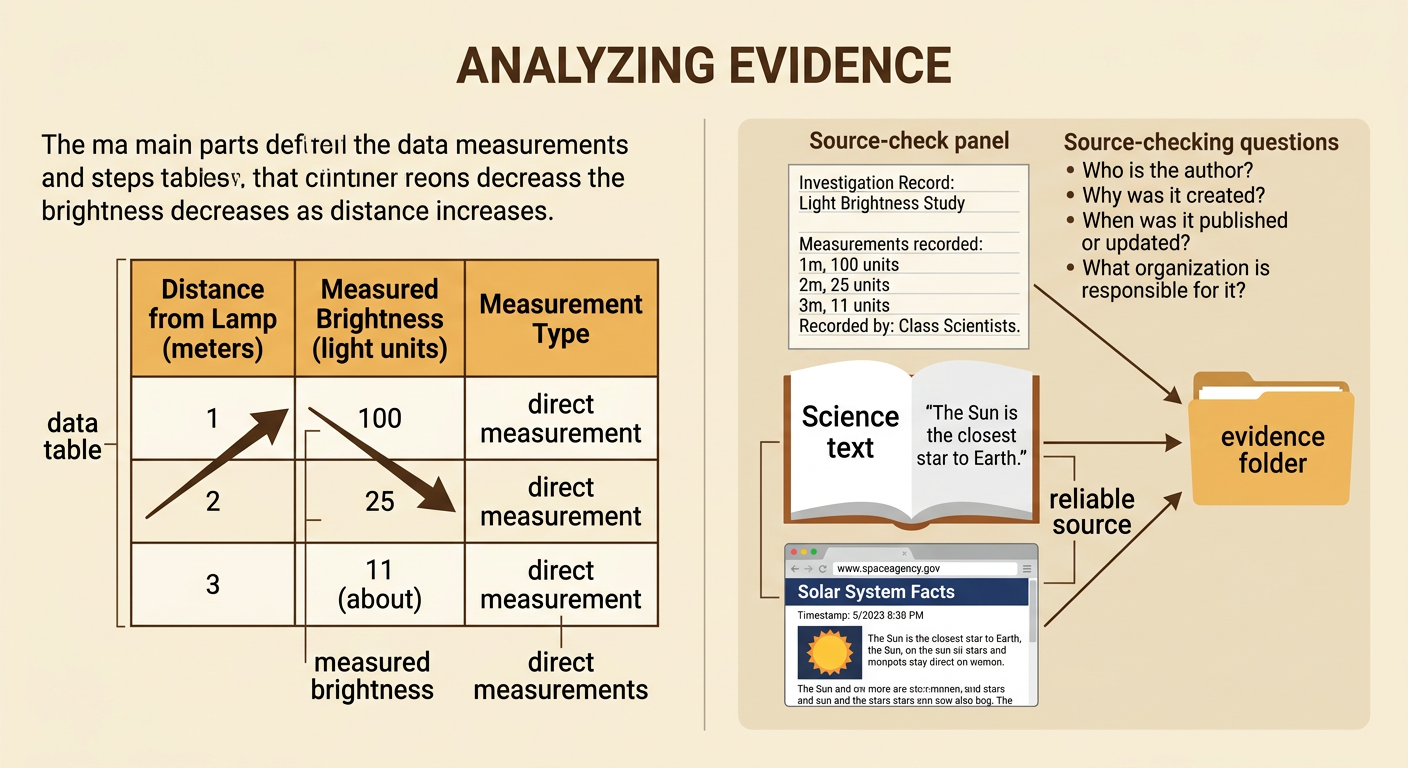
Scientists compare evidence from models, measurements, and reliable informational sources. Suppose a light meter records an identical lamp at three distances: 100 light units at one meter, 25 units at two meters, and about 11 units at three meters. The pattern shows that measured brightness decreases as distance increases. A science text might add, “The Sun is the closest star to Earth.” Quote that sentence exactly when using it as evidence. Then check where each piece of information came from. A classroom investigation provides direct measurements, while a space agency website may provide reviewed astronomical distances. Consider the source’s author, purpose, date, and organization. A diagram can explain spatial relationships, but a data table is better for comparing numbers. Together, these sources support the inference that the Sun appears brightest because it is nearest to Earth.
Building a Scientific Argument
A scientific argument includes a claim, evidence, and reasoning. A strong claim is: The Sun appears brighter than other stars because it is much closer to Earth. Evidence can include the flashlight investigation, measured light data, and accurate information about star distances. For example, the model showed that the same flashlight became dimmer when moved from one meter to two meters away. An informational source states, “The Sun is the closest star to Earth.” The reasoning connects these facts: light spreads out as it travels, so less light from a distant star reaches a given area on Earth. Other stars may produce as much or even more light than the Sun, but their enormous distances make them look faint. This argument explains apparent brightness without incorrectly claiming that the Sun is the brightest star in the universe.
