
Work, Energy, and Power
Students model transfers among kinetic, gravitational potential, and elastic energy while applying conservation of energy to physical systems.
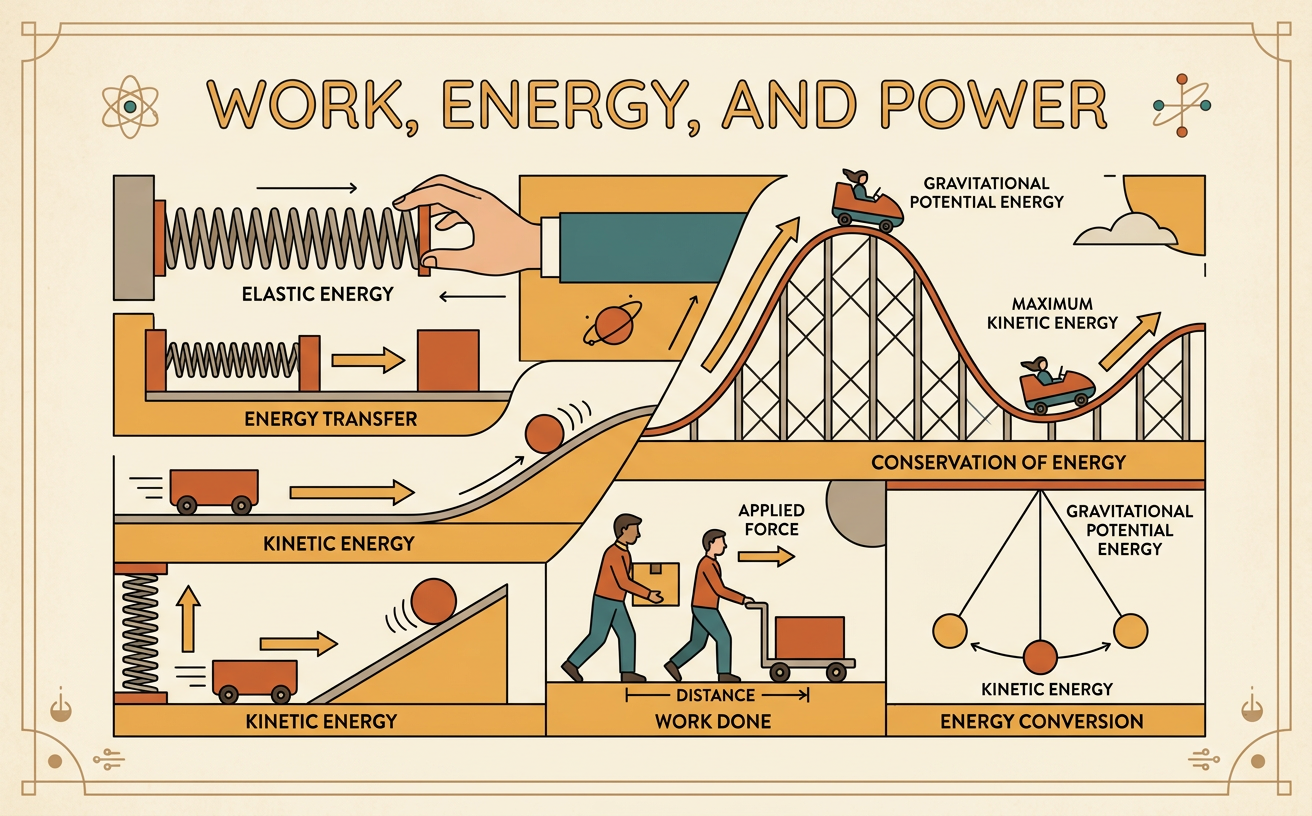
Illustrations are auto-generated and may be placeholders. They can be refreshed to match the narration.
Defining Work
Work is the transfer of energy that occurs when a force acts through a displacement. For a constant force, work is calculated with W = Fd cos θ, where F is force, d is displacement, and θ is the angle between them. Work is measured in joules; one joule equals one newton-meter. A force in the direction of motion does positive work, while a force opposite the motion does negative work. A perpendicular force does zero work. For example, if a student pushes a box 4 meters with a constant horizontal force of 30 newtons, the work is 120 joules. However, when the student carries the box horizontally at constant height, the upward supporting force does no work on the box because it is perpendicular to the displacement.
Kinetic Energy
Kinetic energy is the energy an object has because of its motion. It is modeled by KE = ½mv², where m is mass in kilograms and v is speed in meters per second. Because speed is squared, doubling an object’s speed makes its kinetic energy four times as large. A 1,000-kilogram car moving at 10 meters per second has 50,000 joules of kinetic energy. At 20 meters per second, the same car has 200,000 joules. This nonlinear relationship appears as an upward-curving parabola on a graph of kinetic energy versus speed. According to the work-energy theorem, the net work done on an object equals its change in kinetic energy. Positive net work speeds an object up, while negative net work slows it down.
Potential Energy
Potential energy is stored energy associated with the positions of objects or particles in a system. Near Earth’s surface, gravitational potential energy is modeled by Ug = mgh, where h is measured from a chosen reference level. Raising a 2-kilogram backpack 3 meters increases its gravitational potential energy by about 59 joules because 2 × 9.8 × 3 = 58.8. Elastic potential energy is stored when a spring is stretched or compressed. It is modeled by Us = ½kx², where k is the spring constant and x is the change from equilibrium length. Stretching a spring farther requires work because its particles are displaced from their equilibrium arrangement. The reference position must always be identified; changing it changes the numerical value of potential energy but not the physically meaningful change in energy.
Conservation of Mechanical Energy
Mechanical energy is the sum of kinetic energy and potential energy. In an isolated system with only conservative forces, total mechanical energy remains constant: KEi + PEi = KEf + PEf. Consider a roller-coaster car released from rest at the top of a hill. At the top, it has high gravitational potential energy and nearly zero kinetic energy. As it descends, gravitational potential energy decreases while kinetic energy increases. At the bottom, its speed and kinetic energy are greatest. On a real coaster, friction and air resistance transfer some mechanical energy into thermal energy and sound. Total energy is still conserved, but mechanical energy alone decreases. A valid model must therefore define the system boundary and include all important energy transfers. Energy bar charts can demonstrate that the total remains unchanged even as the amounts in different stores change.
Power and Efficiency
Power describes how quickly work is done or energy is transferred. Average power is P = W/Δt or P = ΔE/Δt, and its unit is the watt, equal to one joule per second. If a motor lifts a 600-joule load in 3 seconds, its average output power is 200 watts. Efficiency compares useful energy output with total energy input: efficiency = useful output energy divided by input energy, multiplied by 100 percent. If the motor receives 800 joules but delivers 600 joules to the load, it is 75 percent efficient; the remaining 200 joules is transferred mainly as thermal energy and sound. Consumers and businesses have incentives to choose efficient devices because lower energy use can reduce operating costs and environmental effects. However, purchase price, reliability, and expected savings also influence the choice.
Energy Models
An energy model uses equations, diagrams, tables, or graphs to represent energy storage and transfer within a defined system. To build a computational model, identify the initial conditions, select equations, calculate each energy quantity, and test whether inputs equal outputs. For example, a 0.50-kilogram ball dropped from 5.0 meters begins with about 24.5 joules of gravitational potential energy. Ignoring air resistance, a model predicts 24.5 joules of kinetic energy just before impact and a speed of about 9.9 meters per second. At the particle scale, greater thermal energy corresponds to more random particle motion, while elastic energy depends on particle positions and interactions. When evaluating a technical claim that a device saves energy, compare its assumptions and predicted values with measurements. Differences may reveal friction, measurement uncertainty, or an incomplete system boundary rather than a failure of energy conservation.