
Work, Energy, and Power
Students calculate work, kinetic energy, potential energy, and power while using conservation of energy to analyze physical systems.
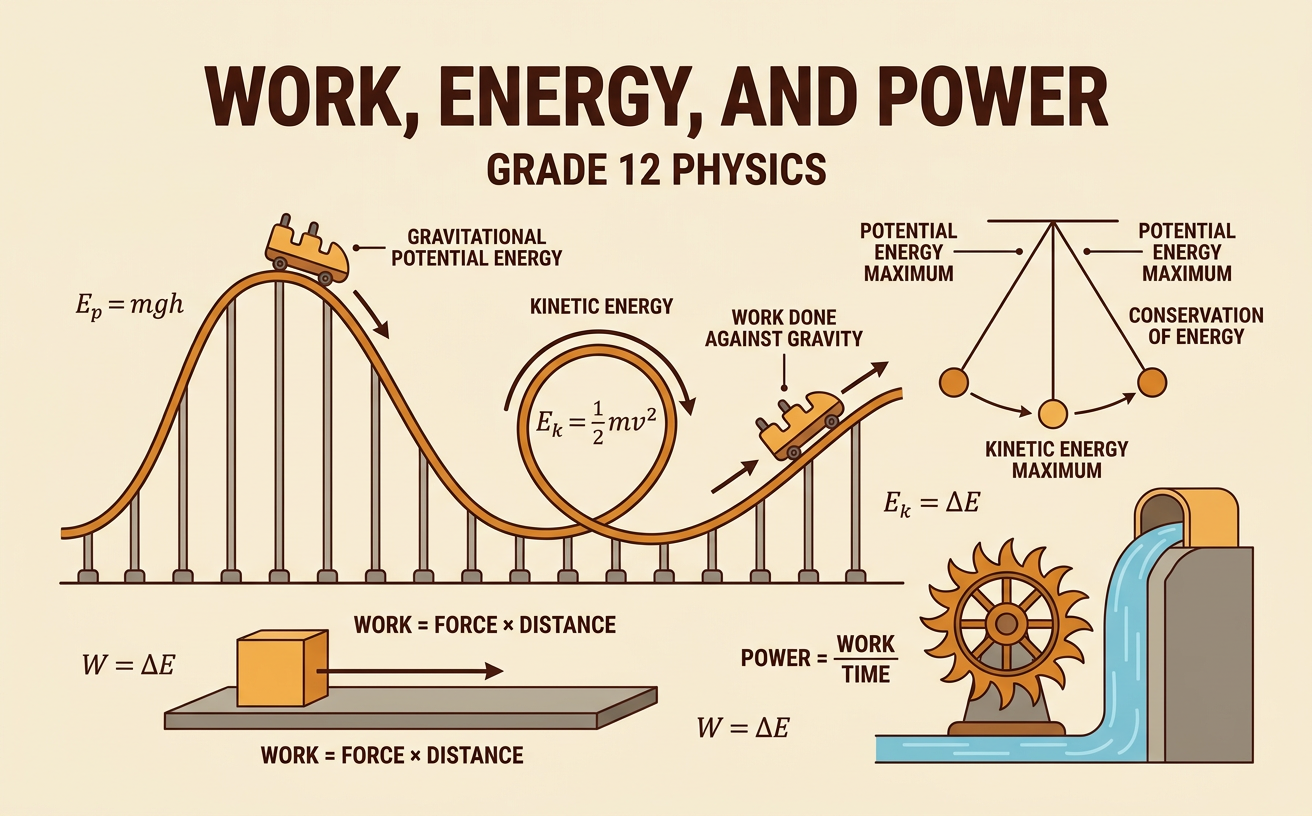
Illustrations are auto-generated and may be placeholders. They can be refreshed to match the narration.
Work by a Constant Force
Work is the transfer of energy that occurs when a force causes displacement. For a constant force, work is calculated with W = Fd cos θ, where F is the force magnitude, d is the displacement, and θ is the angle between them. Work is measured in joules, with 1 J = 1 N·m. A force parallel to displacement does positive work, while a force opposite displacement does negative work. A perpendicular force does zero work. For example, a student pulls a cart 5.0 m with a 40 N force directed 30° above the horizontal. The work done by the pulling force is (40 N)(5.0 m)cos 30°, or about 173 J. Only the force component parallel to the cart’s displacement performs work.
Kinetic Energy
Kinetic energy is the energy an object has because of its motion. It is calculated with KE = ½mv², where m is mass and v is speed. Because speed is squared, doubling an object’s speed makes its kinetic energy four times as large. The work-energy principle states that the net work done on an object equals its change in kinetic energy: Wnet = ΔKE = KEf − KEi. Suppose a 1,000 kg car speeds up from 10 m/s to 20 m/s. Its initial kinetic energy is 50,000 J, and its final kinetic energy is 200,000 J. Therefore, the net work done on the car is 150,000 J. Positive net work increases speed, while negative net work, such as work by braking forces, decreases speed.
Gravitational Potential Energy
Gravitational potential energy is stored energy associated with an object’s position in a gravitational field. Near Earth’s surface, it is calculated with Ug = mgh, where m is mass, g is approximately 9.8 m/s², and h is vertical height relative to a chosen reference level. Only changes in height matter, so ΔUg = mg(hf − hi). For example, lifting a 12 kg backpack from the floor to a shelf 1.5 m high increases its gravitational potential energy by (12 kg)(9.8 m/s²)(1.5 m), or about 176 J. If the backpack later falls, gravity does positive work and its gravitational potential energy decreases. The reference level may be selected for convenience, but it must remain consistent throughout a calculation.
Conservation of Mechanical Energy
Mechanical energy is the sum of kinetic and potential energy: Emech = KE + PE. When only conservative forces, such as gravity or an ideal spring force, do work, total mechanical energy remains constant. Thus, KEi + PEi = KEf + PEf. Consider a 2.0 kg ball dropped from rest at a height of 5.0 m, ignoring air resistance. Initially, its kinetic energy is zero and its gravitational potential energy is 98 J. Just before reaching the ground, its potential energy is nearly zero, so its kinetic energy is about 98 J. Solving ½mv² = mgh gives a speed of about 9.9 m/s. If friction or air resistance acts, mechanical energy decreases because some energy becomes thermal energy, although total energy is still conserved.
Power and Efficiency
Power describes how quickly work is done or energy is transferred. Average power is calculated with P = W/Δt, and its SI unit is the watt, where 1 W = 1 J/s. When a constant force acts parallel to motion, power can also be written as P = Fv. For example, a motor that lifts a 200 N load through 3.0 m in 4.0 s does 600 J of work and produces an average output power of 150 W. Real machines are not perfectly efficient because some input energy becomes thermal energy or sound. Efficiency is calculated as efficiency = useful output energy divided by input energy, multiplied by 100%. If the motor receives 750 J of electrical energy, its efficiency is 600/750 × 100%, or 80%.